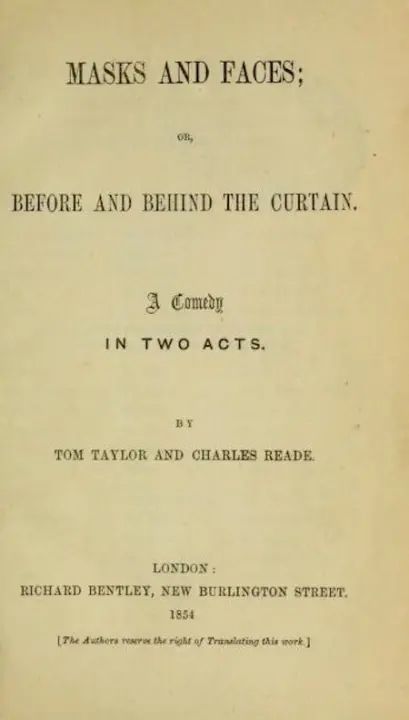
Masks and Faces; or, Before and Behind the Curtain: A Comedy in Two Acts
Tom Taylor & Charles Reade
THE CLASSIC COLLECTION · 1863
"A Simpleton" by Charles Reade is a novel written during the late 19th century. The story centers around a young lady named Rosa Lusignan and her romantic entanglements, particularly with a dedicated physician, Dr. Christopher Staines, and the societal constraints they face. Set against the backdrop of evolving notions of love and marriage, the book explores themes of class, gender roles, and the complexities of human relationships. The beginning of the novel introduces us to Rosa, who is anxiously waiting for Dr. Staines while engaged in an unproductive sewing project. We learn about her beauty and her various skills, but also her dissatisfaction with her current life. The scene shifts when Dr. Staines arrives, highlighting their budding romance filled with youthful hopes and aspirations. However, complications arise when Rosa's father, Mr. Lusignan, disapproves of their relationship due to Dr. Staines' lack of financial security. The unfolding drama captures Rosa's emotional journey, further complicated by health issues and societal expectations, setting the stage for conflicts and dilemmas that will resonate throughout the novel.
Introduction adapted from the source catalogue; source summaries may be automatically generated.
Free to read · English · 130,713 words · No account needed
MAKE TIME FOR A GOOD BOOK
On by default. Untick to stop anonymous reading totals. Each page counts after 10 seconds in view. How this works.
Anonymous counting is on unless you have switched it off.
“And pay you the interest quarterly.”
“Oh, no, no. Dribble us out a little as we want it. That is the way to be truly kind to a simpleton. I hate that word.”
“And suppose I run off with it? Such confiding geese as you corrupt a
man.”
“I shall never corrupt you. Crusty people are the soul of honor.”
“Crusty people!” cried Philip, affecting amazement. “What are they?”
She bit her lip and colored a little; but answered adroitly, “They are people that pretend not to have good hearts, but have the best in the world; far better ones than your smooth ones: that's crusty people.”
“Very well,” said Philip; “and I'll tell you what simpletons are. They are little transparent-looking creatures that look shallow, but are as deep as Old Nick, and make you love them in spite of your judgment. They are the most artful of their sex; for they always achieve its great object, to be loved--the very thing that clever women sometimes fail in.”
“Well, and if we are not to be loved, why live at all--such useless things as I am?” said Rosa simply.
So Philip took charge of her money, and agreed to help her save money for her little Christopher. Poverty should never destroy him, as it had his father.
As months rolled on, she crept out into public a little; but always on foot, and a very little way from home.
Youth and sober life gradually restored her strength, but not her color,
nor her buoyancy.
Yet she was perhaps more beautiful than ever; for a holy sorrow chastened and sublimed her features: it was now a sweet, angelic, pensive beauty, that interested every feeling person at a glance.
She would visit no one; but a twelvemonth after her bereavement, she received a few chosen visitors.
One day a young gentleman called, and sent up his card, “Lord Tadcaster,” with a note from Lady Cicely Treherne, full of kindly feeling. Uncle Philip had reconciled her to Lady Cicely; but they had never met.
Mrs. Staines was much agitated at the very name of Lord Tadcaster; but she would not have missed seeing him for the world.
She received him with her beautiful eyes wide open, to drink in every lineament of one who had seen the last of her Christopher.
Tadcaster was wonderfully improved: he had grown six inches out at sea, and though still short, was not diminutive; he was a small Apollo, a model of symmetry, and had an engaging, girlish beauty, redeemed from downright effeminacy by a golden mustache like silk, and a tanned cheek that became him wonderfully.
Your reading position is saved on this browser. Take it to another device with a library code. Reading pages adapt to text, rather than matching a printed edition.
Tom Taylor & Charles Reade
Charles Reade
Charles Reade
Charles Reade
BEHIND THE BOOK
This eBook is for the use of anyone anywhere in the United States and most other parts of the world at no cost and with almost no restrictions whatsoever. You may copy it, give it away or re-use it under the terms of the Project Gutenberg License included with this eBook or online at www.gutenberg.org. If you are not located in the United States, you will have to check the laws of the country where you are located before using this eBook. Read the source licence.
The original source file, including credits and licence, is retained by this library. Request an original-format copy at no charge. Please include the book title and Project Gutenberg identifier #2301.
KEEP YOUR CURIOSITY GOING
Coulson Kernahan

Maurice Baring
Frances Wright
Cécile Tormay

Frederic Jesup Stimson

W. H. P. (William Henry Pope) Jarvis