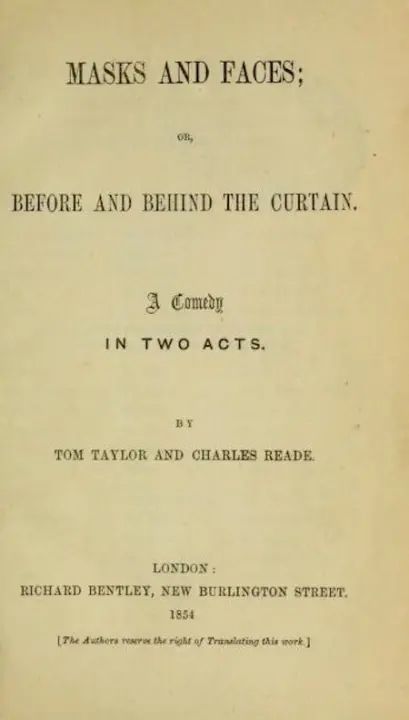
Masks and Faces; or, Before and Behind the Curtain: A Comedy in Two Acts
Tom Taylor & Charles Reade
THE CLASSIC COLLECTION · 1863
"A Simpleton" by Charles Reade is a novel written during the late 19th century. The story centers around a young lady named Rosa Lusignan and her romantic entanglements, particularly with a dedicated physician, Dr. Christopher Staines, and the societal constraints they face. Set against the backdrop of evolving notions of love and marriage, the book explores themes of class, gender roles, and the complexities of human relationships. The beginning of the novel introduces us to Rosa, who is anxiously waiting for Dr. Staines while engaged in an unproductive sewing project. We learn about her beauty and her various skills, but also her dissatisfaction with her current life. The scene shifts when Dr. Staines arrives, highlighting their budding romance filled with youthful hopes and aspirations. However, complications arise when Rosa's father, Mr. Lusignan, disapproves of their relationship due to Dr. Staines' lack of financial security. The unfolding drama captures Rosa's emotional journey, further complicated by health issues and societal expectations, setting the stage for conflicts and dilemmas that will resonate throughout the novel.
Introduction adapted from the source catalogue; source summaries may be automatically generated.
Free to read · English · 130,713 words · No account needed
MAKE TIME FOR A GOOD BOOK
On by default. Untick to stop anonymous reading totals. Each page counts after 10 seconds in view. How this works.
Anonymous counting is on unless you have switched it off.
The Hottentots took their horses, as a matter of course. Their guns were put in a corner. A clean cloth was spread, and they saw they were to sup and sleep there, though the words of invitation were never spoken.
At supper, sun-dried flesh, cabbage, and a savory dish the travellers returned to with gusto. Staines asked what it was: the vrow told him--locusts. They had stripped her garden, and filled her very rooms, and fallen in heaps under her walls; so she had pressed them, by the million, into cakes, had salted them lightly, and stored them, and they were excellent, baked.
After supper, the accomplished Reginald, observing a wire guitar, tuned it with some difficulty, and so twanged it, and sang ditties to it, that the flabby giant's pasty face wore a look of dreamy content over his everlasting pipe; and in the morning, after a silent breakfast, he said, “Mine vriends, stay here a year or two, and rake in mine rubbish. Ven you are tired, here are springbok and antelopes, and you can shoot mit your rifles, and ve vil cook them, and you shall zing us zongs of Vaderland.”
They thanked him heartily, and said they would stay a few days, at all
events.
The placid Boer went a-farming; and the pair shouldered their pick and shovel, and worked on their heap all day, and found a number of pretty stones, but no diamond.
“Come,” said Falcon, “we must go to the river;” and Staines acquiesced. “I bow to experience,” said he.
At the threshold they found two of the little Bulteels, playing with pieces of quartz, crystal, etc., on the door-stone. One of these stones caught Staines's eye directly. It sparkled in a different way from the others: he examined it: it was the size of a white haricot bean, and one side of it polished by friction. He looked at it, and looked, and saw that it refracted the light. He felt convinced it was a diamond.
“Give the boy a penny for it,” said the ingenious Falcon, on receiving
the information.
“Oh!” said Staines. “Take advantage of a child?”
He borrowed it of the boy, and laid it on the table, after supper. “Sir,” said he, “this is what we were raking in your kopjes for, and could not find it. It belongs to little Hans. Will you sell it us? We are not experts, but we think it may be a diamond. We will risk ten pounds on it.”
“Ten pounds!” said the farmer. “Nay, we rob not travellers, mine
vriend.”
“But if it is a diamond, it is worth a hundred. See how it gains fire in
the dusk.”
Your reading position is saved on this browser. Take it to another device with a library code. Reading pages adapt to text, rather than matching a printed edition.
Tom Taylor & Charles Reade
Charles Reade
Charles Reade
Charles Reade
BEHIND THE BOOK
This eBook is for the use of anyone anywhere in the United States and most other parts of the world at no cost and with almost no restrictions whatsoever. You may copy it, give it away or re-use it under the terms of the Project Gutenberg License included with this eBook or online at www.gutenberg.org. If you are not located in the United States, you will have to check the laws of the country where you are located before using this eBook. Read the source licence.
The original source file, including credits and licence, is retained by this library. Request an original-format copy at no charge. Please include the book title and Project Gutenberg identifier #2301.
KEEP YOUR CURIOSITY GOING
Coulson Kernahan

Maurice Baring
Frances Wright
Cécile Tormay

Frederic Jesup Stimson

W. H. P. (William Henry Pope) Jarvis