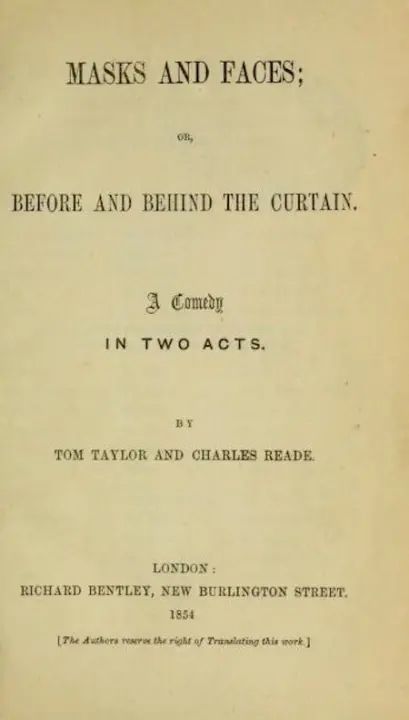
Masks and Faces; or, Before and Behind the Curtain: A Comedy in Two Acts
Tom Taylor & Charles Reade
THE CLASSIC COLLECTION · 1863
"A Simpleton" by Charles Reade is a novel written during the late 19th century. The story centers around a young lady named Rosa Lusignan and her romantic entanglements, particularly with a dedicated physician, Dr. Christopher Staines, and the societal constraints they face. Set against the backdrop of evolving notions of love and marriage, the book explores themes of class, gender roles, and the complexities of human relationships. The beginning of the novel introduces us to Rosa, who is anxiously waiting for Dr. Staines while engaged in an unproductive sewing project. We learn about her beauty and her various skills, but also her dissatisfaction with her current life. The scene shifts when Dr. Staines arrives, highlighting their budding romance filled with youthful hopes and aspirations. However, complications arise when Rosa's father, Mr. Lusignan, disapproves of their relationship due to Dr. Staines' lack of financial security. The unfolding drama captures Rosa's emotional journey, further complicated by health issues and societal expectations, setting the stage for conflicts and dilemmas that will resonate throughout the novel.
Introduction adapted from the source catalogue; source summaries may be automatically generated.
Free to read · English · 130,713 words · No account needed
MAKE TIME FOR A GOOD BOOK
On by default. Untick to stop anonymous reading totals. Each page counts after 10 seconds in view. How this works.
Anonymous counting is on unless you have switched it off.
Ucatella, with all a Kafir's love of fire-arms, clapped her hands with delight. “My child shoots loud and strong,” said she.
“Ay, ay,” replied Phoebe; “they are all alike; wherever there's men, look for quarrelling and firing off. We had only to sit quiet in the wagon.”
“Ay.” said Dick, “the cattle especially--for it is them the varmint were after--and let 'em eat my Hottentots.”
At this picture of the cattle inside the wagon, and the jackals supping on cold Hottentot alongside, Phoebe, who had no more humor than a cat, but a heart of gold, shut up, and turned red with confusion at her false estimate of the recent transaction in fur.
When the sun rose they found themselves in a tract somewhat less arid and inhuman; and, at last, at the rise of a gentle slope, they saw, half a mile before them, a large farmhouse partly clad with creepers, and a little plot of turf, the fruit of eternal watering; item, a flower-bed; item, snow-white palings; item, an air of cleanliness and neatness scarcely known to those dirty descendants of clean ancestors, the Boers. At some distance a very large dam glittered in the sun, and a troop of snow-white sheep were watering at it.
“ENGLAND!” cried Christopher.
“Ay, sir,” said Phoebe; “as nigh as man can make it.” But soon she began to fret: “Oh, dear! where are they all? If it was me, I'd be at the door looking out. Ah, there goes Yuke to rouse them up.”
“Come, Pheeb, don't you fidget,” said Dick kindly. “Why, the lazy lot are scarce out of their beds by this time.”
“More shame for 'em. If they were away from me, and coming home, I should be at the door day AND night, I know. Ah!”
She uttered a scream of delight, for just then, out came Ucatella, with little Tommy on her shoulder, and danced along to meet her. As she came close, she raised the chubby child high in the air, and he crowed; and then she lowered him to his mother, who rushed at him, seized, and devoured him with a hundred inarticulate cries of joy and love unspeakable.
“NATURE!” said Christopher dogmatically, recognizing an old acquaintance, and booking it as one more conquest gained over the past. But there was too much excitement over the cherub to attend to him. So he watched the woman gravely, and began to moralize with all his might. “This,” said he, “is what we used to call maternal love; and all animals had it, and that is why the noble savage went for him. It was very good of you, Miss Savage,” said the poor soul sententiously.
Your reading position is saved on this browser. Take it to another device with a library code. Reading pages adapt to text, rather than matching a printed edition.
Tom Taylor & Charles Reade
Charles Reade
Charles Reade
Charles Reade
BEHIND THE BOOK
This eBook is for the use of anyone anywhere in the United States and most other parts of the world at no cost and with almost no restrictions whatsoever. You may copy it, give it away or re-use it under the terms of the Project Gutenberg License included with this eBook or online at www.gutenberg.org. If you are not located in the United States, you will have to check the laws of the country where you are located before using this eBook. Read the source licence.
The original source file, including credits and licence, is retained by this library. Request an original-format copy at no charge. Please include the book title and Project Gutenberg identifier #2301.
KEEP YOUR CURIOSITY GOING
Coulson Kernahan

Maurice Baring
Frances Wright
Cécile Tormay

Frederic Jesup Stimson

W. H. P. (William Henry Pope) Jarvis