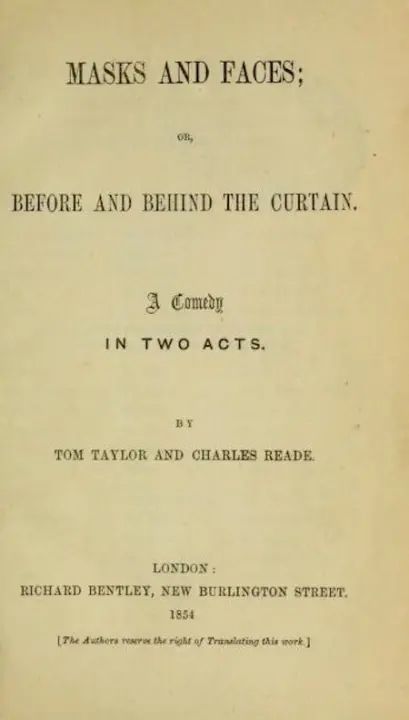
Masks and Faces; or, Before and Behind the Curtain: A Comedy in Two Acts
Tom Taylor & Charles Reade
THE CLASSIC COLLECTION · 1863
"A Simpleton" by Charles Reade is a novel written during the late 19th century. The story centers around a young lady named Rosa Lusignan and her romantic entanglements, particularly with a dedicated physician, Dr. Christopher Staines, and the societal constraints they face. Set against the backdrop of evolving notions of love and marriage, the book explores themes of class, gender roles, and the complexities of human relationships. The beginning of the novel introduces us to Rosa, who is anxiously waiting for Dr. Staines while engaged in an unproductive sewing project. We learn about her beauty and her various skills, but also her dissatisfaction with her current life. The scene shifts when Dr. Staines arrives, highlighting their budding romance filled with youthful hopes and aspirations. However, complications arise when Rosa's father, Mr. Lusignan, disapproves of their relationship due to Dr. Staines' lack of financial security. The unfolding drama captures Rosa's emotional journey, further complicated by health issues and societal expectations, setting the stage for conflicts and dilemmas that will resonate throughout the novel.
Introduction adapted from the source catalogue; source summaries may be automatically generated.
Free to read · English · 130,713 words · No account needed
MAKE TIME FOR A GOOD BOOK
On by default. Untick to stop anonymous reading totals. Each page counts after 10 seconds in view. How this works.
Anonymous counting is on unless you have switched it off.
And the gloom deepened, and the cold waves flung him up to heaven with their giant arms, and then down again to hell: and still that light, his only hope, was several hundred yards from him.
Only for a moment at a time could his eyeballs, straining with agony, catch this will-o'-the-wisp, the boat's light. It groped the sea up and down, but came no near.
When what seemed days of agony had passed, suddenly a rocket rose in the horizon--so it seemed to him.
The lost man gave a shriek of joy; so prone are we to interpret things
hopefully.
Misery! The next time he saw that little light, that solitary spark of hope, it was not quite so near as before. A mortal sickness fell on his heart. The ship had recalled the boats by rocket.
He shrieked, he cried, he screamed, he raved. “Oh, Rosa! Rosa! for her sake, men, men, do not leave me. I am here! here!”
In vain. The miserable man saw the boat's little light retire, recede, and melt into the ship's larger light, and that light glided away.
Then, a cold, deadly stupor fell on him. Then, death's icy claw seized his heart, and seemed to run from it to every part of him. He was a dead man. Only a question of time. Nothing to gain by floating.
But the despairing mind could not quit the world in peace, and even here in the cold, cruel sea, the quivering body clung to this fragment of life, and winced at death's touch, though more merciful.
He despised this weakness; he raged at it; he could not overcome it.
Unable to live or to die, condemned to float slowly, hour by hour, down
into death's jaws.
To a long, death-like stupor succeeded frenzy. Fury seized this great and long-suffering mind. It rose against the cruelty and injustice of his fate. He cursed the world, whose stupidity had driven him to sea, he cursed remorseless nature; and at last he railed on the God who made him, and made the cruel water, that was waiting for his body. “God's justice! God's mercy! God's power! they are all lies,” he shouted, “dreams, chimeras, like Him the all-powerful and good, men babble of by the fire. If there was a God more powerful than the sea, and only half as good as men are, he would pity my poor Rosa and me, and send a hurricane to drive those caitiffs back to the wretch they have abandoned. Nature alone is mighty. Oh, if I could have her on my side, and only God against me! But she is as deaf to prayer as He is: as mechanical and remorseless. I am a bubble melting into the sea. Soul I have none; my body will soon be nothing, nothing. So ends an honest, loving life. I always tried to love my fellow-creatures. Curse them! curse them! Curse the earth! Curse the sea! Curse all nature: there is no other God for me to curse.”
Your reading position is saved on this browser. Take it to another device with a library code. Reading pages adapt to text, rather than matching a printed edition.
Tom Taylor & Charles Reade
Charles Reade
Charles Reade
Charles Reade
BEHIND THE BOOK
This eBook is for the use of anyone anywhere in the United States and most other parts of the world at no cost and with almost no restrictions whatsoever. You may copy it, give it away or re-use it under the terms of the Project Gutenberg License included with this eBook or online at www.gutenberg.org. If you are not located in the United States, you will have to check the laws of the country where you are located before using this eBook. Read the source licence.
The original source file, including credits and licence, is retained by this library. Request an original-format copy at no charge. Please include the book title and Project Gutenberg identifier #2301.
KEEP YOUR CURIOSITY GOING
Coulson Kernahan

Maurice Baring
Frances Wright
Cécile Tormay

Frederic Jesup Stimson

W. H. P. (William Henry Pope) Jarvis