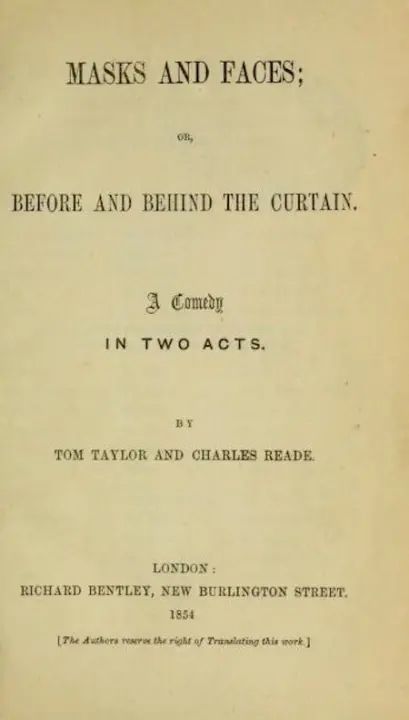
Masks and Faces; or, Before and Behind the Curtain: A Comedy in Two Acts
Tom Taylor & Charles Reade
THE CLASSIC COLLECTION · 1863
"A Simpleton" by Charles Reade is a novel written during the late 19th century. The story centers around a young lady named Rosa Lusignan and her romantic entanglements, particularly with a dedicated physician, Dr. Christopher Staines, and the societal constraints they face. Set against the backdrop of evolving notions of love and marriage, the book explores themes of class, gender roles, and the complexities of human relationships. The beginning of the novel introduces us to Rosa, who is anxiously waiting for Dr. Staines while engaged in an unproductive sewing project. We learn about her beauty and her various skills, but also her dissatisfaction with her current life. The scene shifts when Dr. Staines arrives, highlighting their budding romance filled with youthful hopes and aspirations. However, complications arise when Rosa's father, Mr. Lusignan, disapproves of their relationship due to Dr. Staines' lack of financial security. The unfolding drama captures Rosa's emotional journey, further complicated by health issues and societal expectations, setting the stage for conflicts and dilemmas that will resonate throughout the novel.
Introduction adapted from the source catalogue; source summaries may be automatically generated.
Free to read · English · 130,713 words · No account needed
MAKE TIME FOR A GOOD BOOK
On by default. Untick to stop anonymous reading totals. Each page counts after 10 seconds in view. How this works.
Anonymous counting is on unless you have switched it off.
“Why,” said she, “I was never so well able to bear them. It must be a great thing to put me out now. I am so happy, and live in the future. Well, dear uncle, you can if you like--what does it matter?--only there must be one exception: my own Christie's letters, you know.”
“Of course,” said he, wincing inwardly.
The very next day came a letter of condolence from Miss Lucas. Dr. Philip intercepted it, and locked it up, to be shown her at a more fitting time.
But how could he hope to keep so public a thing as this from entering the house in one of a hundred newspapers?
He went into Gravesend, and searched all the newspapers, to see what he had to contend with. To his horror, he found it in several dailies and weeklies, and in two illustrated papers. He sat aghast at the difficulty and the danger.
The best thing he could think of was to buy them all, and cut out the account. He did so, and brought all the papers, thus mutilated, into the house, and sent them into the kitchen. He said to his old servant, “These may amuse Mr. Lusignan's people, and I have extracted all that interests me.”
By these means he hoped that none of the servants would go and buy more of these same papers elsewhere.
Notwithstanding these precautions, he took the nurse apart, and said, “Now, you are an experienced woman, and to be trusted about an excitable patient. Mind, I object to any female servant entering Mrs. Staines's room with gossip. Keep them outside the door for the present, please. Oh, and nurse, if anything should happen, likely to grieve or to worry her, it must be kept from her entirely: can I trust you?”
“You may, sir.”
“I shall add ten guineas to your fee, if she gets through the month without a shock or disturbance of any kind.”
She stared at him, inquiringly. Then she said,--
“You may rely on me, doctor.”
“I feel I may. Still, she alarms me. She looks quiet enough, but she is
very excitable.”
Not all these precautions gave Dr. Philip any real sense of security; still less did they to Mr. Lusignan. He was not a tender father, in small things, but the idea of actual danger to his only child was terrible to him and he now passed his life in a continual tremble.
This is the less to be wondered at, when I tell you that even the stout Philip began to lose his nerve, his appetite, his sleep, under this hourly terror and this hourly torture.
Your reading position is saved on this browser. Take it to another device with a library code. Reading pages adapt to text, rather than matching a printed edition.
Tom Taylor & Charles Reade
Charles Reade
Charles Reade
Charles Reade
BEHIND THE BOOK
This eBook is for the use of anyone anywhere in the United States and most other parts of the world at no cost and with almost no restrictions whatsoever. You may copy it, give it away or re-use it under the terms of the Project Gutenberg License included with this eBook or online at www.gutenberg.org. If you are not located in the United States, you will have to check the laws of the country where you are located before using this eBook. Read the source licence.
The original source file, including credits and licence, is retained by this library. Request an original-format copy at no charge. Please include the book title and Project Gutenberg identifier #2301.
KEEP YOUR CURIOSITY GOING
Coulson Kernahan

Maurice Baring
Frances Wright
Cécile Tormay

Frederic Jesup Stimson

W. H. P. (William Henry Pope) Jarvis