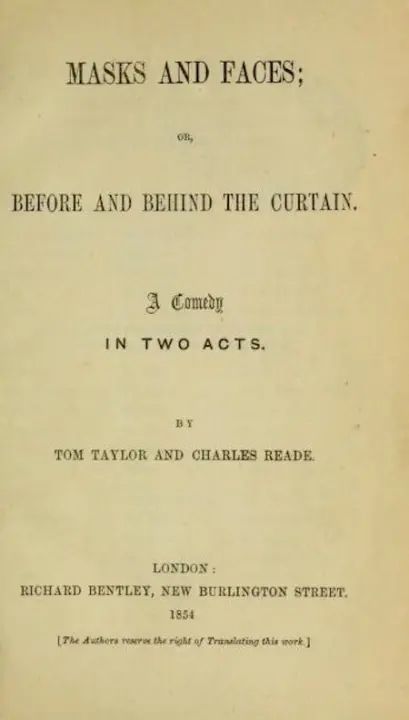
Masks and Faces; or, Before and Behind the Curtain: A Comedy in Two Acts
Tom Taylor & Charles Reade
THE CLASSIC COLLECTION · 1863
"A Simpleton" by Charles Reade is a novel written during the late 19th century. The story centers around a young lady named Rosa Lusignan and her romantic entanglements, particularly with a dedicated physician, Dr. Christopher Staines, and the societal constraints they face. Set against the backdrop of evolving notions of love and marriage, the book explores themes of class, gender roles, and the complexities of human relationships. The beginning of the novel introduces us to Rosa, who is anxiously waiting for Dr. Staines while engaged in an unproductive sewing project. We learn about her beauty and her various skills, but also her dissatisfaction with her current life. The scene shifts when Dr. Staines arrives, highlighting their budding romance filled with youthful hopes and aspirations. However, complications arise when Rosa's father, Mr. Lusignan, disapproves of their relationship due to Dr. Staines' lack of financial security. The unfolding drama captures Rosa's emotional journey, further complicated by health issues and societal expectations, setting the stage for conflicts and dilemmas that will resonate throughout the novel.
Introduction adapted from the source catalogue; source summaries may be automatically generated.
Free to read · English · 130,713 words · No account needed
MAKE TIME FOR A GOOD BOOK
On by default. Untick to stop anonymous reading totals. Each page counts after 10 seconds in view. How this works.
Anonymous counting is on unless you have switched it off.
The weather, however, was fine, and the ship was sailing very fast, when, about half an hour before sunset, the mast-head man hailed that there was a bulk of timber in sight, broad on the weather-bow.
The signalman was sent up, and said it looked like a raft.
The captain, who was on deck, levelled his glass at it, and made it out a raft, with a sort of rail to it, and the stump of a mast.
He ordered the officer of the watch to keep the ship as close to the wind as possible. He should like to examine it if he could.
The master represented, respectfully, that it would be unadvisable to beat to windward for that. “I have no faith in our chronometers, sir, and it is important to make the island before dark; fogs rise here so suddenly.”
“Very well, Mr. Bolt; then I suppose we must let the raft go.”
“MAN ON THE RAFT TO WINDWARD!” hailed the signalman.
This electrified the ship. The captain ran up the mizzen rigging, and scanned the raft, now nearly abeam.
“It IS a man!” he cried, and was about to alter the ship's course when, at that moment, the signalman hailed again,--
“How d'ye know?”
“By the gulls.”
Then succeeded an exciting dialogue between the captain and the master, who, being in his department, was very firm; and went so far as to say he would not answer for the safety of the ship, if they did not sight the land before dark.
The captain said, “Very well,” and took a turn or two. But at last he said, “No. Her Majesty's ship must not pass a raft with a man on it, dead or alive.”
He then began to give the necessary orders; but before they were all out of his mouth, a fatal interruption occurred.
Tadcaster ran into Dr. Staines's cabin, crying, “A raft with a corpse
close by!”
Staines sprang to the quarter port to see, and craning eagerly out, the lower port chain, which had not been well secured, slipped, the port gave way, and as his whole weight rested on it, canted him headlong into the sea.
A smart seaman in the forechains saw the accident, and instantly roared out, “MAN OVERBOARD!” a cry that sends a thrill through a ship's very ribs.
Another smart fellow cut the life-buoy adrift so quickly that it struck the water within ten yards of Staines.
The officer of the watch, without the interval of half a moment, gave the right orders, in the voice of a stentor;
“Let go life-buoy.
“Life-boat's crew away.
“Hands shorten sail.
“Mainsel up.
Your reading position is saved on this browser. Take it to another device with a library code. Reading pages adapt to text, rather than matching a printed edition.
Tom Taylor & Charles Reade
Charles Reade
Charles Reade
Charles Reade
BEHIND THE BOOK
This eBook is for the use of anyone anywhere in the United States and most other parts of the world at no cost and with almost no restrictions whatsoever. You may copy it, give it away or re-use it under the terms of the Project Gutenberg License included with this eBook or online at www.gutenberg.org. If you are not located in the United States, you will have to check the laws of the country where you are located before using this eBook. Read the source licence.
The original source file, including credits and licence, is retained by this library. Request an original-format copy at no charge. Please include the book title and Project Gutenberg identifier #2301.
KEEP YOUR CURIOSITY GOING
Coulson Kernahan

Maurice Baring
Frances Wright
Cécile Tormay

Frederic Jesup Stimson

W. H. P. (William Henry Pope) Jarvis