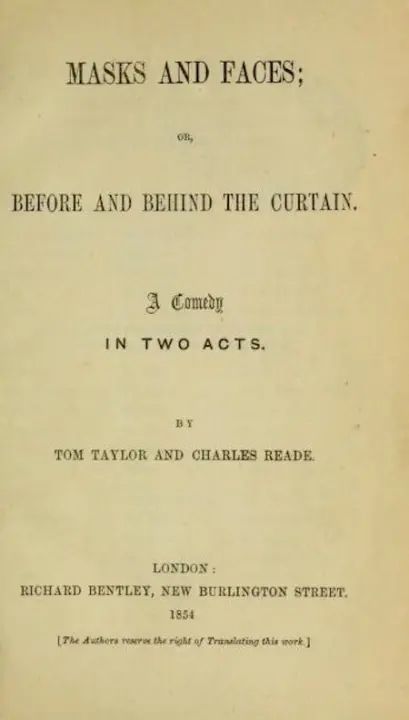
Masks and Faces; or, Before and Behind the Curtain: A Comedy in Two Acts
Tom Taylor & Charles Reade
THE CLASSIC COLLECTION · 1863
"A Simpleton" by Charles Reade is a novel written during the late 19th century. The story centers around a young lady named Rosa Lusignan and her romantic entanglements, particularly with a dedicated physician, Dr. Christopher Staines, and the societal constraints they face. Set against the backdrop of evolving notions of love and marriage, the book explores themes of class, gender roles, and the complexities of human relationships. The beginning of the novel introduces us to Rosa, who is anxiously waiting for Dr. Staines while engaged in an unproductive sewing project. We learn about her beauty and her various skills, but also her dissatisfaction with her current life. The scene shifts when Dr. Staines arrives, highlighting their budding romance filled with youthful hopes and aspirations. However, complications arise when Rosa's father, Mr. Lusignan, disapproves of their relationship due to Dr. Staines' lack of financial security. The unfolding drama captures Rosa's emotional journey, further complicated by health issues and societal expectations, setting the stage for conflicts and dilemmas that will resonate throughout the novel.
Introduction adapted from the source catalogue; source summaries may be automatically generated.
Free to read · English · 130,713 words · No account needed
MAKE TIME FOR A GOOD BOOK
On by default. Untick to stop anonymous reading totals. Each page counts after 10 seconds in view. How this works.
Anonymous counting is on unless you have switched it off.
Every officer in the ship tried him in turn, but without success; for, if they got ready for him, and, the moment he took the bait, jerked the rope hard, in that case he opened his enormous mouth so wide that the bait and hook came out clear. But, sooner or later, he always got the bait, and left his captors the hook.
This went on for days, and his huge dorsal fin always in the ship's
wake.
Then Tadcaster, who had watched these experiments with hope, lost his
spirit and appetite.
Staines reasoned with him, but in vain. Somebody was to die; and, although there were three hundred and more in the ship, he must be the one. At last he actually made his will, and threw himself into Staines's arms, and gave him messages to his mother and Lady Cicely; and ended by frightening himself into a fit.
This roused Staines's pity, and also put him on his mettle. What,
science be beaten by a shark!
He pondered the matter with all his might; and at last an idea came to
him.
He asked the captain's permission to try his hand. This was accorded immediately, and the ship's stores placed at his disposal very politely, but with a sly, comical grin.
Dr. Staines got from the carpenter some sheets of zinc and spare copper, and some flannel: these he cut into three-inch squares, and soaked the flannel in acidulated water. He then procured a quantity of bell-wire, the greater part of which he insulated by wrapping it round with hot gutta percha. So eager was he, that he did not turn in all night.
In the morning he prepared what he called an electric fuse--he filled a soda-water bottle with gunpowder, attaching some cork to make it buoyant, put in the fuse and bung, made it water-tight, connected and insulated his main wires--enveloped the bottle in pork--tied a line to it, and let the bottle overboard.
The captain and officers shook their heads mysteriously. The tars peeped and grinned from every rope to see a doctor try and catch a shark with a soda-water bottle and no hook; but somehow the doctor seemed to know what he was about, so they hovered round, and awaited the result, mystified, but curious, and showing their teeth from ear to ear.
“The only thing I fear,” said Staines, “is that, the moment he takes the bait, he will cut the wire before I can complete the circuit, and fire the fuse.”
Nevertheless, there was another objection to the success of the experiment. The shark had disappeared.
“Well,” said the captain, “at all events, you have frightened him away.”
Your reading position is saved on this browser. Take it to another device with a library code. Reading pages adapt to text, rather than matching a printed edition.
Tom Taylor & Charles Reade
Charles Reade
Charles Reade
Charles Reade
BEHIND THE BOOK
This eBook is for the use of anyone anywhere in the United States and most other parts of the world at no cost and with almost no restrictions whatsoever. You may copy it, give it away or re-use it under the terms of the Project Gutenberg License included with this eBook or online at www.gutenberg.org. If you are not located in the United States, you will have to check the laws of the country where you are located before using this eBook. Read the source licence.
The original source file, including credits and licence, is retained by this library. Request an original-format copy at no charge. Please include the book title and Project Gutenberg identifier #2301.
KEEP YOUR CURIOSITY GOING
Coulson Kernahan

Maurice Baring
Frances Wright
Cécile Tormay

Frederic Jesup Stimson

W. H. P. (William Henry Pope) Jarvis