
Arabia: The Cradle of Islam Studies in the Geography, People and Politics of the Peninsula, with an Account of Islam and Mission-Work.
Samuel Marinus Zwemer
THE CLASSIC COLLECTION · 1920
"A Moslem Seeker After God: Showing Islam at its Best in the Life and Teaching of Al-Ghazali" by Samuel M. Zwemer is a historical account written in the early 20th century. The book explores the life of Al-Ghazali, a pivotal figure in Islamic thought, emphasizing the best aspects of Islam as manifested through his mysticism and theology. It aims to present a sympathetic portrait of Islam that highlights its spiritual depth as well as its struggles with external influences. The opening of the work sets the stage by introducing Al-Ghazali as a significant figure in Islamic history, likening his importance to that of Mohammed. The text describes the environment in which he lived during the 11th century, marked by both cultural richness and moral decay within the Islamic world. It provides a historical context, portraying Al-Ghazali as a major reformer, scholar, and mystic who navigated the complexities of faith, reason, and spirituality during a tumultuous era. This introduction underscores his influence and the relevance of his teachings in offering a path to understanding divine truth, positioning him as an enduring seeker after God.
Introduction adapted from the source catalogue; source summaries may be automatically generated.
Free to read · English · 66,729 words · No account needed
MAKE TIME FOR A GOOD BOOK
On by default. Untick to stop anonymous reading totals. Each page counts after 10 seconds in view. How this works.
Anonymous counting is on unless you have switched it off.
[73] “The Way of a Mystic,” The Moslem World, Vol. II, p. 171.
[74] “Mystics of Islam,” p. 18.
[75] Yet strange to say there was often an utter divorce between these high ideals and practical morality. A surprising statement is made by Al-Ghazali regarding Junaid in this connection. “Ihya,” Vol. II, p. 19.
[76] “Essays on Islam,” by Rev. E. Sell, Madras, 1901, p. 13.
[77] “Mohammedanism,” C. Snouck Hurgronje, New York and London, 1916.
[78] “Der Islam,” Band V, Heft 2/3 article, “Al-Ghazali’s Mishkat Al-Anwar and the Ghazali Problem,” by Canon W. H. T. Gairdner.
[79] “Development of Mohammedanism,” pp. 143-144.
[80] “Ihya,” chapter on Repentance.
[81] One of the texts he uses is (Surah 2, verse 222), “Verily, God loves those who repent and loves those who are purified.” The context is in relation to the infamous statement “Your wives are your tillage, etc.,” which many Moslem commentators interpret as a license for immorality. No wonder that Al-Ghazali was led in this connection to begin to speak on the text “all have sinned” although he does not quote St. Paul’s first chapter to the Romans.
[82] “Al-Badajet,” Cairo Edition, p. 41.
[83] Zwemer, “The Moslem Christ.”
[84] Goldziher, in “Z. D. M. G.,” XXXII, 344.
[85] “Jewish Encyclopædia,” Art. Bible Versions.
[86] After completing this research I found a fuller account of all references to Jesus Christ in Moslem Literature, especially the Ihya as given by Michaël Asin et Palacios in Logia et Agrapha Domini Jesus apud Moslemicos, etc., in Patrologia Orientalis, Tome XIII fascicule 3. Paris 1917.
[87] The story is repeated in Vol. III, p. 206; cf. Matt. 6: 16-18.
[88] These last quotations are from the translation by Homes which was from the Turkish. There seem to be several editions of the “Alchemy of Happiness” and the text varies as well as the number of chapters.
[89] “The Development of Metaphysics in Persia,” p. 75.
Printed in the United States of America
Your reading position is saved on this browser. Take it to another device with a library code. Reading pages adapt to text, rather than matching a printed edition.
Samuel Marinus Zwemer
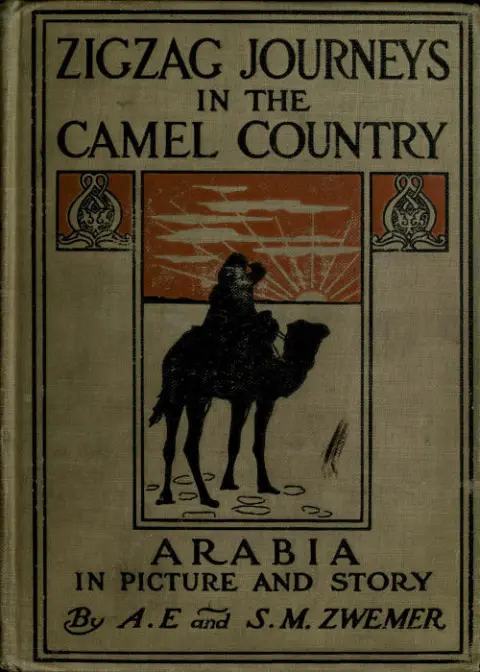
Samuel Marinus Zwemer & Amy E. Zwemer
Samuel Marinus Zwemer & Amy E. Zwemer
BEHIND THE BOOK
This eBook is for the use of anyone anywhere in the United States and most other parts of the world at no cost and with almost no restrictions whatsoever. You may copy it, give it away or re-use it under the terms of the Project Gutenberg License included with this eBook or online at www.gutenberg.org. If you are not located in the United States, you will have to check the laws of the country where you are located before using this eBook. Read the source licence.
The original source file, including credits and licence, is retained by this library. Request an original-format copy at no charge. Please include the book title and Project Gutenberg identifier #74846.
KEEP YOUR CURIOSITY GOING

David Patterson (Spirit) Hatch

David Patterson (Spirit) Hatch

David Patterson (Spirit) Hatch
Cécile Tormay

Moritz Busch
John L. Ransom