
Arabia: The Cradle of Islam Studies in the Geography, People and Politics of the Peninsula, with an Account of Islam and Mission-Work.
Samuel Marinus Zwemer
THE CLASSIC COLLECTION · 1920
"A Moslem Seeker After God: Showing Islam at its Best in the Life and Teaching of Al-Ghazali" by Samuel M. Zwemer is a historical account written in the early 20th century. The book explores the life of Al-Ghazali, a pivotal figure in Islamic thought, emphasizing the best aspects of Islam as manifested through his mysticism and theology. It aims to present a sympathetic portrait of Islam that highlights its spiritual depth as well as its struggles with external influences. The opening of the work sets the stage by introducing Al-Ghazali as a significant figure in Islamic history, likening his importance to that of Mohammed. The text describes the environment in which he lived during the 11th century, marked by both cultural richness and moral decay within the Islamic world. It provides a historical context, portraying Al-Ghazali as a major reformer, scholar, and mystic who navigated the complexities of faith, reason, and spirituality during a tumultuous era. This introduction underscores his influence and the relevance of his teachings in offering a path to understanding divine truth, positioning him as an enduring seeker after God.
Introduction adapted from the source catalogue; source summaries may be automatically generated.
Free to read · English · 66,729 words · No account needed
MAKE TIME FOR A GOOD BOOK
On by default. Untick to stop anonymous reading totals. Each page counts after 10 seconds in view. How this works.
Anonymous counting is on unless you have switched it off.
[44] A recent traveller says: “There is a hole in the wall which is supposed to communicate with the cave below. Jews write letters to Abraham and place them in this hole, to tell him how badly they are being treated by the Moslems. But the Moslem boys are said to know that the hole has no great depth, and to collect these letters and burn them before Abraham has seen them.”
[45] Cf. his “Ihya” and also his “Al-Wajiz.”
[46] M. J. De Goeje, “Memoire sur les Carmathes du Bahrain et Les Fatimides,” (Leiden, 1886) pp. 104-114.
[47] In the Ihya Al-Ghazali gives the prayer to be offered when kissing
the Black Stone.
[48] “Mekka,” Dr. C. Snouck Hurgronje, Vol. I, den Haag, 1888.
[49] Burton’s “Pilgrimage,” Vol. II, Appendix, pp. 323-324.
[50] Macdonald, “The Life of Al-Ghazzali,” pp. 97-98.
[51] Burton’s “Pilgrimage to Al-Medinah and Meccah,” Vol. I, p. 12.
[52] Macdonald’s “Life of Al-Ghazzali,” pp. 105, 107-108, quoted from
Murtadha.
[53] Quoted in Hayat-ul-Hayawan.
[54] An exposition of the Creed of the People of the Sunna on the two Words of Witnessing (kalimatai ’sh-shahada) which form one of the foundations of Islam. This creed is intended to be committed to memory by children. It forms the first section of the second book of Ghazali’s Ihya, Vol. II, pp. 17-42 of edit. of Cairo with commentary of the Sayyid Murtadha. We are indebted for the translation to Professor Macdonald (Muslim Theology and Jurisprudence).
[55] For the process see pp. 170 et seq. of “Mafatih Al-Ghaib” (Cairo, 1327) by Ahmed Al-Zarkawi, a contemporary Egyptian magician, and on the subject in general, the sixth and seventh Risalas in that volume.
[56] Cf. Al-Faidh al Mutawalli of Ahmed Damanhuri, Cairo, 1331.
[57] “Encyclopædia of Islam,” article Buduh.
[58] See a paper on this subject by Ali Bey Bargat, Sur Deux Bronzes du Musée Arabe—“Bulletin de l’Inst. Egypt.,” IV: 7.
[59] For critical notes on his works see R. Gosche, pp. 249-300, also Gardner’s remarks and list.
[60] “The Mystics of Islam.”
[61] Macdonald, p. 72.
[62] Compare the two statements facing this chapter; also the references to “The Gospel,” in Chapter IX.
[63] “Jewish Encyclopædia,” article “Ghazali.”
[64] Macdonald.
[65] In regard to the influence of Al-Ghazali’s writings, R. Gosche remarks: “It is characteristic how his influence has spread. The later mystical portions of his Ihya have especially influenced Mohammedan circles in India. His two works on philosophy exerted influence in Spain and among later Jewish writers, for the best manuscripts of the Tahafut are found in Maghrabi character.”
[66] Adolf Wuttke, “Christian Ethics,” Vol. I, p. 172.
[67] Macdonald, pp. 118-119.
[68] “Ihya,” Vol. II, pp. 32-33, “Mizan al ʿAmal,” pp. 126-128, etc.
[69] “Alchemy of Happiness,” pp. 94-96.
[70] “Alchemy of Happiness.”
[71] “Mizan al ʿAmal.”
[72] “The Mystics of Islam.”
Your reading position is saved on this browser. Take it to another device with a library code. Reading pages adapt to text, rather than matching a printed edition.
Samuel Marinus Zwemer
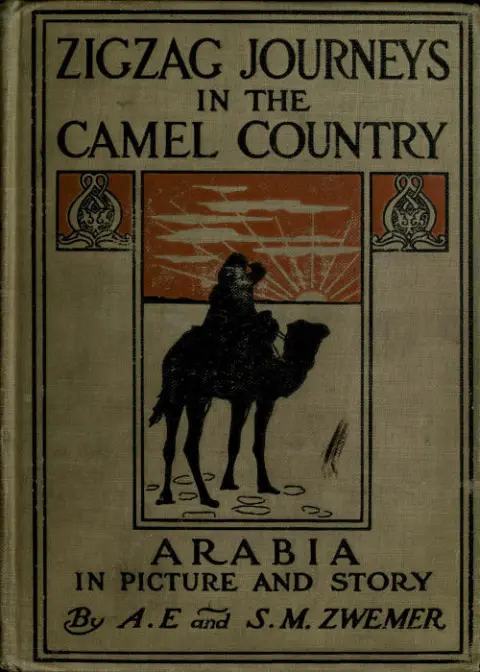
Samuel Marinus Zwemer & Amy E. Zwemer
Samuel Marinus Zwemer & Amy E. Zwemer
BEHIND THE BOOK
This eBook is for the use of anyone anywhere in the United States and most other parts of the world at no cost and with almost no restrictions whatsoever. You may copy it, give it away or re-use it under the terms of the Project Gutenberg License included with this eBook or online at www.gutenberg.org. If you are not located in the United States, you will have to check the laws of the country where you are located before using this eBook. Read the source licence.
The original source file, including credits and licence, is retained by this library. Request an original-format copy at no charge. Please include the book title and Project Gutenberg identifier #74846.
KEEP YOUR CURIOSITY GOING

David Patterson (Spirit) Hatch

David Patterson (Spirit) Hatch

David Patterson (Spirit) Hatch
Cécile Tormay

Moritz Busch
John L. Ransom