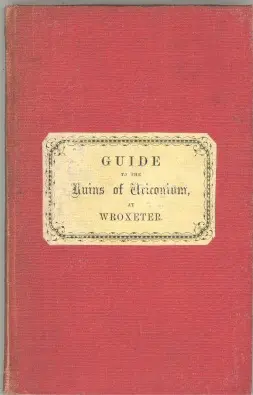
The Ruins of the Roman City of Uriconium, at Wroxeter, near Shrewsbury
Thomas Wright
THE CLASSIC COLLECTION · 1862
"A History of Domestic Manners and Sentiments in England During the Middle Ages" by Thomas Wright is a historical account written in the mid-19th century. The book seeks to provide a comprehensive look at the everyday life, customs, and thoughts of the English people during the Middle Ages, emphasizing their domestic arrangements and practices. The author aims to fill a gap in literature by creating a vivid picture of historical domestic life, juxtaposing it with modern society to illustrate how past customs have shaped contemporary manners and sentiments. At the start of the book, Wright introduces his purpose and methodology, stating that his work focuses on domestic manners and sentiments rather than the traditional histories of rulers and events. He briefly discusses the existing literature on related subjects, emphasizing the need for a cohesive view of domestic life during various historical periods. Wright outlines the structure of his work, which will explore the Anglo-Saxon period through to the Reformation, highlighting the significant transitions in social customs and practices, ultimately aiming to create an engaging narrative that draws from original research rather than previous compilations. The opening chapters promise to examine aspects such as housing, dining customs, and the furnishings of Anglo-Saxon households, setting the stage for a detailed investigation of medieval domestic life.
Introduction adapted from the source catalogue; source summaries may be automatically generated.
Free to read · English · 152,792 words · No account needed
MAKE TIME FOR A GOOD BOOK
On by default. Untick to stop anonymous reading totals. Each page counts after 10 seconds in view. How this works.
Anonymous counting is on unless you have switched it off.
The lord, surprised at the agitation in the countenance of the friar, who had come in without any sort of introduction, invites him to sit down, and inquires into his business. There is a scene in the early English metrical romance of Ipomydon, in which this hero and his preceptor Tholoman go to the residence of the heiress of Calabria. At the castle gate they were stopped by the porter, whom they ask to announce them in the hall:--
The porter to theyme they gan calle,
And prayd hym, ‘Go into the halle,
And say thy lady gent and fre,
That come ar men of ferre contré,
And, if it plese hyr, we wold hyr prey
That we myght ete with hyr to-day.’
--Weber, Metr. Rom. ii. 290.
The porter “courteously” undertook the message, and, at the immediate order of the lady, who was sitting at her meat, he went back, took charge of their horses and pages, and introduced them into the hall. Then they asked to be taken into the lady’s service, who accepted their offer, and invited them to take their place at the dinner:--
He thankid the lady cortesly,
She comandyth hym to the mete;
But, or he satte in any sete,
He saluted theym grate and smalle,
As a gentille man shuld in halle.
--Weber, ii. 292.
Perhaps, before entering the mediæval hall, we shall do well to give a glance at the kitchen. It is an opinion, which has not unfrequently been entertained, that living in the middle ages was coarse and not elaborate; and that old English fare consisted chiefly in roast beef and plum-pudding. That nothing, however, could be more incorrect, is fully proved by the rather numerous mediæval cookery books which are still preserved, and which contain chiefly directions for made dishes, many of them very complicated, and, to appearance, extremely delicate. The office of cook, indeed, was one of great importance, and was well paid; and the kitchens of the aristocracy were very extensive, and were furnished with a considerable variety of implements of cookery. On account, no doubt, of this importance, Alexander Neckam, although an ecclesiastic, commences his vocabulary (or, as it is commonly entitled, Liber de Utensilibus), compiled in the latter part of the twelfth century, with an account of the kitchen and its furniture. He enumerates, among other objects, a table for chopping and mincing herbs and vegetables; pots, trivets or tripods, an axe, a mortar and pestle, a mover, or pot-stick, for stirring, a crook or pot-hook (uncus), a caldron, a frying-pan, a gridiron, a posnet or saucepan, a dish, a platter, a saucer, or vessel for mixing sauce, a hand-mill, a pepper-mill, a mier, or instrument for reducing bread to crumbs. John de Garlande, in his “Dictionarius,” composed towards the middle of the thirteenth century, gives a similar enumeration; and a comparison of the vocabularies of the fifteenth century, shows that the arrangements of the kitchen had undergone little change during the intervening period. From these vocabularies the following list of kitchen utensils is gathered:--a brandreth, or iron tripod, for supporting the caldron over the fire; a caldron, a dressing-board and dressing-knife, a brass-pot, a posnet, a frying-pan, a gridiron, or, as it is sometimes called, a roasting-iron; a spit, a “gobard,” explained in the MS. by ipegurgium; a mier, a flesh-hook, a scummer, a ladle, a pot-stick, a slice for turning meat in the frying-pan, a pot-hook, a mortar and pestle, a pepper-quern, a platter, a saucer.
Your reading position is saved on this browser. Take it to another device with a library code. Reading pages adapt to text, rather than matching a printed edition.
BEHIND THE BOOK
This eBook is for the use of anyone anywhere in the United States and most other parts of the world at no cost and with almost no restrictions whatsoever. You may copy it, give it away or re-use it under the terms of the Project Gutenberg License included with this eBook or online at www.gutenberg.org. If you are not located in the United States, you will have to check the laws of the country where you are located before using this eBook. Read the source licence.
The original source file, including credits and licence, is retained by this library. Request an original-format copy at no charge. Please include the book title and Project Gutenberg identifier #59351.
KEEP YOUR CURIOSITY GOING
Cécile Tormay

Moritz Busch
John L. Ransom
Frances Wright
Cécile Tormay

Mabel Potter Daggett