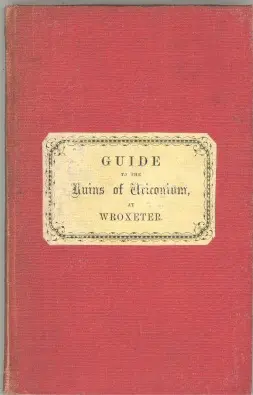
The Ruins of the Roman City of Uriconium, at Wroxeter, near Shrewsbury
Thomas Wright
THE CLASSIC COLLECTION · 1862
"A History of Domestic Manners and Sentiments in England During the Middle Ages" by Thomas Wright is a historical account written in the mid-19th century. The book seeks to provide a comprehensive look at the everyday life, customs, and thoughts of the English people during the Middle Ages, emphasizing their domestic arrangements and practices. The author aims to fill a gap in literature by creating a vivid picture of historical domestic life, juxtaposing it with modern society to illustrate how past customs have shaped contemporary manners and sentiments. At the start of the book, Wright introduces his purpose and methodology, stating that his work focuses on domestic manners and sentiments rather than the traditional histories of rulers and events. He briefly discusses the existing literature on related subjects, emphasizing the need for a cohesive view of domestic life during various historical periods. Wright outlines the structure of his work, which will explore the Anglo-Saxon period through to the Reformation, highlighting the significant transitions in social customs and practices, ultimately aiming to create an engaging narrative that draws from original research rather than previous compilations. The opening chapters promise to examine aspects such as housing, dining customs, and the furnishings of Anglo-Saxon households, setting the stage for a detailed investigation of medieval domestic life.
Introduction adapted from the source catalogue; source summaries may be automatically generated.
Free to read · English · 152,792 words · No account needed
MAKE TIME FOR A GOOD BOOK
On by default. Untick to stop anonymous reading totals. Each page counts after 10 seconds in view. How this works.
Anonymous counting is on unless you have switched it off.
We begin now to be a little better acquainted with the domestic occupations of the ladies, but we shall be able to treat more fully of these in a subsequent chapter. Not the least usual of these was weaving, an art which appears to have been practised very extensively by the female portion of the larger households. The manuscript Psalter in Trinity College, Cambridge, furnishes us with the very curious group of female weavers given in our cut No. 73. It explains itself, as much, at least, as it can easily be explained, and I will only observe that the scissors here employed are of the form common to the Romans, to the Saxons, and to the earlier Normans; they are the Saxon scear, and this name, as well as the form, is still preserved in that of the “shears” of the modern clothiers. Music was also a favourite occupation, and the number of musical instruments appears to be considerably increased. Some of these seem to have been elaborately constructed. The manuscript last mentioned furnishes us with the accompanying figure of a large organ, of laborious though rather clumsy workmanship.
In the dwellings of the nobles and gentry, there was more show of furniture under the Normans than under the Saxons. Cupboards (armaria, armoires) were more numerous, and were filled with vessels of earthenware, wood, or metal, as well as with other things. Chests and coffers were adorned with elaborate carving, and were sometimes inlaid with metal, and even with enamel. The smaller ones were made of ivory, or bone, carved with historical subjects. Rich ornamentation generally began with ecclesiastics, and we find by the subjects carved upon them that the earlier ivory coffers or caskets belonged to churchmen. When they were made for lords and ladies, they were usually ornamented with subjects from romance, or from the current literature of the day. The beds, also, were more ornamental, and assumed novel forms. Our cut No. 75, taken from MS. Cotton. Nero, C. iv., differs little from some of the Anglo-Saxon figures of beds. But the tester bed, or bed with a roof at the head, and hangings, was now introduced. In Reginald of Durham, we are told of a sacristan who was accustomed to sit in his bed and read at night. One night, having fixed his candle upon one of the sides of the bed (supra spondilia lectuli suprema), he fell accidentally asleep. The fire communicated itself from the candle to the bed, which, being filled with straw, was soon enveloped in flame, and this communicated itself with no less rapidity to the combination of arches and planks of which the frame of the bed was composed (ligna materies archarum et asserum copiosa). Above the bed was a wooden frame (quædam tabularia stratura), on which he was accustomed to pile the curtains, dorsals, and other similar furniture of the church. Neckam, in the latter part of the twelfth century, describes the chamber as having its walls covered with a curtain, or tapestry. Besides the bed, he says, there should be a chair, and at the foot of the bed a bench. On the bed was placed a quilt (culcitra) of feathers (plumalis), to which is joined a pillow; and this is covered with a pointed (punctata) or striped (stragulata) quilt, and a cushion is placed upon this, on which to lay the head. Then came sheets (lintheamina, linceuls), made sometimes of rich silks, but more commonly of linen, and these were covered with a coverlet made of green say, or of cloth made of the hair of the badger, cat, beaver, or sable. On one side of the chamber was a perche, or pole, projecting from the wall, for the falcons, and in another place a similar perch for hanging articles of dress. It was not unusual to have only one chamber in the house, in which there were, or could be made, several beds, so that all the company, even if of different sexes, slept in the same room. Servants and persons of lower degree might sleep unceremoniously in the hall. In the romance of Huon de Bordeaux (p. 270), Huon, his wife, and his brother, when lodged in a great abbey, sleep in three different beds in the same room, no doubt in the guest-house. Among the Anglo-Normans, the chamber seems to have frequently, if not generally, occupied an upper floor, so that it was approached by stairs.
Your reading position is saved on this browser. Take it to another device with a library code. Reading pages adapt to text, rather than matching a printed edition.
BEHIND THE BOOK
This eBook is for the use of anyone anywhere in the United States and most other parts of the world at no cost and with almost no restrictions whatsoever. You may copy it, give it away or re-use it under the terms of the Project Gutenberg License included with this eBook or online at www.gutenberg.org. If you are not located in the United States, you will have to check the laws of the country where you are located before using this eBook. Read the source licence.
The original source file, including credits and licence, is retained by this library. Request an original-format copy at no charge. Please include the book title and Project Gutenberg identifier #59351.
KEEP YOUR CURIOSITY GOING
Cécile Tormay

Moritz Busch
John L. Ransom
Frances Wright
Cécile Tormay

Mabel Potter Daggett