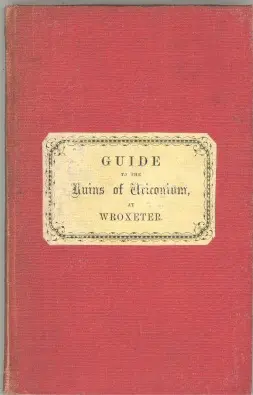
The Ruins of the Roman City of Uriconium, at Wroxeter, near Shrewsbury
Thomas Wright
THE CLASSIC COLLECTION · 1862
"A History of Domestic Manners and Sentiments in England During the Middle Ages" by Thomas Wright is a historical account written in the mid-19th century. The book seeks to provide a comprehensive look at the everyday life, customs, and thoughts of the English people during the Middle Ages, emphasizing their domestic arrangements and practices. The author aims to fill a gap in literature by creating a vivid picture of historical domestic life, juxtaposing it with modern society to illustrate how past customs have shaped contemporary manners and sentiments. At the start of the book, Wright introduces his purpose and methodology, stating that his work focuses on domestic manners and sentiments rather than the traditional histories of rulers and events. He briefly discusses the existing literature on related subjects, emphasizing the need for a cohesive view of domestic life during various historical periods. Wright outlines the structure of his work, which will explore the Anglo-Saxon period through to the Reformation, highlighting the significant transitions in social customs and practices, ultimately aiming to create an engaging narrative that draws from original research rather than previous compilations. The opening chapters promise to examine aspects such as housing, dining customs, and the furnishings of Anglo-Saxon households, setting the stage for a detailed investigation of medieval domestic life.
Introduction adapted from the source catalogue; source summaries may be automatically generated.
Free to read · English · 152,792 words · No account needed
MAKE TIME FOR A GOOD BOOK
On by default. Untick to stop anonymous reading totals. Each page counts after 10 seconds in view. How this works.
Anonymous counting is on unless you have switched it off.
There was a table used in the chamber or bower, which differed altogether from that used in the hall. It was named myse, disc (from the Latin discus), and beod; all words which convey the idea of its being round--beodas (in the plural) was the term applied to the scales of a balance. The Latin phrase, of the 127th Psalm, in circuitu mensæ tuæ, which was evidently understood by the Anglo-Saxon translators as referring to a round table, is translated by one, on ymbhwyrfte mysan thine, and by another, in ymbhwyrfte beodes thines. If we refer back to the preceding chapter, we shall see, in the subjects which appear to exhibit a small domestic party (see cuts No. 15, 19, and 24), that the table is round; and this was evidently the usual form given among the Anglo-Saxons to the table used in the chamber or private room. This form has been preserved as a favourite one in England down to a very recent period, as that of the parlour-table among the class of society most likely to retain Anglo-Saxon tastes and sentiments. In the pictures, the round table is generally represented as supported on three or four legs, though there are instances in which it was represented with one. In the latter case, the board of the table probably turned up on a hinge, as in our old parlour tea-tables; and in the former it was perhaps capable of being taken off the legs; for there is reason for believing that it was only laid out when wanted, and that, when no longer in use, it was put away on one side of the room or in a closet, in the smallest possible compass.
We have no information to explain to us how the bower or chamber was warmed. In the hall, it is probable that the fire gave warmth and light at the same time, although, in the fragment of the Anglo-Saxon poem relating to the fight at Finnesburg, there is an indistinct intimation that the hall was sometimes lighted with horns, or cressets; but, in the chamber, during the long evenings of winter, it was necessary to have an artificial light to enable its occupants to read, or work, or play. The Anglo-Saxon name for this article, so necessary for domestic comfort, was candel or condel (our candle); and, so general was the application of this term, that it was even used figuratively as we now use the word lamp. Thus, the Anglo-Saxon poets spoke of the sun as rodores candel (the candle of the firmament), woruld-candel (the candle of the world), heofon-condel (the candle of heaven), wyn-condel (the candle of glory). The candle was, no doubt, originally a mere mass of fat plastered round a wick (candel-weoc), and stuck upon an upright stick. Hence the instrument on which it was afterwards supported received the name of candel-sticca or candel-stæf, a candlestick; and the original idea was preserved even when the candle supporter had many branches, it being then called a candel-treow, or candle-tree. The original arrangement of the stick was also preserved; for, down to a very recent period, the candle was not inserted in a socket in the candlestick as at present, but it was stuck upon a spike. The Anglo-Saxon writers speak of candel-snytels, or snuffers. Other names less used, for a candle or some article for giving light, were blacern or blæcern, which is explained in glossaries by the Latin lucerna, and thæcela, the latter signifying merely a light. It was usual, also, among our Saxon forefathers, as among ourselves, to speak of the instrument for illumination as merely leoht, a light--“bring me a light.” A candlestick and candle are represented in one of the cuts in our last chapter (cut No. 19). The Anglo-Saxons, no doubt, derived the use of lamps from the Romans; and they were so utterly at a loss for a word to describe this mode of illumination, that they always called it leoht-fæt, a light-vat, or vessel of light. In our cut (No. 31) we have an Anglo-Saxon lamp, placed on a candelabrum or stand, exactly in the Roman manner. It will be remembered that Asser, a writer of somewhat doubtful authenticity, ascribes to king Alfred the invention of lanterns, as a protection to the candle, to prevent it from swealing in consequence of the wind entering through the crevices of the apartments--not a very bright picture of the comforts of an Anglo-Saxon chamber. The candles were made of wax as well as tallow. The candlestick was of different materials. In one instance we find it termed, in Anglo-Saxon, a leoht-isern, literally a light-iron: perhaps this was the term used for the lamp-stand, as figured in our last cut. In the inventories we have mention of ge-bonene candel-sticcan (candlesticks of bone), of silver-gilt candlesticks, and of ornamented candlesticks.
Your reading position is saved on this browser. Take it to another device with a library code. Reading pages adapt to text, rather than matching a printed edition.
BEHIND THE BOOK
This eBook is for the use of anyone anywhere in the United States and most other parts of the world at no cost and with almost no restrictions whatsoever. You may copy it, give it away or re-use it under the terms of the Project Gutenberg License included with this eBook or online at www.gutenberg.org. If you are not located in the United States, you will have to check the laws of the country where you are located before using this eBook. Read the source licence.
The original source file, including credits and licence, is retained by this library. Request an original-format copy at no charge. Please include the book title and Project Gutenberg identifier #59351.
KEEP YOUR CURIOSITY GOING
Cécile Tormay

Moritz Busch
John L. Ransom
Frances Wright
Cécile Tormay

Mabel Potter Daggett