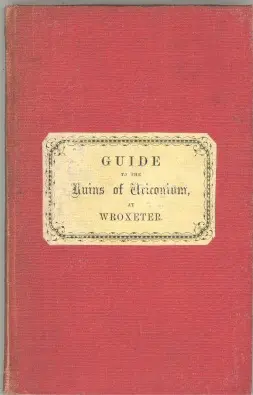
The Ruins of the Roman City of Uriconium, at Wroxeter, near Shrewsbury
Thomas Wright
THE CLASSIC COLLECTION · 1862
"A History of Domestic Manners and Sentiments in England During the Middle Ages" by Thomas Wright is a historical account written in the mid-19th century. The book seeks to provide a comprehensive look at the everyday life, customs, and thoughts of the English people during the Middle Ages, emphasizing their domestic arrangements and practices. The author aims to fill a gap in literature by creating a vivid picture of historical domestic life, juxtaposing it with modern society to illustrate how past customs have shaped contemporary manners and sentiments. At the start of the book, Wright introduces his purpose and methodology, stating that his work focuses on domestic manners and sentiments rather than the traditional histories of rulers and events. He briefly discusses the existing literature on related subjects, emphasizing the need for a cohesive view of domestic life during various historical periods. Wright outlines the structure of his work, which will explore the Anglo-Saxon period through to the Reformation, highlighting the significant transitions in social customs and practices, ultimately aiming to create an engaging narrative that draws from original research rather than previous compilations. The opening chapters promise to examine aspects such as housing, dining customs, and the furnishings of Anglo-Saxon households, setting the stage for a detailed investigation of medieval domestic life.
Introduction adapted from the source catalogue; source summaries may be automatically generated.
Free to read · English · 152,792 words · No account needed
MAKE TIME FOR A GOOD BOOK
On by default. Untick to stop anonymous reading totals. Each page counts after 10 seconds in view. How this works.
Anonymous counting is on unless you have switched it off.
Though gardening and horticulture in general, as arts, were undergoing considerable improvement during this period, the garden itself appears to have been much more neglected, except as far as it was the scene of other pastimes. A bowling-green was the most important part of the pleasure garden in the sixteenth and seventeenth centuries; and bowls, and exercises of a similar character, were the favourite amusements of all classes. The gardens themselves, which were apart from the house, and made more retired by lofty walls enclosing them, were usually adorned with alcoves and summer-houses, or, as they were then more usually termed, garden-houses, but these were chiefly celebrated, especially in the seventeenth century, as places of intrigue. There are continual allusions to this usage in the popular writers of the time. Thus, one of the personages in Beaumont and Fletcher’s “Woman Hater” exclaims, “This is no garden-house: in my conscience she went forth with no dishonest intent.” And, in the play of the “Mayor of Quinsborough,”--
Poor soul, she’s entic’d forth by her own sex To be betray’d to man, who in some garden-house, Or remote walk, taking his lustful time, Binds darkness on her eyes, surprises her.
A character in another old play, “The London Prodigal,” seeking employment of a rather equivocal character, says, “Now God thank you, sweet lady, if you have any friend, or garden-house, where you may employ a poor gentleman as your friend, I am yours to command in all secret service.”
Amid the gaiety which was so especially characteristic of this age, a spirit of vulgar barbarity had arisen and spread itself very widely, and the popular games most practised were in general coarse and cruel. A foreign writer already quoted, but one who was evidently a very unprejudiced observer, has left us some rather amusing remarks on this subject which are worthy of being repeated. “The English,” he says, “have games which are peculiar to them, or at least, which they affect and practise more than people do elsewhere. To see cocks fight is a royal pleasure in England. Their combats of bulls and dogs, of bears and dogs, and sometimes of bulls and bears, are not combats to the last gasp, like those of cocks. Everything that is called fighting is a delicious thing to an Englishman. If two little boys quarrel in a street, the passers stop, make in a moment a ring round them, and encourage them to settle it by blows of the fist. If it comes to fighting, each takes off his cravat and his jacket, and gives them in charge to one of the company; then begin the blows of the fist, in the face if possible, the blows of the foot on their shins, the pulling of one another by the hair, &c. The one who has knocked the other down, may give him one blow or two when he is down, but no more, and every time the one who is down will rise, the other must return to the combat as long as he pleases. During the combat, the circle of spectators encourage the combatants to the great joy of their hearts, and never separate them, so long as things are done according to rule. And these spectators are not only other children, and street porters, but all sorts of respectable people, some of whom make their way through the crowd to see nearer, others mount upon the shops, and all would pay for places, if stages could be built up in a moment. The fathers and mothers of the little boys who are fighting look on like the others, and encourage the one who gives way, or is wanting in strength. These kind of combats are less frequent among grown-up men than among children, but they are not uncommon. If the driver of a hackney-coach has a dispute about his fare, with a gentleman whom he has carried, and the gentleman offers to settle the dispute by fighting, the coachman agrees to it willingly. The gentleman takes off his sword, disposes of it in some shop with his walking-stick, his gloves, and his cravat, and fights in the manner I have described. If the coachman is well beaten, which is almost always the case, he is considered as paid; but if he beats, he who is beaten must pay the sum that was in question, and that which caused the quarrel. I once saw the late duke of Grafton fighting in the open street in the middle of the Strand with a coachman, whom he thrashed in a terrible manner. In France, we treat such kind of people with blows of a stick or, sometimes, of the flat of the sword; but in England that is never done; they never use a sword or stick against those who are not similarly armed; and if any unlucky foreigner (for it would never come into the mind of an Englishman) should strike with the sword any one who had not got one, it is certain that in an instant a hundred persons would fall upon him, and perhaps beat him so that he would never recover. Wrestling is also one of the diversions of the English, especially in the northern provinces. Ringing the bells is one of their great pleasures, especially in the country; there is a way of doing it, but their peal is quite different from those of Holland and the Low Countries. In winter football is a useful and charming exercise; it is a ball of leather, as large as a man’s head, and filled with wind; it is tossed with the feet in the streets. To expose a cock in a place, and kill it at a distance of forty or fifty paces with a stick, is also a very diverting thing; but this pleasure only belongs to a certain season. This also is the case with the dances of the milkwomen, with the throwing at one another of tennis-balls by girls, and with divers other little exercises.” Such was the rude character of the amusement of all classes of our population during the seventeenth century.
Your reading position is saved on this browser. Take it to another device with a library code. Reading pages adapt to text, rather than matching a printed edition.
BEHIND THE BOOK
This eBook is for the use of anyone anywhere in the United States and most other parts of the world at no cost and with almost no restrictions whatsoever. You may copy it, give it away or re-use it under the terms of the Project Gutenberg License included with this eBook or online at www.gutenberg.org. If you are not located in the United States, you will have to check the laws of the country where you are located before using this eBook. Read the source licence.
The original source file, including credits and licence, is retained by this library. Request an original-format copy at no charge. Please include the book title and Project Gutenberg identifier #59351.
KEEP YOUR CURIOSITY GOING
Cécile Tormay

Moritz Busch
John L. Ransom
Frances Wright
Cécile Tormay

Mabel Potter Daggett