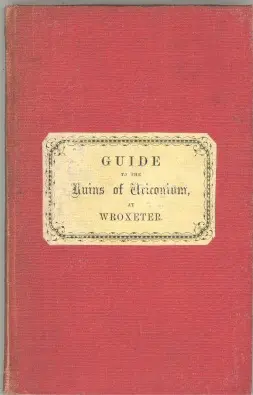
The Ruins of the Roman City of Uriconium, at Wroxeter, near Shrewsbury
Thomas Wright
THE CLASSIC COLLECTION · 1862
"A History of Domestic Manners and Sentiments in England During the Middle Ages" by Thomas Wright is a historical account written in the mid-19th century. The book seeks to provide a comprehensive look at the everyday life, customs, and thoughts of the English people during the Middle Ages, emphasizing their domestic arrangements and practices. The author aims to fill a gap in literature by creating a vivid picture of historical domestic life, juxtaposing it with modern society to illustrate how past customs have shaped contemporary manners and sentiments. At the start of the book, Wright introduces his purpose and methodology, stating that his work focuses on domestic manners and sentiments rather than the traditional histories of rulers and events. He briefly discusses the existing literature on related subjects, emphasizing the need for a cohesive view of domestic life during various historical periods. Wright outlines the structure of his work, which will explore the Anglo-Saxon period through to the Reformation, highlighting the significant transitions in social customs and practices, ultimately aiming to create an engaging narrative that draws from original research rather than previous compilations. The opening chapters promise to examine aspects such as housing, dining customs, and the furnishings of Anglo-Saxon households, setting the stage for a detailed investigation of medieval domestic life.
Introduction adapted from the source catalogue; source summaries may be automatically generated.
Free to read · English · 152,792 words · No account needed
MAKE TIME FOR A GOOD BOOK
On by default. Untick to stop anonymous reading totals. Each page counts after 10 seconds in view. How this works.
Anonymous counting is on unless you have switched it off.
With a lean visage, like a carv’d face
On a court-cupboard.
The sixteenth century was especially the age of tapestries, and no gentleman could consider his rooms furnished if they wanted these important adjuncts. They were now elaborately worked into great historical pictures, sacred or profane, or mythological or other subjects, to suit the varieties of tastes. Sir John Elyot, in his “Governor,” reminds his readers that “semblable decking oughte to bee in the house of a noblemanne, or man of honoure; I meane concerning ornaments of hall and chambers in arras, painted tables, and images concernynge historyes, wherein is represented some monument of vertue most cunningly,” &c. At the commencement of the seventeenth century this practice was already beginning to go out of fashion, and it was not long afterwards that it was entirely laid aside: and the walls were again covered with panels, or painted or whitewashed, and adorned with pictures. In our last cut, of the date of 1633, we see the walls thus decorated with paintings.
The rapid social revolution which was now going on, gradually produced changes in most of the articles of domestic economy. Thus, the old spiked candlestick was early in the century superseded by the modern socket candlestick. The chandelier represented in our cut No. 299, taken from one of Albert Durer’s prints of the Life of the Virgin, published in 1509, in its spikes for the candles and its other characteristics, belongs to a ruder and earlier style of household furniture, and has nothing in common with the rich chandeliers which now began to be used.
The parlour appears in the sixteenth century to have been a room the particular use of which was in a state of transition. Subsequently, as domestic life assumed greater privacy than when people lived publicly in the hall, the parlour became the living room; but in the sixteenth century, though in London it was already used as the dining-room, in the country it appears to have been considered as a sort of amalgamation of a store-room and a bedroom. This is best understood from the different inventories of its furniture which have been preserved. In 1558, the parlour of Robert Hyndmer, rector of Sedgefield, in the county of Durham, contained--“a table with a joined frame, two forms, and a carpet; carved cupboards; a plain cupboard; nine joined stools; hangings of tapestry; and a turned chair.” In the parlour at Hilton Castle, in the same county, in 1559, there were--“one iron chimney, two tables, one counter, two chairs, one cupboard, six forms, two old carpets, and three old hangings.” In 1564, Margaret Cottom, a widow of Gateshead, had in her parlour--“one inner bed of wainscot, a stand, a bed, a presser of wainscot, three chests, a Dantzic coffer;” a considerable quantity of linen and cloth of different kinds, and for different purposes; “tallow candles, and wooden dishes, a feather bed, a bolster, and a cod (pillow), two coverlets, two happgings (coverlets of a coarser kind), three blankets, three cods (pillows), with an old mattress; five cushions, a steel cap, and a covering; a tin bottle, a cap-case with a lock.” In the house of William Dalton, a wealthy merchant of Durham in 1556, the parlour must have been very roomy indeed to contain all the “household stuff” which it holds in the inventory, namely, “a chimney, with a pair of tongs; a bedstead close made; a feather bed, a pair of sheets, a covering of apparels, an ‘ovese’ bed, a covering wrought of silk; a cod (pillow), and a pillow-bere; a trundle-bed, a feather bed, a twilt (quilt), a happing (coverlet), and a bolster; a stand-bed, a feather-bed, a mattress, a pair of blankets, a red covering, a bolster, and curtains; eight cods, and eight pillow-beres; seven pair of linen sheets; eight pair of strakin (a sort of kersey) sheets; six pair of harden (hempen) sheets; thirteen yards of diaper tabling; ten yards and a half of table-cloth; twenty-one yards of towelling; four hand towels; two dozen napkins; five pillow-beres; two head sheets; a pair of blankets; two ‘overse’ beds, and three curtains; a cupboard; a table, with a carpet; a counter, with a carpet; a Dantzic chest; a bond chest; a bond coffer; an ambry; a long settle, and a chair; three buffet stools; a little stool; two forms; red hangings; a painted cloth; three chests; a stand-bed, a pair of blankets, two sheets, a covering, and two cods; an ‘ambre call.’” In 1567, the parlour at Beaumont Hill, a gentleman’s house in the north, contained the following furniture:--“One trundle bed, with a feather bed; two coverlets, a bolster, two blankets, two carpet table cloths, two coverlets, one presser, a little table, one chest, three chairs, and three forms.” In other inventories, down to the end of the century, we find the parlour continuing to be stored in this indiscriminate manner.
Your reading position is saved on this browser. Take it to another device with a library code. Reading pages adapt to text, rather than matching a printed edition.
BEHIND THE BOOK
This eBook is for the use of anyone anywhere in the United States and most other parts of the world at no cost and with almost no restrictions whatsoever. You may copy it, give it away or re-use it under the terms of the Project Gutenberg License included with this eBook or online at www.gutenberg.org. If you are not located in the United States, you will have to check the laws of the country where you are located before using this eBook. Read the source licence.
The original source file, including credits and licence, is retained by this library. Request an original-format copy at no charge. Please include the book title and Project Gutenberg identifier #59351.
KEEP YOUR CURIOSITY GOING
Cécile Tormay

Moritz Busch
John L. Ransom
Frances Wright
Cécile Tormay

Mabel Potter Daggett