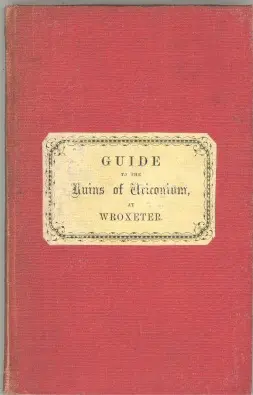
The Ruins of the Roman City of Uriconium, at Wroxeter, near Shrewsbury
Thomas Wright
THE CLASSIC COLLECTION · 1862
"A History of Domestic Manners and Sentiments in England During the Middle Ages" by Thomas Wright is a historical account written in the mid-19th century. The book seeks to provide a comprehensive look at the everyday life, customs, and thoughts of the English people during the Middle Ages, emphasizing their domestic arrangements and practices. The author aims to fill a gap in literature by creating a vivid picture of historical domestic life, juxtaposing it with modern society to illustrate how past customs have shaped contemporary manners and sentiments. At the start of the book, Wright introduces his purpose and methodology, stating that his work focuses on domestic manners and sentiments rather than the traditional histories of rulers and events. He briefly discusses the existing literature on related subjects, emphasizing the need for a cohesive view of domestic life during various historical periods. Wright outlines the structure of his work, which will explore the Anglo-Saxon period through to the Reformation, highlighting the significant transitions in social customs and practices, ultimately aiming to create an engaging narrative that draws from original research rather than previous compilations. The opening chapters promise to examine aspects such as housing, dining customs, and the furnishings of Anglo-Saxon households, setting the stage for a detailed investigation of medieval domestic life.
Introduction adapted from the source catalogue; source summaries may be automatically generated.
Free to read · English · 152,792 words · No account needed
MAKE TIME FOR A GOOD BOOK
On by default. Untick to stop anonymous reading totals. Each page counts after 10 seconds in view. How this works.
Anonymous counting is on unless you have switched it off.
This custom of pledging in drinking was as old as the times of the Anglo-Saxons, when it existed in the “wæs heil” and “drinc heil,” commemorated in the story of the British Vortigern and the Saxon Rowena, and it is alluded to in several ballads of the fourteenth and fifteenth centuries, as in that of “King Edward and the Shepherd,” where the man who drinks pledges his companion with the word “passelodion,” and the other replies by “berafrynde,” and in that of “The Kyng and the Hermyt,” where the words of pledging and reply are “fusty bandyas,” and “stryke pautnere.” Both these ballads are printed in Hartshorne’s “Ancient Metrical Tales.” The drinking of the healths of absent individuals appears to have been introduced at a later period, and was carried to its greatest degree of extravagance on the continent. The person whose health a man gave was usually expected to be his mistress; and in France he was expected, in doing this, to drink as many times his glass or cup full of wine as there were letters in her name. Thus, in Ronsard’s “Bacchanales,” the gallant drinks nine times to his mistress Cassandre, because there were nine letters in her name:--
Neuf fois, au nom de Cassandre,
Je vois prendre
Neuf fois du vin du flacon;
Affin de neuf fois le boire
En memoire
Des neuf lettres de son nom.
And a less celebrated poet, of a rather later date, Guillaume Colletet, in a piece entitled “Le Trebuchement de l’Ivrongne,” printed at Paris in 1627, introduces one of his personages drinking six times to his mistress, because her name was Cloris:--
Six fois je m’en vas boire au beau nom de Cloris, Cloris, le seul desir de ma chaste pensée.
The manner of pledging at table, as it still existed in England, is described rather ludicrously in the “Memoires d’Angleterre,” of the year 1698, already quoted. “While in France,” the author says, “the custom of drinking healths is almost abolished among people of any distinction, as being equally importunate and ridiculous, it exists here in all its ancient force. To drink at table, without drinking to the health of some one in especial, among ordinary people, would be considered as drinking on the sly, and as an act of incivility. There are in this proceeding two principal and singular grimaces, which are universally observed among people of all orders and all sorts. It is, that the person to whose health another drinks, if he be of inferior condition, or even equal, to that of him who drinks, must remain as inactive as a statue while the drinker drinks. If, for instance, he is in the act of taking something from a dish, he must suddenly stop, return his fork or spoon to its place, and wait, without stirring more than a stone, until the other has drunk; after which, the second grimace is to make him an inclinabo, at the risk of dipping his perriwig in the gravy in his plate. I confess that, when a foreigner first sees these manners, he thinks them laughable. Nothing appears so droll as to see a man who is in the act of chewing a morsel which he has in his mouth, of cutting his bread, of wiping his mouth, or of doing anything else, who suddenly takes a serious air, when a person of some respectability drinks to his health, looks fixedly at this person, and becomes as motionless as if a universal paralysis had seized him, or he had been struck by a thunderbolt. It is true that, as good manners absolutely demand this respectful immobility in the patient, it requires also a little circumspection in the agent. When any one will drink to the health of another, he must fix his eye upon him for a moment, and give him the time, if it be possible, to swallow his morsel.” It is hardly necessary to observe that this custom is the origin of our modern practice of “taking wine” with each other at table, which is now also becoming obsolete.
Your reading position is saved on this browser. Take it to another device with a library code. Reading pages adapt to text, rather than matching a printed edition.
BEHIND THE BOOK
This eBook is for the use of anyone anywhere in the United States and most other parts of the world at no cost and with almost no restrictions whatsoever. You may copy it, give it away or re-use it under the terms of the Project Gutenberg License included with this eBook or online at www.gutenberg.org. If you are not located in the United States, you will have to check the laws of the country where you are located before using this eBook. Read the source licence.
The original source file, including credits and licence, is retained by this library. Request an original-format copy at no charge. Please include the book title and Project Gutenberg identifier #59351.
KEEP YOUR CURIOSITY GOING
Cécile Tormay

Moritz Busch
John L. Ransom
Frances Wright
Cécile Tormay

Mabel Potter Daggett