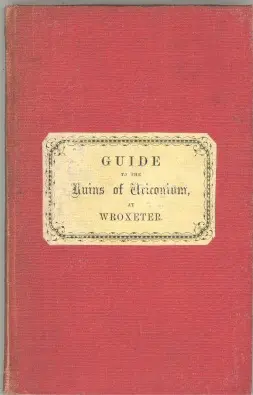
The Ruins of the Roman City of Uriconium, at Wroxeter, near Shrewsbury
Thomas Wright
THE CLASSIC COLLECTION · 1862
"A History of Domestic Manners and Sentiments in England During the Middle Ages" by Thomas Wright is a historical account written in the mid-19th century. The book seeks to provide a comprehensive look at the everyday life, customs, and thoughts of the English people during the Middle Ages, emphasizing their domestic arrangements and practices. The author aims to fill a gap in literature by creating a vivid picture of historical domestic life, juxtaposing it with modern society to illustrate how past customs have shaped contemporary manners and sentiments. At the start of the book, Wright introduces his purpose and methodology, stating that his work focuses on domestic manners and sentiments rather than the traditional histories of rulers and events. He briefly discusses the existing literature on related subjects, emphasizing the need for a cohesive view of domestic life during various historical periods. Wright outlines the structure of his work, which will explore the Anglo-Saxon period through to the Reformation, highlighting the significant transitions in social customs and practices, ultimately aiming to create an engaging narrative that draws from original research rather than previous compilations. The opening chapters promise to examine aspects such as housing, dining customs, and the furnishings of Anglo-Saxon households, setting the stage for a detailed investigation of medieval domestic life.
Introduction adapted from the source catalogue; source summaries may be automatically generated.
Free to read · English · 152,792 words · No account needed
MAKE TIME FOR A GOOD BOOK
On by default. Untick to stop anonymous reading totals. Each page counts after 10 seconds in view. How this works.
Anonymous counting is on unless you have switched it off.
In the sixteenth century, the articles of furniture in the hall continued to be much the same as in the century preceding. It continued to be furnished with hangings of tapestry, but they seem not always to have been in use; and they were still placed not absolutely against the wall, but apparently at a little distance from it, so that people might conceal themselves behind them. If the hall was not a very large one, a table was placed in the middle, with a long bench on each side. There was generally a cupboard, or a “hutch,” if not more, with side tables, one or more chairs, and perhaps a settle, according to the taste or means of the possessor. We hear now also of tables with leaves, and of folding tables, as well as of counters, or desks, for writing, and dressers, or small cupboards. The two latter articles were evidently, from their names, borrowed from the French. Cushions were also kept in the hall, for the seats of the principal persons of the household, or for the females. The furniture of the hall of William Lawson, of Newcastle-upon-Tyne, in 1551, consisted of one table of wainscot, valued at twenty shillings, two double counters, valued together at thirty shillings, a drawer and two forms, estimated at five shillings, two cushions and two chairs, also valued at five shillings, five other cushions, valued at twelve shillings, two carpet cloths and a cupboard cloth, valued together at ten shillings, and the hangings in the hall, estimated to be worth fifty shillings. This seems to have been a very well furnished hall; that of Robert Goodchild, parish clerk of St. Andrew’s in Newcastle, in 1557, contained an almery (or large cupboard), estimated at ten shillings; a counter “of the myddell bynde,” six shillings; a cupboard, three shillings and fourpence; five basins and six lavers, eight shillings; seventeen “powder (pewter) doblers,” seventeen shillings; six pewter dishes and a hand-basin, five shillings; six pewter saucers, eighteen pence; four pottle pots, five shillings and fourpence, three pint pots and three quart pots, three shillings; ten candlesticks, six shillings; a little pestle and a mortar, two shillings; three old chairs, eighteen pence; six old cushions, two shillings; and two counter-cloths. Much of the furniture of English houses at this time was imported from Flanders. Jane Lawson, in the year last mentioned, had in her hall at Little Burdon in Northumberland, “Flanders counters with their carpets.” She had also in the hall, a long side table, three long forms and another form, two chairs, three stools, six new cushions and three old cushions, and an almery. The whole furniture of the hall of the rectory house of Sedgefield in Durham, which appears to have been a large house and well entertained, consisted of a table of plane-tree with joined frame, two tables of fir with frames, two forms, a settle, and a pair of trestles. The hall of Bertram Anderson, a rich and distinguished merchant and alderman of Newcastle-upon-Tyne, in 1570, was furnished with two tables with the carpets (table-covers), three forms, one dozen cushions, half-a-dozen green cushions, one counter with the carpet, two “basinges” (basins), and two covers, one chair, and one little chair. This is a striking proof of the rarity of chairs even at this late date. Buffet stools, which are supposed to be the stools with a flat top and a hole in the middle through which the hand might be passed to lift them, are also mentioned among the articles of furniture in the hall at this period. The furniture of the hall at the manor-house of Croxdale, in the county of Durham, in the year 1571, consisted of one cupboard, one table, two buffet stools, and one chair; yet Salvin of Croxdale was looked upon as one of the principal gentry of the Palatinate. In enumerating the furniture of the ancient hall, we must not forget the arms which were usually displayed there, especially by such as had dependent upon them a certain number of men whom it was their duty or their pride to arm. The hall of a rich merchant of Newcastle, named John Wilkinson, contained in 1571, the following furniture: one almery, one table of wainscot, one counter, one little counter, one dresser of wainscot, one “pulk,” three chairs, three forms, three buffet stools, six cushions of tapestry, six old cushions of tapestry, six green cushions, two long carpet cloths, two short carpet cloths, one say carpet cloth, the “hyngars” in the hall, on the almery head one basin and ewer, one great charger, three new “doblers,” one little chest for sugar, and one pair of wainscot tables; and of arms, two jacks, three sallets of iron, one bow and two sheaves of arrows, three bills, and two halberts. Some of the entries in these inventories are amusing; and, while speaking of arms, it may be stated, that a widow lady of Bury, Mary Chapman, who would appear to have been a warlike dame, making her will in 1649, leaves to one of her sons, among other things, “also my muskett, rest, bandileers, sword, and headpiece, my jacke, a fine paire of sheets, and a hutche.” In 1577, Thomas Liddell, merchant of Newcastle, had in his hall, “three tables of waynscoot, sex qwyshons of tapestery, a cowborde, three wainscoot formes, two chayrs, three green table clothes, fower footstoles, sixe quyshons, two candlesticks, a louckinge glasse, sexe danske pootts of powther (pewter), two basings, and two vewers (ewers), a laver and a basinge, fyve buffatt stules.” It is curious thus to trace the furniture of the hall at different periods, and compare them together; and we cannot but remark from the frequency with which the epithet old is applied to different articles, towards the end of the century that the hall was beginning rapidly to fall into disuse. The cause of this was no doubt the increasing taste for domestic retirement, and the wish to withdraw from the publicity which had always attended the hall, and it gradually became the mere entrance lobby of the house, the place where strangers or others were allowed to remain until their presence had been announced, which is the sense in which we commonly use the word hall, as part of the house, at the present day. In the enumeration of the parts of a house given in the English edition of Comenius’s “Janua Linguarum,” in the middle of the seventeenth century, there is no mention of a hall. “A house,” we are told in this quaint book, “is divided into inner rooms, such as are the entry, the stove, the kitchen, the buttery, the dining-room, the gallery, the bed-chamber, with a privy made by it; baskets are of use for carrying things to and fro; and chests (which are made fast with a key) for keeping them. The floor is under the roof. In the yard is a well, a stable, and a bath. Under the house is the cellar.”
Your reading position is saved on this browser. Take it to another device with a library code. Reading pages adapt to text, rather than matching a printed edition.
BEHIND THE BOOK
This eBook is for the use of anyone anywhere in the United States and most other parts of the world at no cost and with almost no restrictions whatsoever. You may copy it, give it away or re-use it under the terms of the Project Gutenberg License included with this eBook or online at www.gutenberg.org. If you are not located in the United States, you will have to check the laws of the country where you are located before using this eBook. Read the source licence.
The original source file, including credits and licence, is retained by this library. Request an original-format copy at no charge. Please include the book title and Project Gutenberg identifier #59351.
KEEP YOUR CURIOSITY GOING
Cécile Tormay

Moritz Busch
John L. Ransom
Frances Wright
Cécile Tormay

Mabel Potter Daggett