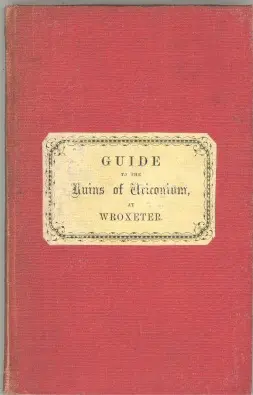
The Ruins of the Roman City of Uriconium, at Wroxeter, near Shrewsbury
Thomas Wright
THE CLASSIC COLLECTION · 1862
"A History of Domestic Manners and Sentiments in England During the Middle Ages" by Thomas Wright is a historical account written in the mid-19th century. The book seeks to provide a comprehensive look at the everyday life, customs, and thoughts of the English people during the Middle Ages, emphasizing their domestic arrangements and practices. The author aims to fill a gap in literature by creating a vivid picture of historical domestic life, juxtaposing it with modern society to illustrate how past customs have shaped contemporary manners and sentiments. At the start of the book, Wright introduces his purpose and methodology, stating that his work focuses on domestic manners and sentiments rather than the traditional histories of rulers and events. He briefly discusses the existing literature on related subjects, emphasizing the need for a cohesive view of domestic life during various historical periods. Wright outlines the structure of his work, which will explore the Anglo-Saxon period through to the Reformation, highlighting the significant transitions in social customs and practices, ultimately aiming to create an engaging narrative that draws from original research rather than previous compilations. The opening chapters promise to examine aspects such as housing, dining customs, and the furnishings of Anglo-Saxon households, setting the stage for a detailed investigation of medieval domestic life.
Introduction adapted from the source catalogue; source summaries may be automatically generated.
Free to read · English · 152,792 words · No account needed
MAKE TIME FOR A GOOD BOOK
On by default. Untick to stop anonymous reading totals. Each page counts after 10 seconds in view. How this works.
Anonymous counting is on unless you have switched it off.
The implements attached to the fireplace had hitherto been few in number, and simple in character, but they now became more numerous. In the inventories previous to the sixteenth century they are seldom mentioned at all, and the glossaries speak only of tongs and bellows. In the will of John Baret of Bury, made in 1463, “a payre of tongys and a payre belwys” are mentioned. John Hedge, a large householder of the same town in 1504, speaks of “spytts, rakks, cobernys, aundernnys, trevettes, tongs, with all other iryn werkes moveabyll within my house longying.” This would seem to show that cobirons and andirons were not identical, and it has been supposed that the former denomination belonged more particularly to the rests for supporting the spit. The schoolmaster of Bury, in 1552, bequeathed to his hostess, “my cobbornes, the fire pany (? pan), and the tonges.” If we turn to the north, we find in the collection of wills published by the Surtees Society a more frequent enumeration of the fire implements. William Blakeson, prebendary of Durham, possessed in 1549 only “a payre of cobyrons and one payre of tongys.” In 1551, William Lawson, of Newcastle-on-Tyne, had in his hall “one yryn chymney, and a poor, with one paire of tonges,” which are valued at the rather high sum of thirty shillings. This is the first mention of the iron chimney, or grate, but it occurs continually after the middle of the sixteenth century. In 1557, the “iron chymney” of the parish clerk of St. Andrew’s in Newcastle was valued at twenty shillings. The fire implements in the hall of the farm-house at West Runcton near Northallerton, in 1562, were “j. cryssett, ij. rachyncrokes, j. pair of tonges, one paire off cobyrons, j. speitt, one paire off potes.” We find the cresset frequently included among the implements attached to the fireplace. The racking-crook was the pothook. In 1564, John Bynley, minor canon of Durham, had in his hall “one iron chimney, with a bake (back), porre (a por, or poker), tongs, fier shoel (fire shovel), spette (spit), and a littell rake pertening thereto.” The fire-irons in the hall of Margaret Cottam, widow, of Gateshead, in 1564, were “one iron chimney, one porr, one payre of toynges, gibcrokes, rakincroke, and racks.” The gibcrokes was probably a sort of pothook or jack. Nearly the same list of articles occurs frequently in subsequent inventories. In 1567, a housekeeper of Durham had among other such articles “a gallous (gallows) of iron with iiij. crocks.” The gallows was, of course, the cross-bar of iron, which projected across the chimney, and from which the crooks or chains with hooks at the end for sustaining pots were suspended; as the gallows turned upon hinges, the pot could be moved over the sire, or from it, at pleasure, without being taken from the hook, and as the crooks, of which there were usually more than one, were of different lengths, the pot might be placed lower to the fire or higher from it, at will. From the character of some of these adjuncts to the fireplace, it is evident that the hall fire was frequently used for cooking. The sixteenth century was the period at which ornamentation was carried to a very high degree in every description of household utensil, and to judge from the valuation of some of these articles in the inventories, they were no doubt of elegant or elaborate work. Numerous examples of ornamental ironwork, specially applied to fire-dogs or andirons, will be found in Mr. M. A. Lower’s interesting paper on the ironworks of Sussex; and many others, still more elaborate, are preserved in some of our old gentlemen’s houses in different parts of the country; but this ornamentation was carried to a far higher degree in the great manufactories on the continent, from whence our countrymen in the sixteenth and seventeenth centuries obtained a large portion of their richer furniture. The figure in the middle of the group of fire-irons represented in our cut No. 280, is an example of a fire-dog of this elaborate description, preserved in the collection of count Brancaleoni, in Paris, whence also the other articles in the cut are taken. Most of them explain themselves; the implement to the right is a somewhat singularly formed pair of tongs; that immediately beneath the fire-dog is an instrument for moving the logs of wood which then served as fuel. As a further example of the remarkable manner in which almost every domestic article was at this period adorned, we may point out a box-iron, for ironing linen, &c. (cut No. 281), which is also preserved in one of the French collections; such an article was of course not made to be exposed to the action of the fire, and this circumstance gave rise to the contrivance of forming it into a box, with a separate iron which was to be heated and placed inside.428
Your reading position is saved on this browser. Take it to another device with a library code. Reading pages adapt to text, rather than matching a printed edition.
BEHIND THE BOOK
This eBook is for the use of anyone anywhere in the United States and most other parts of the world at no cost and with almost no restrictions whatsoever. You may copy it, give it away or re-use it under the terms of the Project Gutenberg License included with this eBook or online at www.gutenberg.org. If you are not located in the United States, you will have to check the laws of the country where you are located before using this eBook. Read the source licence.
The original source file, including credits and licence, is retained by this library. Request an original-format copy at no charge. Please include the book title and Project Gutenberg identifier #59351.
KEEP YOUR CURIOSITY GOING
Cécile Tormay

Moritz Busch
John L. Ransom
Frances Wright
Cécile Tormay

Mabel Potter Daggett