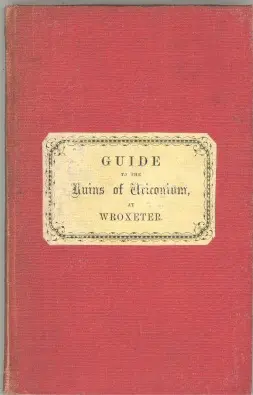
The Ruins of the Roman City of Uriconium, at Wroxeter, near Shrewsbury
Thomas Wright
THE CLASSIC COLLECTION · 1862
"A History of Domestic Manners and Sentiments in England During the Middle Ages" by Thomas Wright is a historical account written in the mid-19th century. The book seeks to provide a comprehensive look at the everyday life, customs, and thoughts of the English people during the Middle Ages, emphasizing their domestic arrangements and practices. The author aims to fill a gap in literature by creating a vivid picture of historical domestic life, juxtaposing it with modern society to illustrate how past customs have shaped contemporary manners and sentiments. At the start of the book, Wright introduces his purpose and methodology, stating that his work focuses on domestic manners and sentiments rather than the traditional histories of rulers and events. He briefly discusses the existing literature on related subjects, emphasizing the need for a cohesive view of domestic life during various historical periods. Wright outlines the structure of his work, which will explore the Anglo-Saxon period through to the Reformation, highlighting the significant transitions in social customs and practices, ultimately aiming to create an engaging narrative that draws from original research rather than previous compilations. The opening chapters promise to examine aspects such as housing, dining customs, and the furnishings of Anglo-Saxon households, setting the stage for a detailed investigation of medieval domestic life.
Introduction adapted from the source catalogue; source summaries may be automatically generated.
Free to read · English · 152,792 words · No account needed
MAKE TIME FOR A GOOD BOOK
On by default. Untick to stop anonymous reading totals. Each page counts after 10 seconds in view. How this works.
Anonymous counting is on unless you have switched it off.
Yea, sir, sette up youer saile,
And rowe fourth with evill haile,
For withouten fayle
I will not oute of this towne,
But I have my gossippes everyechone (every one)
One foote further I will not gone (go).
They shall not drowne, by Sante John,
And I maye save ther life!
They loven me full wel, by Christe!
But thout lett them into they cheiste,
Elles (otherwise) rowe nowe wher the leiste (where you like),
And gette thee a newe wiffe_.
It is to be supposed that Noah, when he wanted her, had found her with her gossips in the tavern. At last, Noah’s three sons are obliged to drag their mother into the “boat,” when a scene occurs which appears thus briefly indicated in the text,--
Noye.
Welckome, wiffe, into this botte!
Noye’s Wiffe.
Have thou that for thy note! [She beats him.]
Noye.
Ha, ha! marye, this is hotte!
It is good for to be still.
The conversation of these “gossips,” when they met, was loose and coarse in the extreme, and, as described in contemporary writings, the practice even of profane swearing prevailed generally among both sexes to a degree which, to our ears, would sound perfectly frightful--it was one of the vices against which the moralists preached most bitterly. Life, indeed, in spite of its occasional refinement in the higher ranks of society, was essentially coarse at this period, and we can hardly conceive much delicacy of people who dieted as, for instance, the family of the earl of Northumberland are reported to have done in the household book, compiled in 1512, which was published by bishop Percy. I only give the breakfast allowances, which, on flesh-days, were “for my lord and my lady,” a loaf of bread “in trenchers,” two manchets (loaves of fine meal), one quart of beer (or, as we should now call it, ale), a quart of wine, half a chine of mutton, or a chine of beef boiled; for “my lord Percy and Mr. Thomas Percy” (the two elder children), half a loaf of household bread, a manchet, one pottle of beer (two quarts--they were not yet allowed wine), a chicken, or else three mutton bones boiled; “breakfasts for the nurcery, for my lady Margaret and Mr. Ingram Percy” (who in fact were mere children), a manchet, one quart of beer, and three mutton bones boiled; for my lady’s gentlewomen, a loaf of household bread, a pottle of beer, and three mutton bones boiled, or else a piece of beef boiled. It will be seen here that the family dined two to a plate, or mess, as was the usual custom in the middle ages. On fish-days, the breakfast allowances were as follows: for my lord and my lady, a loaf of bread in trenchers, two manchets, a quart of beer, a quart of wine, two pieces of salt fish, six baked herrings, or a dish of sprats; for the two elder sons, half a loaf of household bread, a manchet, a pottle of beer, a dish of butter, a piece of salt fish, a dish of sprats, or three white (fresh) herrings; for the two children in the nursery, a manchet, a quart of beer, a dish of butter, a piece of salt fish, a dish of sprats, or three white herrings; and for my lady’s gentlewomen, a loaf of bread, a pottle of beer, a piece of salt fish, or three white herrings. We shall be inclined, in comparing it with our modern style of living, to consider this as a very substantial meal to begin the day with.
Your reading position is saved on this browser. Take it to another device with a library code. Reading pages adapt to text, rather than matching a printed edition.
BEHIND THE BOOK
This eBook is for the use of anyone anywhere in the United States and most other parts of the world at no cost and with almost no restrictions whatsoever. You may copy it, give it away or re-use it under the terms of the Project Gutenberg License included with this eBook or online at www.gutenberg.org. If you are not located in the United States, you will have to check the laws of the country where you are located before using this eBook. Read the source licence.
The original source file, including credits and licence, is retained by this library. Request an original-format copy at no charge. Please include the book title and Project Gutenberg identifier #59351.
KEEP YOUR CURIOSITY GOING
Cécile Tormay

Moritz Busch
John L. Ransom
Frances Wright
Cécile Tormay

Mabel Potter Daggett