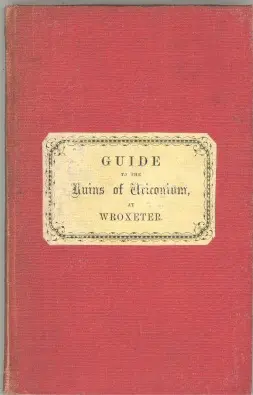
The Ruins of the Roman City of Uriconium, at Wroxeter, near Shrewsbury
Thomas Wright
THE CLASSIC COLLECTION · 1862
"A History of Domestic Manners and Sentiments in England During the Middle Ages" by Thomas Wright is a historical account written in the mid-19th century. The book seeks to provide a comprehensive look at the everyday life, customs, and thoughts of the English people during the Middle Ages, emphasizing their domestic arrangements and practices. The author aims to fill a gap in literature by creating a vivid picture of historical domestic life, juxtaposing it with modern society to illustrate how past customs have shaped contemporary manners and sentiments. At the start of the book, Wright introduces his purpose and methodology, stating that his work focuses on domestic manners and sentiments rather than the traditional histories of rulers and events. He briefly discusses the existing literature on related subjects, emphasizing the need for a cohesive view of domestic life during various historical periods. Wright outlines the structure of his work, which will explore the Anglo-Saxon period through to the Reformation, highlighting the significant transitions in social customs and practices, ultimately aiming to create an engaging narrative that draws from original research rather than previous compilations. The opening chapters promise to examine aspects such as housing, dining customs, and the furnishings of Anglo-Saxon households, setting the stage for a detailed investigation of medieval domestic life.
Introduction adapted from the source catalogue; source summaries may be automatically generated.
Free to read · English · 152,792 words · No account needed
MAKE TIME FOR A GOOD BOOK
On by default. Untick to stop anonymous reading totals. Each page counts after 10 seconds in view. How this works.
Anonymous counting is on unless you have switched it off.
Agnes Hubbard, a lady of Bury, in Suffolk, who made her will in 1418, left among other things, “one feather-bed” (unum lectum de plumis). A rich townsman of the same place bequeathed, in 1463, to his niece, “certeyne stuffe of ostilment,” among which he enumerates “my grene hanggyd bedde steynyd with my armys therin, that hanggith in the chambyr ovir kechene, with the curtynez, the grene keveryng longgyng therto; another coverlyte, ij. blanketts, ij. peyre of good shetes, the trampsoun, the costerys of that chambyr and of the drawgth chambyr next, tho that be of the same soort, a grete pilve (pillow) and a smal pilve; the fethirbeed is hire owne that hire maistresse gaf hire at London.” After enumerating other articles of different kinds, the testator proceeds--“And I geve hire the selour and the steynyd clooth of the coronacion of Our Lady, with the clothes of myn that long to the bedde that she hath loyen (lain) in, and the beddyng in the draught chamber for hire servaunth to lyn in; and a banker of grene and red lying in hire chambyr with the longe chayer (a settle, probably); and a stondyng coffre and a long coffre in the drawth chambyr.” William Honyboorn, also of Bury, bequeathed to his wife in 1493, “my best ffether bedde with the traunsome, a whyte selour and a testour theron, with iij. white curteyns therto, a coverlight white and blewe lyeng on the same bedde, with the blankettes.” The same man leaves to his daughter, “a ffether bedde next the best, a materas lyeng under the same, iiij. peyr shetys, iij. pelowes, a peyr blankettes.” John Coote, who made his will at Bury in 1502, left to his wife, for term of her life, “alle my plate, brasse, pewter, hanggynges, celers, testers, fetherbeddes, traunsoms, coverlytes, blankettes, shetes, pelows, and all other stuff of hussold (household);” and afterwards bequeaths these articles separately to his son and daughter, after their mother’s death:--“I will that William Coote have my beste hanged bede, celer, testor, and curteyns longgyng to the same, the beste fetherbede, the beste coverlyght, the beste peyer of blankettes, the beste peyer shetes; and Alys Coote to have the next hanged bede, celer, and testour, wyth the ij^{de} fetherbede, blankettes, and the ij^{de} peyer shetes.” In the will of Anne Barett, of Bury, dated in 1504, we read, “Item, I bequeth to Avyse my servaunte x. marc, a ffether bed, a traunsom, a payre shetes, a payre blankettes, a coverlyght.” Lastly, the will of Agar Herte, a widow of the same town, made in 1522, contains the following items:--“Item, I bequethe to Richard Jaxson, my son, a ffetherbed, ij. trawnsoms, a matras, ij. pelowes, iiij. payer of schetes, a payer of blankettes, and a coveryng of arasse, and a secunde coverlyght, a selour and a testour steynyd with fflowers, and iij. curteyns;” ... “Item, I bequethe to Jone Jaxson, my dowghter, a fetherbed, a matras, a bolster, ij. pelowes, iiij. payer of schetes, a payer of blankettes, a coverlyght with fflowre de lyce, a selour and a testour steynyd with Seynt Kateryn at the hed and the crusifix on the selour, ... a secunde coverlyght, ij. pelow-beris (pillow-covers), the steynyd clothes abowte the chamber where I ly;” ... “Item, I bequethe to Fraunces Wrethe a ffetherbed, a bolster, a payer of blankettes, my best carpet, a new coverlyght with fflowers, ij. payer of schetes, ij. pelows with the berys.”
Your reading position is saved on this browser. Take it to another device with a library code. Reading pages adapt to text, rather than matching a printed edition.
BEHIND THE BOOK
This eBook is for the use of anyone anywhere in the United States and most other parts of the world at no cost and with almost no restrictions whatsoever. You may copy it, give it away or re-use it under the terms of the Project Gutenberg License included with this eBook or online at www.gutenberg.org. If you are not located in the United States, you will have to check the laws of the country where you are located before using this eBook. Read the source licence.
The original source file, including credits and licence, is retained by this library. Request an original-format copy at no charge. Please include the book title and Project Gutenberg identifier #59351.
KEEP YOUR CURIOSITY GOING
Cécile Tormay

Moritz Busch
John L. Ransom
Frances Wright
Cécile Tormay

Mabel Potter Daggett