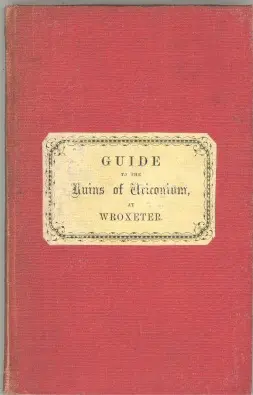
The Ruins of the Roman City of Uriconium, at Wroxeter, near Shrewsbury
Thomas Wright
THE CLASSIC COLLECTION · 1862
"A History of Domestic Manners and Sentiments in England During the Middle Ages" by Thomas Wright is a historical account written in the mid-19th century. The book seeks to provide a comprehensive look at the everyday life, customs, and thoughts of the English people during the Middle Ages, emphasizing their domestic arrangements and practices. The author aims to fill a gap in literature by creating a vivid picture of historical domestic life, juxtaposing it with modern society to illustrate how past customs have shaped contemporary manners and sentiments. At the start of the book, Wright introduces his purpose and methodology, stating that his work focuses on domestic manners and sentiments rather than the traditional histories of rulers and events. He briefly discusses the existing literature on related subjects, emphasizing the need for a cohesive view of domestic life during various historical periods. Wright outlines the structure of his work, which will explore the Anglo-Saxon period through to the Reformation, highlighting the significant transitions in social customs and practices, ultimately aiming to create an engaging narrative that draws from original research rather than previous compilations. The opening chapters promise to examine aspects such as housing, dining customs, and the furnishings of Anglo-Saxon households, setting the stage for a detailed investigation of medieval domestic life.
Introduction adapted from the source catalogue; source summaries may be automatically generated.
Free to read · English · 152,792 words · No account needed
MAKE TIME FOR A GOOD BOOK
On by default. Untick to stop anonymous reading totals. Each page counts after 10 seconds in view. How this works.
Anonymous counting is on unless you have switched it off.
Such amusements as these mentioned, with games of different kinds in which the ladies took part, and dancing, generally occupied the afternoon, from dinner to supper, the hour of which latter meal seems usually to have been six o’clock. The favourite amusement was dancing. A family party at the dance is represented in our cut No. 253, from M. Barrois’ manuscript of the “Comte d’Artois.” The numerous dances which were now in vogue seem to have completely eclipsed the old carole, or round dance, and the latter word, which was a more general one, had displaced the former. The couple here on their legs are supposed to be performing one of the new and tasteful fashionable dances, which were much more lively than those of the earlier period; some of them were so much so as to scandalise greatly the sage moralists of the time. The after-dinner amusements were resumed after supper; and a practice had now established itself of prolonging the day’s enjoyment to a late hour, and taking a second, or, as it was called, a rere-supper (arrière souper), which was called the banquet in France, where the three great meals were now the dinner, the supper, and the banquet, and dinner appears to have been considered as the least meal of the three. It was thus, probably, that, in course of time, dinner took the place of supper, and supper that of banquet.
We have a very curious illustration of the extravagant living at table of the latter half of the fifteenth century, in the curious allegorical tapestry long preserved at Nancy, in Lorrain, and said by tradition, probably with truth, to have been the ornament of the tent of Charles le Téméraire, duke of Burgundy, when he laid siege to Nancy in 1477, and was defeated and slain. It is of Flemish workmanship, and no doubt pictures the manners of the Burgundian nobles and gentry, but at that time the court of Burgundy was the model of the fashionable life of western Europe. It happens, curiously enough, that a few years later a rather obscure French writer, named Nicole de La Chesnaye, compiling one of those allegorical dramas then so popular under the title of “Moralities,” took the story of this tapestry as his subject, and has thus left us the full explanation of what might otherwise have been not easily understood. The title of this morality is “La Nef de Santé” (the ship of health), and a second title is “La condamnacion des bancquetz” (the condemnation of banquets); and its object is to show the unhappy consequences of the extravagance in eating and drinking, which then prevailed. It opens with a conversation between three allegorical personages named Dinner, Supper, and Banquet, who declare their intention to lead joyous life evening and morning, and they resolve on imitating Passe-Temps (pastime) and Bonne-Compagnie (good company). At this moment Bonne-Compagnie herself, who is described as a dashing damsel (gorrière damoiselle), enters with all her people, namely, Gourmandize (greediness), Friandize (daintiness), Passe-Temps, already mentioned, Je-Boy-à-Vous (I drink to you), Je-Pleige-d’Autant (I pledge the same), and Acoustumance (custom). Each names what he prefers in good cheer, and Bonne-Compagnie, to begin the day, orders a collation, at which, among other things, are served damsons (prunes de Damas), which appear at this time to have been considered as delicacies. There is here a marginal direction to the purport that, if the morality should be performed in the season when real damsons could not be had, the performers must have some made of wax to look like real ones. They now take their places at table, and, while they are eating, Je-Boy-à-Vous calls the attention of the company to the circumstance that Gourmandize, in his haste to eat the damsons, had swallowed a snail. Passe-Temps next proposes a dance, and chooses for his partner the lady Friandize, comparing her to Helen, and telling her that he was Paris. She, in reply, compares herself to Medea, and her partner to Jason. Then the musicians, “placed on a stage or some higher place,” are to play a measure “pretty short.” Dinner, Supper, and Banquet next make their appearance, and, addressing Bonne-Compagnie, make their apology for entering without being invited; but the lady receives them well, asks their names, and, in return, tells them those of her people. Dinner, to show his gratitude for this friendly reception, invites the whole party to go to his feast, which is just ready; and Supper invites them to a second repast, and Banquet to a third. They accept the invitation of Dinner, and are served with friture, brouet, potage, gros pâtés, &c. Meanwhile Supper and Banquet look upon the party from “some high window,” and converse on the consequences likely to follow their excesses. This scene is represented in the first compartment of the tapestry, as it now exists (for it has undergone considerable mutilation), and is represented in our cut No. 254. It is a good picture of a seignorial repast of the fifteenth century. There are people at table, besides those enumerated in the morality, who are here indicated by their names: Passe-Temps at one end of the table, a lady to his left, and after her Je-Boy-à-Vous, who has Bonne-Compagnie by his side, and to her left Dinner, the host. To the right of Passe-Temps sits the lady Gourmandize, and to her right Je-Vous-Pleige (I pledge you), and next to him Friandize. The cups in which they are drinking are flat-shaped, and appear, by the colours in the original, to be of glass, with the brims, and other parts in some, gilt. The minstrels, in the gallery, are playing with trumpets. Among the attendants, we see the court fool, with his bauble, who had now become an ordinary, and almost a necessary, personage in the household of the rich; it was the result of an increasing taste for the coarse buffoonery which characterised an unrefined state of society. The court fool was licensed to utter with impunity whatever came to his thought, however mordant or however indecent. Beside him are two valets with dogs, which appear to have been usually admitted to the hall, and to have eaten the refuse on the spot. A window above gives us a view of the country, with buildings in the distance, and Supper and Banquet looking in upon the company. An inscription in the upper corner to the right tells us how these two personages came slyly to look at the assembly, and how through envy they conspired to take vengeance upon the feasters--
Your reading position is saved on this browser. Take it to another device with a library code. Reading pages adapt to text, rather than matching a printed edition.
BEHIND THE BOOK
This eBook is for the use of anyone anywhere in the United States and most other parts of the world at no cost and with almost no restrictions whatsoever. You may copy it, give it away or re-use it under the terms of the Project Gutenberg License included with this eBook or online at www.gutenberg.org. If you are not located in the United States, you will have to check the laws of the country where you are located before using this eBook. Read the source licence.
The original source file, including credits and licence, is retained by this library. Request an original-format copy at no charge. Please include the book title and Project Gutenberg identifier #59351.
KEEP YOUR CURIOSITY GOING
Cécile Tormay

Moritz Busch
John L. Ransom
Frances Wright
Cécile Tormay

Mabel Potter Daggett