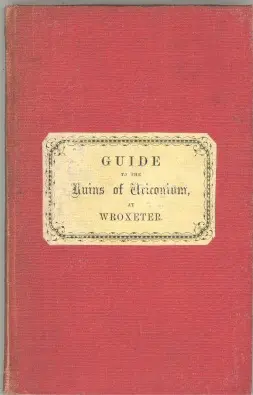
The Ruins of the Roman City of Uriconium, at Wroxeter, near Shrewsbury
Thomas Wright
THE CLASSIC COLLECTION · 1862
"A History of Domestic Manners and Sentiments in England During the Middle Ages" by Thomas Wright is a historical account written in the mid-19th century. The book seeks to provide a comprehensive look at the everyday life, customs, and thoughts of the English people during the Middle Ages, emphasizing their domestic arrangements and practices. The author aims to fill a gap in literature by creating a vivid picture of historical domestic life, juxtaposing it with modern society to illustrate how past customs have shaped contemporary manners and sentiments. At the start of the book, Wright introduces his purpose and methodology, stating that his work focuses on domestic manners and sentiments rather than the traditional histories of rulers and events. He briefly discusses the existing literature on related subjects, emphasizing the need for a cohesive view of domestic life during various historical periods. Wright outlines the structure of his work, which will explore the Anglo-Saxon period through to the Reformation, highlighting the significant transitions in social customs and practices, ultimately aiming to create an engaging narrative that draws from original research rather than previous compilations. The opening chapters promise to examine aspects such as housing, dining customs, and the furnishings of Anglo-Saxon households, setting the stage for a detailed investigation of medieval domestic life.
Introduction adapted from the source catalogue; source summaries may be automatically generated.
Free to read · English · 152,792 words · No account needed
MAKE TIME FOR A GOOD BOOK
On by default. Untick to stop anonymous reading totals. Each page counts after 10 seconds in view. How this works.
Anonymous counting is on unless you have switched it off.
Take the ribs of a boar, while they are fresh, and parboil them till they are half boiled; then roast them, and, when they are roasted, chop them, and put them in a pot with good fresh beef broth and wine, and add cloves, maces, pines, currants, and powdered pepper; then put chopped onions in a pan, with fresh grease, fry them first and then boil them; next, take bread, steeped in broth, “draw it up” and put it to the onions, and colour it with sandal-wood and saffron, and as it settles, put a little vinegar mixed with powdered cinnamon to it; then take brawn, and cut it into slices two inches long, and throw it into the pot with the foregoing, and serve it all up together.
Raffyolys were a sort of patties, made as follows:--
Take swine’s flesh, seethe it, chop it small, add to it yolks of eggs, and mix them well together; put to this a little minced lard, grated cheese, powdered ginger, and cinnamon; make of this balls of the size of an apple, and wrap them up in the cawl of the swine, each ball by itself; make a raised crust of dough, and put the ball in it, and bake it; when they are baked, take yolks of eggs well beaten, with sugar and pepper, coloured with saffron, and pour this mixture over them.
Flampoyntes were made thus:--
Take good “interlarded” pork, seethe it, and chop it, and grind it small; put to it good fat cheese grated, and sugar and pepper; put this in raised paste like the preceding; then make a thin leaf of dough, out of which cut small “points,” fry these in grease, and then stick them in the foregoing mixture after it has been put in the crust, and bake it.
Such was a tolerably respectable dinner at the end of the fourteenth century; but the same treatise gives us the following bill of fare, for a larger dinner, though still arranged in three courses:--
First Course.
Browet farsed, and charlet, for pottage. Baked mallard. Teals. Small birds. Almond milk served with them. Capon roasted with the syrup. Roasted veal. Pig roasted “‘endored,’ and served with the yolk on his neck over gilt.” Herons. A “leche.” A tart of flesh.
Second Course.
Browet of Almayne and Viaunde rial for pottage. Mallard. Roasted rabbits. Pheasant. Venison. Jelly. A leche. Urchynnes (hedgehogs). Pome de orynge.
Third Course.
Boar in egurdouce, and Mawmené, for pottage. Cranes. Kid. Curlew. Partridge. (All roasted.) A leche. A crustade. A peacock endored and roasted, and served with the skin. Cockagris. Flaumpoyntes. Daryoles. Pears in syrup.
Your reading position is saved on this browser. Take it to another device with a library code. Reading pages adapt to text, rather than matching a printed edition.
BEHIND THE BOOK
This eBook is for the use of anyone anywhere in the United States and most other parts of the world at no cost and with almost no restrictions whatsoever. You may copy it, give it away or re-use it under the terms of the Project Gutenberg License included with this eBook or online at www.gutenberg.org. If you are not located in the United States, you will have to check the laws of the country where you are located before using this eBook. Read the source licence.
The original source file, including credits and licence, is retained by this library. Request an original-format copy at no charge. Please include the book title and Project Gutenberg identifier #59351.
KEEP YOUR CURIOSITY GOING
Cécile Tormay

Moritz Busch
John L. Ransom
Frances Wright
Cécile Tormay

Mabel Potter Daggett