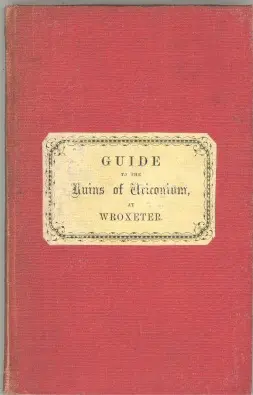
The Ruins of the Roman City of Uriconium, at Wroxeter, near Shrewsbury
Thomas Wright
THE CLASSIC COLLECTION · 1862
"A History of Domestic Manners and Sentiments in England During the Middle Ages" by Thomas Wright is a historical account written in the mid-19th century. The book seeks to provide a comprehensive look at the everyday life, customs, and thoughts of the English people during the Middle Ages, emphasizing their domestic arrangements and practices. The author aims to fill a gap in literature by creating a vivid picture of historical domestic life, juxtaposing it with modern society to illustrate how past customs have shaped contemporary manners and sentiments. At the start of the book, Wright introduces his purpose and methodology, stating that his work focuses on domestic manners and sentiments rather than the traditional histories of rulers and events. He briefly discusses the existing literature on related subjects, emphasizing the need for a cohesive view of domestic life during various historical periods. Wright outlines the structure of his work, which will explore the Anglo-Saxon period through to the Reformation, highlighting the significant transitions in social customs and practices, ultimately aiming to create an engaging narrative that draws from original research rather than previous compilations. The opening chapters promise to examine aspects such as housing, dining customs, and the furnishings of Anglo-Saxon households, setting the stage for a detailed investigation of medieval domestic life.
Introduction adapted from the source catalogue; source summaries may be automatically generated.
Free to read · English · 152,792 words · No account needed
MAKE TIME FOR A GOOD BOOK
On by default. Untick to stop anonymous reading totals. Each page counts after 10 seconds in view. How this works.
Anonymous counting is on unless you have switched it off.
A traveller, indeed, had many things to carry with him. He took provisions with him, or was obliged, at times, to reckon on what he could kill, or obtain undressed, and hence he was obliged to carry cooking apparatus with him. He carried flint and steel to strike a light, and be able to make a fire, as he might have to bivouac in a solitary place, or in the midst of a forest. In the romance of “Garin le Loherain,” when the count Begues of Belin finds himself benighted in the forest, he prepares for passing the night comfortably, and, as a matter of course, draws out his flint (fusil), and lights a fire:--
Et li quens est desous l’arbre ramé;
Prent son fusil, s’a le fu alumé,
Grant et plenier, merveilleus embrasé.
--Garin le Loherain, ii., p. 231.
The traveller also often carried materials for laying a bed, if benighted on the road; and he had, above all, to take sufficient money with him in specie. He sometimes also carried a portable tent with him, or materials for making one. In the English romance of “Ipomydon” (Weber, ii. 343), the maiden messenger of the heiress of Calabria carries her tent with her, and usually lodges at night under it--
As they rode by the way,
The mayde to the dwarfe gan saye,
“Undo my tente, and sette it faste,
For here a whyle I wille me ryste.”
Mete and drynke bothe they had,
That was fro home with them lad.
It may be remarked that in this story the first thought of every gallant knight who passes is to treat the lady with violence. All these incumbrances, combined with the badness of the roads, rendered travelling slow--of which we might quote abundant examples. At the end of the twelfth century, it took Giraldus Cambrensis four days to travel from Powisland to Haughmond Abbey, near Shrewsbury. The roads, too, were infested with robbers and banditti, and travellers were only safe in their numbers, and in being sufficiently well armed to repel attacks. In the accompanying cut (No. 219), from a manuscript of the fourteenth century (MS. Reg. 10 E. iv.), a traveller is taking his repose under a tree,--it is, perhaps, intended to be understood that he is passing the night in a wood,--while he is plundered by robbers, who are here jokingly represented in the forms of monkeys. While one is emptying his “male” or box, the other is carrying off his girdle, with the large pouch attached to it, in which, no doubt, the traveller carried his money, and perhaps his eatables. The insecurity of the roads in the middle ages was, indeed, very great, for not only were the forests filled with bands of outlaws, who stripped all who fell into their hands, but the knights and landed gentry, and even noblemen, took to the highways not unfrequently, and robbed unscrupulously. Moreover, they built their castles near difficult passes, or by a river where there was a bridge or ford, and where, therefore, they commanded it, and there they levied arbitrary taxes on all who passed, and, on the slightest attempt at resistance, plundered the traveller of his property, and put him to death or threw him into their dungeons. Incidents of this kind are common in the mediæval romances and stories. Piers de Bruville, in the history of Fulke Fitz-Warine, may be mentioned as an example of this class of marauders. “At that time,” says the story, “there was a knight in the country who was called Piers de Bruville. This Piers used to collect all the sons of gentlemen of the country who were wild, and other ribald people, and used to go about the country, and slew and robbed loyal people, merchants, and others.” In the fabliau of the “Chevalier au Barizel,” we are told of a great baron who issued continually from his strong castle to plunder the country around. “He watched so closely the roads, that he slew all the pilgrims, and plundered the merchants; many of them he brought to mishap. He spared neither clergy nor monk, recluse, hermit, or canon; and the nuns and lay-sisters he caused to live in open shame, when he had them in his power; and he spared neither dames nor maids, of whatever rank or class, whether poor or rich, or well educated or simple, but he put them all to open shame” (Barbazan, i. 209).
Your reading position is saved on this browser. Take it to another device with a library code. Reading pages adapt to text, rather than matching a printed edition.
BEHIND THE BOOK
This eBook is for the use of anyone anywhere in the United States and most other parts of the world at no cost and with almost no restrictions whatsoever. You may copy it, give it away or re-use it under the terms of the Project Gutenberg License included with this eBook or online at www.gutenberg.org. If you are not located in the United States, you will have to check the laws of the country where you are located before using this eBook. Read the source licence.
The original source file, including credits and licence, is retained by this library. Request an original-format copy at no charge. Please include the book title and Project Gutenberg identifier #59351.
KEEP YOUR CURIOSITY GOING
Cécile Tormay

Moritz Busch
John L. Ransom
Frances Wright
Cécile Tormay

Mabel Potter Daggett