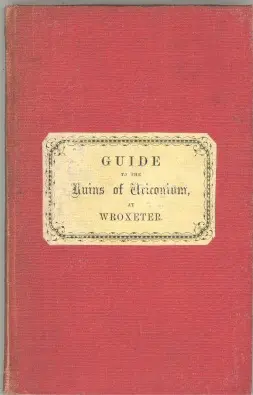
The Ruins of the Roman City of Uriconium, at Wroxeter, near Shrewsbury
Thomas Wright
THE CLASSIC COLLECTION · 1862
"A History of Domestic Manners and Sentiments in England During the Middle Ages" by Thomas Wright is a historical account written in the mid-19th century. The book seeks to provide a comprehensive look at the everyday life, customs, and thoughts of the English people during the Middle Ages, emphasizing their domestic arrangements and practices. The author aims to fill a gap in literature by creating a vivid picture of historical domestic life, juxtaposing it with modern society to illustrate how past customs have shaped contemporary manners and sentiments. At the start of the book, Wright introduces his purpose and methodology, stating that his work focuses on domestic manners and sentiments rather than the traditional histories of rulers and events. He briefly discusses the existing literature on related subjects, emphasizing the need for a cohesive view of domestic life during various historical periods. Wright outlines the structure of his work, which will explore the Anglo-Saxon period through to the Reformation, highlighting the significant transitions in social customs and practices, ultimately aiming to create an engaging narrative that draws from original research rather than previous compilations. The opening chapters promise to examine aspects such as housing, dining customs, and the furnishings of Anglo-Saxon households, setting the stage for a detailed investigation of medieval domestic life.
Introduction adapted from the source catalogue; source summaries may be automatically generated.
Free to read · English · 152,792 words · No account needed
MAKE TIME FOR A GOOD BOOK
On by default. Untick to stop anonymous reading totals. Each page counts after 10 seconds in view. How this works.
Anonymous counting is on unless you have switched it off.
Hawking was a favourite recreation with the ladies, and in the illuminated manuscripts they often figure in scenes of this kind. Sometimes they are on foot, as in the group represented in our cut No. 203, taken from a manuscript in the British Museum (MS. Reg. 2 B. vii.). One lady has let go her hawk, which is in the act of striking a heron; the other retains her hawk on her hand. The latter, as will be seen, is hooded. Each of the ladies who possess hawks has one glove only--the hawk’s glove; the other hand is without gloves. They took with them, as shown here, dogs in couples to start the game. The dogs used for this purpose were spaniels, and the old treatise on domestic affairs entitled “Le Ménagier de Paris,” gives particular directions for choosing them. In the illuminations, hawking parties are more frequently represented on horseback than on foot; and often there is a mixture of riders and pedestrians. The treatise just referred to directs that the horse for hawking should be a low one, easy to mount and dismount, and very quiet, that he may go slowly, and show no restiveness. Hawking appears to have commenced at the beginning of August; and until the middle of that month it was confined almost entirely to partridges. Quails, we are told, came in in the middle of August, and from that time forward everything seems to have been considered game that came to hand, for when other birds fail, the ladies are told that they may hunt fieldfares, and even jays and magpies. September and October were the busiest hawking months.
Hawking was, indeed, a favourite diversion with the ladies, and they not only accompanied the gentlemen to this sport, but frequently engaged in it alone. The hawking of the ladies, however, appears to have been especially that of herons and water-fowl; and this was called going to the river (aller en rivière), and was very commonly pursued on foot. It may be mentioned that the fondness of the ladies for the diversion of hawking is alluded to in the twelfth century by John of Salisbury. The hawking on the river, indeed, seems to have been that particular branch of the sport which gave most pleasure to all classes, and it is that which is especially represented in the drawings in the Anglo-Saxon manuscripts. Dogs were commonly used in hawking to rouse the game in the same manner as at the present day, but in hawking on the river, where dogs were of course less effective, other means were adopted. In a manuscript already quoted in the present chapter (MS. Reg. 2 B. vii.), of the beginning of the fourteenth century, a group of ladies hawking on the banks of a river are accompanied by a man, perhaps the falconer, who makes a noise to rouse the water-fowl. Our cut No. 204 is taken from a very interesting manuscript of the fourteenth century, made for the monastery of St. Bartholomew, in Smithfield, and now preserved in the library of the British Museum (MS. Reg. 10 E. iv.); it is part of a scene in which ladies are hawking on a river, and a female is rousing the water-fowl with a tabor. The fountain is one of those conventional objects by which the mediæval artist indicated a spring, or running stream. This seems to have been a very common method of rousing the game; and it is represented in one of the carved seats, or misereres (as they have been termed technically), in Gloucester cathedral, which is copied in our cut No. 205. This scene is rather curiously illustrated by an anecdote told by an old chronicler, Ralph de Diceto, of a man who went to the river to hunt teal with his hawk, and roused them with “what is called by the river-hawkers a tabor.”[49] The tending of the hawks used in these diversions was no slight occupation in the mediæval household, and was the subject of no little study; they were cherished with the utmost care, and carried about familiarly on the wrist in all places and under all sorts of circumstances. It was a common practice, indeed, to go to church with the hawk on the wrist. One of the early French poets, Gaces de la Buigne, who wrote a metrical treatise on hunting in the middle of the fourteenth century, advises his readers to carry their hawks with them wherever there were assemblies of people, whether in churches or elsewhere--
Your reading position is saved on this browser. Take it to another device with a library code. Reading pages adapt to text, rather than matching a printed edition.
BEHIND THE BOOK
This eBook is for the use of anyone anywhere in the United States and most other parts of the world at no cost and with almost no restrictions whatsoever. You may copy it, give it away or re-use it under the terms of the Project Gutenberg License included with this eBook or online at www.gutenberg.org. If you are not located in the United States, you will have to check the laws of the country where you are located before using this eBook. Read the source licence.
The original source file, including credits and licence, is retained by this library. Request an original-format copy at no charge. Please include the book title and Project Gutenberg identifier #59351.
KEEP YOUR CURIOSITY GOING
Cécile Tormay

Moritz Busch
John L. Ransom
Frances Wright
Cécile Tormay

Mabel Potter Daggett