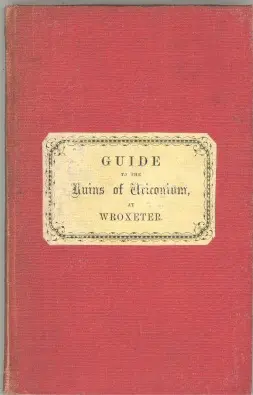
The Ruins of the Roman City of Uriconium, at Wroxeter, near Shrewsbury
Thomas Wright
THE CLASSIC COLLECTION · 1862
"A History of Domestic Manners and Sentiments in England During the Middle Ages" by Thomas Wright is a historical account written in the mid-19th century. The book seeks to provide a comprehensive look at the everyday life, customs, and thoughts of the English people during the Middle Ages, emphasizing their domestic arrangements and practices. The author aims to fill a gap in literature by creating a vivid picture of historical domestic life, juxtaposing it with modern society to illustrate how past customs have shaped contemporary manners and sentiments. At the start of the book, Wright introduces his purpose and methodology, stating that his work focuses on domestic manners and sentiments rather than the traditional histories of rulers and events. He briefly discusses the existing literature on related subjects, emphasizing the need for a cohesive view of domestic life during various historical periods. Wright outlines the structure of his work, which will explore the Anglo-Saxon period through to the Reformation, highlighting the significant transitions in social customs and practices, ultimately aiming to create an engaging narrative that draws from original research rather than previous compilations. The opening chapters promise to examine aspects such as housing, dining customs, and the furnishings of Anglo-Saxon households, setting the stage for a detailed investigation of medieval domestic life.
Introduction adapted from the source catalogue; source summaries may be automatically generated.
Free to read · English · 152,792 words · No account needed
MAKE TIME FOR A GOOD BOOK
On by default. Untick to stop anonymous reading totals. Each page counts after 10 seconds in view. How this works.
Anonymous counting is on unless you have switched it off.
The earliest account of an English garden is given by Alexander Neckam, who flourished in the latter half of the twelfth century, in the sixty-sixth chapter of the second book of his treatise, De naturis rerum, which exists only in manuscripts (I quote from one in the British Museum, MS. Reg. 12 G. xi.). He introduces at least one plant, the mandrake, which was fabulous, and gives several names which I shall be obliged to leave in his original Latin, as, perhaps through corruption of the text, I cannot interpret them, but there can be little doubt that it is in general a correct enumeration of the plants and trees cultivated in a complete English garden of the period. “A garden,” he says, “should be adorned on this part with roses, lilies, the marigold, molis, and mandrakes, and on that part with parsley, cost, fennel, southernwood, coriander, sage, savery, hyssop, mint, rue, dittany, smallage, pellitory, lettuce, cresses, ortulano, and the piony. Let there also be beds (areæ) enriched with onions, leeks, garlic, melons, and scallions (hinnuilis). The garden is also ennobled by the cucumber which creeps on its belly, and by the soporiferous poppy, as well as by the daffodil and the acanthus. Nor let pot-herbs be wanting, if you can help it, such as beets, herb mercury, orache, the acedula, (sorrel?) and the mallow. It is useful also to the gardener to have anise, mustard, white pepper, and wormwood.” Neckam then goes on to the fruit-trees. “A noble garden,” he says, “will give you medlars, quinces, the pearmain (volema), peaches, pears of St. Regle, pomegranates, citrons (or lemons), oranges, almonds, dates, and figs.” When Neckam speaks of a “noble garden,” he of course speaks of that of a great baron or prince, and enumerates fruits of choice, and mostly above the common range. Medlars and quinces were formerly held in great esteem, and much used. I have ventured to interpret volema as meaning the pearmain, which was considered one of the choicest apples, as the apple is not mentioned in the list, and as in one of the early glossaries that meaning is attached to the word. Peaches were, as we have seen, known to the Anglo-Saxons; and in 1276 we find slips of peach-trees mentioned in an official record as planted in the king’s garden at Westminster. The pear of St. Regle was one of the choice kinds of pears brought from France, and it and several other kinds of pears are enumerated in the accounts of the earl of Lincoln’s garden in Holborn (London) in 1296. It is rather surprising that Mr. Hudson Turner, in his very valuable volume on domestic architecture, where he supposes that mala aurea in Neckam’s list were intended for the golden apples of the Hesperides, should not have known that the malum aureum of the middle ages was the orange. Pomegranates, citrons, oranges, almonds, dates, and figs, are known to have been cultivated in England at different periods, but it is not probable that the fruit came often to perfection. It may be remarked that Neckam gives a separate chapter to the cultivation of the vine, which belonged to the vineyard, and not to the garden. After an enumeration of plants which were not grown in Western Europe, Neckam gives a list of others, known for their medicinal qualities, some of which can hardly have been planted in a garden, unless it belonged to a physician; although it appears to have been the custom to devote a corner of the garden to the medicinal plants most in use, in order that they might be ready at hand when wanted. The gardener’s tools in the twelfth century, as enumerated by Neckam in his treatise De Utensilibus, were few and simple; he had an axe, or twibill, a knife for grafting, a spade, and a pruning-hook.
Your reading position is saved on this browser. Take it to another device with a library code. Reading pages adapt to text, rather than matching a printed edition.
BEHIND THE BOOK
This eBook is for the use of anyone anywhere in the United States and most other parts of the world at no cost and with almost no restrictions whatsoever. You may copy it, give it away or re-use it under the terms of the Project Gutenberg License included with this eBook or online at www.gutenberg.org. If you are not located in the United States, you will have to check the laws of the country where you are located before using this eBook. Read the source licence.
The original source file, including credits and licence, is retained by this library. Request an original-format copy at no charge. Please include the book title and Project Gutenberg identifier #59351.
KEEP YOUR CURIOSITY GOING
Cécile Tormay

Moritz Busch
John L. Ransom
Frances Wright
Cécile Tormay

Mabel Potter Daggett