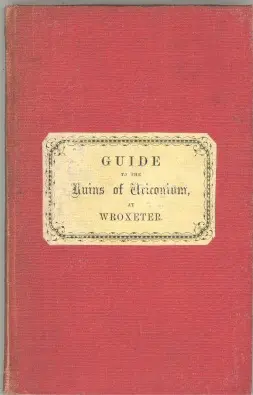
The Ruins of the Roman City of Uriconium, at Wroxeter, near Shrewsbury
Thomas Wright
THE CLASSIC COLLECTION · 1862
"A History of Domestic Manners and Sentiments in England During the Middle Ages" by Thomas Wright is a historical account written in the mid-19th century. The book seeks to provide a comprehensive look at the everyday life, customs, and thoughts of the English people during the Middle Ages, emphasizing their domestic arrangements and practices. The author aims to fill a gap in literature by creating a vivid picture of historical domestic life, juxtaposing it with modern society to illustrate how past customs have shaped contemporary manners and sentiments. At the start of the book, Wright introduces his purpose and methodology, stating that his work focuses on domestic manners and sentiments rather than the traditional histories of rulers and events. He briefly discusses the existing literature on related subjects, emphasizing the need for a cohesive view of domestic life during various historical periods. Wright outlines the structure of his work, which will explore the Anglo-Saxon period through to the Reformation, highlighting the significant transitions in social customs and practices, ultimately aiming to create an engaging narrative that draws from original research rather than previous compilations. The opening chapters promise to examine aspects such as housing, dining customs, and the furnishings of Anglo-Saxon households, setting the stage for a detailed investigation of medieval domestic life.
Introduction adapted from the source catalogue; source summaries may be automatically generated.
Free to read · English · 152,792 words · No account needed
MAKE TIME FOR A GOOD BOOK
On by default. Untick to stop anonymous reading totals. Each page counts after 10 seconds in view. How this works.
Anonymous counting is on unless you have switched it off.
Donques enmainne le bon Danois Ogier,
E Gloriande, qui par le doit le tient._
--Roman d’Ogier, p. 110.
So, in the romance of “La Violette,” at the festivities given by the king, the guests “distributed themselves in couples in the hall (i. e. a gentleman with a lady), one taking the other by the finger, and so they arranged themselves two and two”--
Quant il orent assés deduit,
Par la sale s’acoinsent tuit;
Li uns prent l’autre par le doi,
Si s’arangierent doi et doi.
--Roman de la Violette, p. 10.
In the curious poem entitled “La Court de Paradis,” the sainted ladies in heaven are represented as thus walking and holding each other by the finger,--
L’une tint l’autre par les dois.
--Barbazan, iii. 139.
As a mark of great familiarity, two princes, Pepin’s son, Charles, and the duke Namles, are represented in the romance of “Ogier” as one, Charles, holding his hand on the duke’s shoulder, while the duke held him by his mantle, as they walked along; they were going to church together:--
Kalles sa main li tint desus l’espaule;
Namles tint lui par le mantel de paile.
--Roman d’Ogier, p. 143.
It may be remarked that sitting was equally a matter of etiquette with walking, though we sometimes meet with ladies and gentlemen seated in a manner which is anything but ceremonious. In the annexed cut (No. 198), taken from a manuscript of the fourteenth century, the reference to which I have unfortunately lost, a number of ladies, seated on the ground, and apparently in the open air, are listening to the admonitions of an episcopal preacher.
As I have introduced the subject of the love of our forefathers for trees and flowers, some account of gardening in the middle ages will not be out of place, especially as what has hitherto been written on the history of gardening in England during this early period, has been very imperfect and incorrect. We have no direct information relating to the gardens of our Anglo-Saxon forefathers--in fact, our knowledge is limited to a few words gathered from the old vocabularies. The ordinary names for a garden, wyrt-tun and wyrt-geard, a plant-inclosure and a plant-yard, are entirely indefinite, for the word wyrt was applied to all plants whatever, and perhaps they indicate what we should call the kitchen-garden. The latter word, which was sometimes spelt ort-geard, orc-geard, and orcyrd, was the origin of our modern orchard, which is now limited to an inclosure of fruit-trees. Flowers were probably cultivated in the inclosed space round the houses. It would appear that the Saxons, before they became acquainted with the Romans, cultivated very few plants, if we may judge from the circumstance that throughout the Anglo-Saxon period the names by which these were known were nearly all derived from the Latin. The leek appears to have been the principal table vegetable among the Anglo-Saxons, as it was among the Welsh its name, leac, or leah, is pure Anglo-Saxon, and its importance was considered so much above that of any other vegetable, that leac-tun, the leek-garden, became the common name for the kitchen-garden, and leac-weard, a leek-keeper, was used to designate the gardener. The other alliaceous plants were considered as so many varieties of the leek, and were known by such names as enne-leac, or ynne-leac, supposed to be the onion, and gar-leac, or garlic. Bean is also an Anglo-Saxon word; but, singularly enough, the Anglo-Saxons seem not to have been originally acquainted with peas, for the only name they had for them was the Latin pisa, and pyse. Even for the cabbage tribe, the only Anglo-Saxon name we know is simply the Latin brassica; and the colewort, which was named cawl, and cawl-wyrt, was derived from the Latin caulis. So the turnip was called næpe, from the Latin napus; and rædic, or radish, is perhaps from raphanus.[29] Garden cresses, parsley, mint, sage, rue, and other herbs,[30] were in use, but mostly, except the cresses, with Latin names.
Your reading position is saved on this browser. Take it to another device with a library code. Reading pages adapt to text, rather than matching a printed edition.
BEHIND THE BOOK
This eBook is for the use of anyone anywhere in the United States and most other parts of the world at no cost and with almost no restrictions whatsoever. You may copy it, give it away or re-use it under the terms of the Project Gutenberg License included with this eBook or online at www.gutenberg.org. If you are not located in the United States, you will have to check the laws of the country where you are located before using this eBook. Read the source licence.
The original source file, including credits and licence, is retained by this library. Request an original-format copy at no charge. Please include the book title and Project Gutenberg identifier #59351.
KEEP YOUR CURIOSITY GOING
Cécile Tormay

Moritz Busch
John L. Ransom
Frances Wright
Cécile Tormay

Mabel Potter Daggett