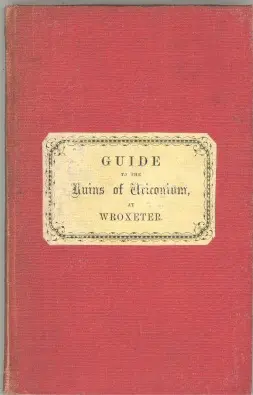
The Ruins of the Roman City of Uriconium, at Wroxeter, near Shrewsbury
Thomas Wright
THE CLASSIC COLLECTION · 1862
"A History of Domestic Manners and Sentiments in England During the Middle Ages" by Thomas Wright is a historical account written in the mid-19th century. The book seeks to provide a comprehensive look at the everyday life, customs, and thoughts of the English people during the Middle Ages, emphasizing their domestic arrangements and practices. The author aims to fill a gap in literature by creating a vivid picture of historical domestic life, juxtaposing it with modern society to illustrate how past customs have shaped contemporary manners and sentiments. At the start of the book, Wright introduces his purpose and methodology, stating that his work focuses on domestic manners and sentiments rather than the traditional histories of rulers and events. He briefly discusses the existing literature on related subjects, emphasizing the need for a cohesive view of domestic life during various historical periods. Wright outlines the structure of his work, which will explore the Anglo-Saxon period through to the Reformation, highlighting the significant transitions in social customs and practices, ultimately aiming to create an engaging narrative that draws from original research rather than previous compilations. The opening chapters promise to examine aspects such as housing, dining customs, and the furnishings of Anglo-Saxon households, setting the stage for a detailed investigation of medieval domestic life.
Introduction adapted from the source catalogue; source summaries may be automatically generated.
Free to read · English · 152,792 words · No account needed
MAKE TIME FOR A GOOD BOOK
On by default. Untick to stop anonymous reading totals. Each page counts after 10 seconds in view. How this works.
Anonymous counting is on unless you have switched it off.
I. jor sist es chambres son pere,
Une estole et i. amit pere
De soie et d’or molt soutilment,
Si i fait ententevement
Mainte croisete et mainte estoile,
Et dist ceste chanchon à toile.
--Roman de la Violette, p. 113.
In one of Rutebeuf’s fabliaux, a woman makes excuse for being up late at night that she was anxious to finish a piece of linen cloth she was weaving:--
Sire, fet-elle, il me faut traimer
A une toile que je fais.
And in another fabliau, that of “Guillaume au Faucon,” a young “bacheler” entering suddenly the chamber of the ladies, finds them all occupied in embroidering a piece of silk with the ensigns of the lord of the castle. Embroidery, indeed, was a favourite occupation: a lady thus employed is represented in our cut No. 168, taken from a richly illuminated manuscript of the fourteenth century, in the British Museum (MS. Reg. 2 B. vii.) The ladies, too, not only made up the cloths into dresses and articles of other kinds, but they were extensively employed in the various processes of making the cloth itself. Our cut No. 169, taken from a manuscript of about the same period (MS. Reg. 10 E. iv.), represents the process of carding the wool; and the same manuscript furnishes us with another cut (No. 170), in which a lady appears in the employment of spinning it into yarn. Our next cut (No. 171), taken from an illumination in an early French translation of the Metamorphoses of Ovid (in the National Library, MS. 6986), represents three ladies (intended for the three Fates) employed in these domestic occupations, and will give us a notion of the implements they used.
Domestic animals, particularly dogs and birds, were favourite companions of the ladies in their chambers. A favourite falcon had frequently its “perche” in a corner of the chamber; and in the illuminations we sometimes see the lady seated with the bird on her wrist. Birds in cages are also not unfrequently alluded to through the thirteenth and fourteenth centuries. In the romance of “La Violette” a tame lark plays rather an important part in the story. Our cut No. 172, where we see two birds in a cage together, and which is curious for the form of the cage, is given by Willemin from a manuscript of the fourteenth century at Paris. The hawk, though usually kept only for hunting, sometimes became a pet, and persons carried their hawks on the fist even in social parties within doors. The jay is spoken of as a cage-bird. The parrot, under the name of papejay, popinjay, or papingay, is also often spoken of during the middle ages, although, in all probability, it was very rare. The favourite talking-bird was the pie, or magpie, which often plays a very remarkable part in mediæval stories. The aptness of this bird for imitation led to an exaggerated estimate of its powers, and it is frequently made to give information to the husband of the weaknesses of his wife. Several mediæval stories turn upon this supposed quality. The good chevalier de la Tour-Landry, in his book of counsels to his daughters, composed in the second half of the fourteenth century, tells a story of a magpie as a warning of the danger of indulging in gluttony. “I will tell you,” he says, “a story in regard to women who eat dainty morsels in the absence of their lords. There was a lady who had a pie in a cage, which talked of everything which it saw done. Now it happened that the lord of the household preserved a large eel in a pond, and kept it very carefully, in order to give it to some of his lords or of his friends, in case they should visit him. So it happened that the lady said to her female attendant that it would be good to eat the great eel, and accordingly they eat it, and agreed that they would tell their lord that the otter had eaten it. And when the lord returned, the pie began to say to him, ‘My lord, my lady has eaten the eel.’ Then the lord went to his pond, and missed his eel; and he went into the house, and asked his wife what had become of it. She thought to excuse herself easily, but he said that he knew all about it, and that the pie had told him. The result was that there was great quarrelling and trouble in the house; but when the lord was gone away, the lady and her female attendant went to the pie, and plucked all the feathers from his head, saying, ‘You told about the eel.’ And so the poor pie was quite bald. But from that time forward, when it saw any people who were bald or had large foreheads, the pie said to them, ‘Ah! you told about the eel!’ And this is a good example how no woman ought to eat any choice morsel by gluttony without the knowledge of her lord, unless it be to give it to people of honour; for this lady was afterwards mocked and jeered for eating the eel, through the pie which complained of it.” The reader will recognise in this the origin of a much more modern story.
Your reading position is saved on this browser. Take it to another device with a library code. Reading pages adapt to text, rather than matching a printed edition.
BEHIND THE BOOK
This eBook is for the use of anyone anywhere in the United States and most other parts of the world at no cost and with almost no restrictions whatsoever. You may copy it, give it away or re-use it under the terms of the Project Gutenberg License included with this eBook or online at www.gutenberg.org. If you are not located in the United States, you will have to check the laws of the country where you are located before using this eBook. Read the source licence.
The original source file, including credits and licence, is retained by this library. Request an original-format copy at no charge. Please include the book title and Project Gutenberg identifier #59351.
KEEP YOUR CURIOSITY GOING
Cécile Tormay

Moritz Busch
John L. Ransom
Frances Wright
Cécile Tormay

Mabel Potter Daggett