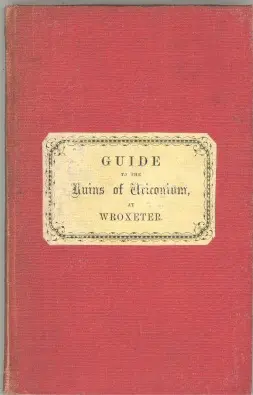
The Ruins of the Roman City of Uriconium, at Wroxeter, near Shrewsbury
Thomas Wright
THE CLASSIC COLLECTION · 1862
"A History of Domestic Manners and Sentiments in England During the Middle Ages" by Thomas Wright is a historical account written in the mid-19th century. The book seeks to provide a comprehensive look at the everyday life, customs, and thoughts of the English people during the Middle Ages, emphasizing their domestic arrangements and practices. The author aims to fill a gap in literature by creating a vivid picture of historical domestic life, juxtaposing it with modern society to illustrate how past customs have shaped contemporary manners and sentiments. At the start of the book, Wright introduces his purpose and methodology, stating that his work focuses on domestic manners and sentiments rather than the traditional histories of rulers and events. He briefly discusses the existing literature on related subjects, emphasizing the need for a cohesive view of domestic life during various historical periods. Wright outlines the structure of his work, which will explore the Anglo-Saxon period through to the Reformation, highlighting the significant transitions in social customs and practices, ultimately aiming to create an engaging narrative that draws from original research rather than previous compilations. The opening chapters promise to examine aspects such as housing, dining customs, and the furnishings of Anglo-Saxon households, setting the stage for a detailed investigation of medieval domestic life.
Introduction adapted from the source catalogue; source summaries may be automatically generated.
Free to read · English · 152,792 words · No account needed
MAKE TIME FOR A GOOD BOOK
On by default. Untick to stop anonymous reading totals. Each page counts after 10 seconds in view. How this works.
Anonymous counting is on unless you have switched it off.
We hardly perceive how the name of tables disappeared. It seems probable that at this time the game of tables meant simply what we now call backgammon, a word the oldest mention of which, so far as I have been able to discover, occurs in Howell’s “Familiar Letters,” first printed in 1646. It is there written baggamon. In the “Compleat Gamester,” 1674, backgammon and ticktack occur as two distinct games at what would have formerly been called tables; and another similar game was called Irish. Curiously enough, in the earlier part of the last century the game of backgammon was most celebrated as a favourite game among country parsons.
Another game existing in the middle ages, but much more rarely alluded to, was called dames, or ladies, and has still preserved that name in French. In English, it was changed for that of draughts, derived no doubt from the circumstance of drawing the men from one square to another. Our cut No. 155, taken from a manuscript in the British Museum of the beginning of the fourteenth century, known commonly as Queen Mary’s Psalter (MS. Reg. 2 B. vii.), represents a lady and gentleman playing at dames, or draughts, differing only from the character of the game at the present day in the circumstance that the draughtsmen are evidently square.
The mediæval games were gradually superseded by a new contrivance, that of playing-cards, which were introduced into Western Europe in the course of the fourteenth century. It has been suggested that the idea of playing-cards was taken from chess--in fact, that they are the game of chess transferred to paper, and without a board, and they are generally understood to have been derived from the East. Cards, while they possessed some of the characteristics of chess, presented the same mixture of chance and skill which distinguished the game of tables. An Italian writer, probably of the latter part of the fifteenth century, named Cavelluzzo, author of a history of Viterbo, states that “in the year 1379 was brought into Viterbo the game of cards, which comes from the country of the Saracens, and is with them called naib.” Cards are still in Spanish called naipes, which is said to be derived from the Arabic: but they were certainly known in the west of Europe before the date given by Cavelluzzo. Our cut No. 156 is taken from a very fine manuscript of the romance of “Meliadus,” in the British Museum (MS. Addit. 12,228, fol. 313, v^o), which was written apparently in the south of France between the years 1330 and 1350; it represents a royal party playing at cards, which was therefore considered at that time as the amusement of the highest classes of society. They are, however, first distinctly alluded to in history in the year 1393. In that year Charles VI. of France was labouring under a visitation of insanity; and we find in the accounts of his treasurer, Charles Poupart, an entry to the following effect:--“Given to Jacquemin Gringonneur, painter, for three packs of cards, gilt and diversly coloured, and ornamented with several devices, to deliver to the lord the king for his amusement, fifty-six sols of Paris.” It is clear from this entry that the game of cards was then tolerably well known in France, and that it was by no means new, though it was evidently not a common game, and the cards had to be made by a painter--that is, as I suppose, an illuminator of manuscripts. We find as yet no allusion to them in England: and it is remarkable that neither Chaucer, nor any of the numerous writers of his and the following age, ever speak of them. An illuminated manuscript of apparently the earlier part of the fifteenth century, perhaps of Flemish workmanship (it contains a copy of Raoul de Presle’s French translation of St. Augustine’s “Civitas Dei”), presents us with another card-party, which we give in our cut No. 157. Three persons are here engaged in the game, two of whom are ladies. After the date at which three packs of cards were made for the amusement of the lunatic king, the game of cards seems soon to have become common in France; for less than four years later--on the 22nd of January, 1397--the provost of Paris considered it necessary to publish an edict, forbidding working people to play at tennis, bowls, dice, cards, or ninepins, on working days. By one of the acts of the synod of Langres, in 1404, the clergy were expressly forbidden to play at cards. These had now made their way into Germany, and had become so popular there, that early in the fifteenth century card-making had become a regular trade.
Your reading position is saved on this browser. Take it to another device with a library code. Reading pages adapt to text, rather than matching a printed edition.
BEHIND THE BOOK
This eBook is for the use of anyone anywhere in the United States and most other parts of the world at no cost and with almost no restrictions whatsoever. You may copy it, give it away or re-use it under the terms of the Project Gutenberg License included with this eBook or online at www.gutenberg.org. If you are not located in the United States, you will have to check the laws of the country where you are located before using this eBook. Read the source licence.
The original source file, including credits and licence, is retained by this library. Request an original-format copy at no charge. Please include the book title and Project Gutenberg identifier #59351.
KEEP YOUR CURIOSITY GOING
Cécile Tormay

Moritz Busch
John L. Ransom
Frances Wright
Cécile Tormay

Mabel Potter Daggett