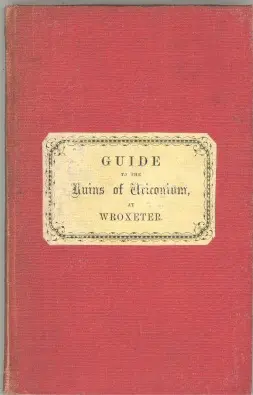
The Ruins of the Roman City of Uriconium, at Wroxeter, near Shrewsbury
Thomas Wright
THE CLASSIC COLLECTION · 1862
"A History of Domestic Manners and Sentiments in England During the Middle Ages" by Thomas Wright is a historical account written in the mid-19th century. The book seeks to provide a comprehensive look at the everyday life, customs, and thoughts of the English people during the Middle Ages, emphasizing their domestic arrangements and practices. The author aims to fill a gap in literature by creating a vivid picture of historical domestic life, juxtaposing it with modern society to illustrate how past customs have shaped contemporary manners and sentiments. At the start of the book, Wright introduces his purpose and methodology, stating that his work focuses on domestic manners and sentiments rather than the traditional histories of rulers and events. He briefly discusses the existing literature on related subjects, emphasizing the need for a cohesive view of domestic life during various historical periods. Wright outlines the structure of his work, which will explore the Anglo-Saxon period through to the Reformation, highlighting the significant transitions in social customs and practices, ultimately aiming to create an engaging narrative that draws from original research rather than previous compilations. The opening chapters promise to examine aspects such as housing, dining customs, and the furnishings of Anglo-Saxon households, setting the stage for a detailed investigation of medieval domestic life.
Introduction adapted from the source catalogue; source summaries may be automatically generated.
Free to read · English · 152,792 words · No account needed
MAKE TIME FOR A GOOD BOOK
On by default. Untick to stop anonymous reading totals. Each page counts after 10 seconds in view. How this works.
Anonymous counting is on unless you have switched it off.
A rather rude illumination is one of the manuscripts, of which M. Barrois has given a fac-simile in his edition of this romance, representing Charles striking his opponent with the rook. According to another version of the story, the young prince, using the rook as a missile, threw it at him. An incident in the romance of the “Quatre Fils d’Aymon,” where the agents of Regnault go to arrest the duke Richard of Normandy, and find him playing at chess, is thus told quaintly in the English version, printed by Copeland:--“When duke Richarde saw that these sergeauntes had him thus by the arm, and helde in his hande a lady of ivery, wherewith he would have given a mate to Yonnet, he withdrew his arme, and gave to one of the sergeauntes such a stroke with it into the forehead, that he made him tumble over and over at his feete; and than he tooke a rooke, and smote another withall upon his head, that he all to-brost it to the brayne.”
The chess-boards were naturally large, and were sometimes made of the precious metals, and of other rich materials. In one romance, the chess-board and men are made of crystal; in another, that of “Alexander,” the men are made of sapphires and topazes. A chess-board, preserved in the museum of the Hôtel de Cluny, at Paris, and said to have been the one given by the old man of the mountains (the sheikh of the Hassassins) to St. Louis, is made of rock-crystal, and mounted in silver gilt. In the romances, however, the chess-board is sometimes spoken of as made of ormier, or elm. In fact, when the game of chess came into extensive use, it became necessary not only to make the chess-board and men of less expensive materials and smaller, but to give to the latter simple conventional forms, instead of making them elaborate sculptures. The foundation for this latter practice had already been laid by the Arabs, whose tenets, contrary to those of the Persians, proscribed all images of living beings. The mediæval conventional form of the rook, a figure with a bi-parted head, somewhat approaching to the heraldic form of the fleur-de-lis, appears to have been taken directly from the Arabs. The knight was represented by a small upright column, the upper part of it bent to one side, and is supposed to have been meant for a rude representation of the horse’s head. The aufin, or bishop, had the same form as the knight, except that the bent end was cleft, probably as an indication of the episcopal mitre. The accompanying figure of a chess-board (No. 144), taken from a manuscript of the earlier part of the fourteenth century (MS. Cotton. Cleopat. B. ix.), but no doubt copied from one of the latter part of the thirteenth century, when the Anglo-Norman metrical treatise on chess which it illustrates was composed, gives all the conventional forms of chess-men used at that time. The piece at the left-hand extremity of the lower row is evidently a king. The other king is seen in the centre of the upper row. Immediately to the left of the latter is the queen, and the two figures below the king and queen are knights, while those to the left of the queen and white knight are rooks. Those in the right-hand corner, at top and bottom, are aufins, or bishops. The pawns on this chess-board bear a striking resemblance to those found in the Isle of Lewis. The same forms, with very slight variations, present themselves in the scenes of chess-playing as depicted in the illuminated manuscripts. Thus, in a manuscript of the French prose romance of “Meliadus,” in the British Museum (MS. Addit. No. 12,228, fol. 23, v^o), written between the years 1330 and 1350, we have an interesting sketch (given in our cut No. 145) of two kings engaged in this game. The rooks and the bishops are distinctly represented, but the others are less easily recognised, in consequence of the imperfect drawing. Our next cut (No. 146) is taken from the well-known manuscript of the poetry of the German Minnesingers, made for Rudiger von Manesse, early in the fourteenth century, and now preserved in the National Library in Paris, and represents the prince poet, Otto of Brandenburg, playing at chess with a lady. We have here the same conventional forms of chess-men, a circumstance which shows that the same types prevailed in England, France, and Germany. Another group, in which a king is introduced playing at chess, forms the subject of our cut No. 147, and is taken from a manuscript of the thirteenth century, in the Harleian collection in the British Museum (No. 1275), consisting of a numerous series of illustrations of the Bible history, executed evidently in England. It will be seen that the character of chess as a royal game is sustained throughout.
Your reading position is saved on this browser. Take it to another device with a library code. Reading pages adapt to text, rather than matching a printed edition.
BEHIND THE BOOK
This eBook is for the use of anyone anywhere in the United States and most other parts of the world at no cost and with almost no restrictions whatsoever. You may copy it, give it away or re-use it under the terms of the Project Gutenberg License included with this eBook or online at www.gutenberg.org. If you are not located in the United States, you will have to check the laws of the country where you are located before using this eBook. Read the source licence.
The original source file, including credits and licence, is retained by this library. Request an original-format copy at no charge. Please include the book title and Project Gutenberg identifier #59351.
KEEP YOUR CURIOSITY GOING
Cécile Tormay

Moritz Busch
John L. Ransom
Frances Wright
Cécile Tormay

Mabel Potter Daggett