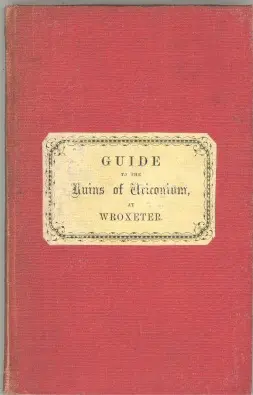
The Ruins of the Roman City of Uriconium, at Wroxeter, near Shrewsbury
Thomas Wright
THE CLASSIC COLLECTION · 1862
"A History of Domestic Manners and Sentiments in England During the Middle Ages" by Thomas Wright is a historical account written in the mid-19th century. The book seeks to provide a comprehensive look at the everyday life, customs, and thoughts of the English people during the Middle Ages, emphasizing their domestic arrangements and practices. The author aims to fill a gap in literature by creating a vivid picture of historical domestic life, juxtaposing it with modern society to illustrate how past customs have shaped contemporary manners and sentiments. At the start of the book, Wright introduces his purpose and methodology, stating that his work focuses on domestic manners and sentiments rather than the traditional histories of rulers and events. He briefly discusses the existing literature on related subjects, emphasizing the need for a cohesive view of domestic life during various historical periods. Wright outlines the structure of his work, which will explore the Anglo-Saxon period through to the Reformation, highlighting the significant transitions in social customs and practices, ultimately aiming to create an engaging narrative that draws from original research rather than previous compilations. The opening chapters promise to examine aspects such as housing, dining customs, and the furnishings of Anglo-Saxon households, setting the stage for a detailed investigation of medieval domestic life.
Introduction adapted from the source catalogue; source summaries may be automatically generated.
Free to read · English · 152,792 words · No account needed
MAKE TIME FOR A GOOD BOOK
On by default. Untick to stop anonymous reading totals. Each page counts after 10 seconds in view. How this works.
Anonymous counting is on unless you have switched it off.
So, in the same romance, the emperor Pepin, arriving at his camp, had no sooner entered his tent than, having put on a loose tunic (bliaut), and a mantle, he called for a chess-board, and sat down to play--
Eschés demande, si est au jeu assis.
--Ib., ii. 127.
Even Witikind, the king of the pagan Saxons, is represented as amusing himself with this game. When the messenger, who carried him news that Charlemagne was on the way to make war upon him, arrived at “Tremoigne,” the palace of the Saxon king, he found Witikind playing at chess with Escorfaus de Lutise, and the Saxon queen. Sebile, who was also well acquainted with the game, looking on--
A lui joe as eschas Escorfaus de Lutise;
Sebile les esgarde, qi do jeu est aprise.
--Chanson des Saxons, i. 91.
Witikind was so angry at this intelligence, that his face “became as red as a cherry,” and he broke the chess-board to pieces--
D’ire et de mautalant rugist comme cerise; Le message regarde, le geu peçoie et brise.
In the “Chanson de Geste” of Guerin de Montglaive, the story turns upon an imprudent act of Charlemagne, who stakes his whole kingdom upon a game of chess, and losing it to Guerin, is obliged to compound with him by surrendering to him his right to the city of Montglaive, then in the possession of the Saracens.
These “Chansons de Geste,” formed upon the traditions of the early Carlovingian period, can only of course be taken as a picture of the manner of the age at which they were composed, that is, of the twelfth and thirteenth centuries, and we know, from historical evidence, that the picture is strictly true. At that period chess certainly was what has been termed the royal game. The celebrated Walter Mapes, writing in the latter half of the twelfth century, gives a curious anecdote relating to tragical events which had occurred at the court of Britany, apparently in the earlier part of the same century. Alan of Britany, perhaps the last of the name who had ruled over that country, had, at the suggestion of his wife, entrapped a feudatory prince, Remelin, and subjected him to the loss of his eyes and other mutilations. Remelin’s son, Wigan, having escaped a similar fate, made war upon Alan, and reduced him to such extremities that, through the interference of the king of France, he made his peace with Wigan, by giving him his daughter in marriage, and thus for many years the country remained in peace. But it appears that the lady always shared in her father’s feuds, and looked with exulting contempt on her father’s mutilated enemy. One day she was playing with her husband at chess, and, towards the end of the game, Wigan, called away by some important business, asked one of his knights to take his place at the chess-board. The lady was the conqueror, and when she made her last move, she said to the knight, “It is not to you, but to the son of the mutilated that I say ‘mate.’” Wigan heard this sarcasm, and, deeply offended, hurried to the residence of his father-in-law, took him by surprise, and inflicted upon him the same mutilations which had been experienced by Remelin. Then, returning home, he engaged in another game with his wife, and, having gained it, threw the eyes and other parts of which her father had been deprived on the chess-board, exclaiming, “I say mate, to the daughter of the mutilated.” The story goes on to say that the lady concealed her desire of vengeance, until she found an opportunity of effecting the murder of her husband.
Your reading position is saved on this browser. Take it to another device with a library code. Reading pages adapt to text, rather than matching a printed edition.
BEHIND THE BOOK
This eBook is for the use of anyone anywhere in the United States and most other parts of the world at no cost and with almost no restrictions whatsoever. You may copy it, give it away or re-use it under the terms of the Project Gutenberg License included with this eBook or online at www.gutenberg.org. If you are not located in the United States, you will have to check the laws of the country where you are located before using this eBook. Read the source licence.
The original source file, including credits and licence, is retained by this library. Request an original-format copy at no charge. Please include the book title and Project Gutenberg identifier #59351.
KEEP YOUR CURIOSITY GOING
Cécile Tormay

Moritz Busch
John L. Ransom
Frances Wright
Cécile Tormay

Mabel Potter Daggett