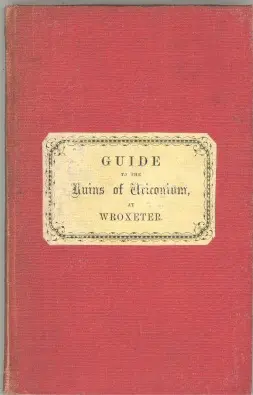
The Ruins of the Roman City of Uriconium, at Wroxeter, near Shrewsbury
Thomas Wright
THE CLASSIC COLLECTION · 1862
"A History of Domestic Manners and Sentiments in England During the Middle Ages" by Thomas Wright is a historical account written in the mid-19th century. The book seeks to provide a comprehensive look at the everyday life, customs, and thoughts of the English people during the Middle Ages, emphasizing their domestic arrangements and practices. The author aims to fill a gap in literature by creating a vivid picture of historical domestic life, juxtaposing it with modern society to illustrate how past customs have shaped contemporary manners and sentiments. At the start of the book, Wright introduces his purpose and methodology, stating that his work focuses on domestic manners and sentiments rather than the traditional histories of rulers and events. He briefly discusses the existing literature on related subjects, emphasizing the need for a cohesive view of domestic life during various historical periods. Wright outlines the structure of his work, which will explore the Anglo-Saxon period through to the Reformation, highlighting the significant transitions in social customs and practices, ultimately aiming to create an engaging narrative that draws from original research rather than previous compilations. The opening chapters promise to examine aspects such as housing, dining customs, and the furnishings of Anglo-Saxon households, setting the stage for a detailed investigation of medieval domestic life.
Introduction adapted from the source catalogue; source summaries may be automatically generated.
Free to read · English · 152,792 words · No account needed
MAKE TIME FOR A GOOD BOOK
On by default. Untick to stop anonymous reading totals. Each page counts after 10 seconds in view. How this works.
Anonymous counting is on unless you have switched it off.
The early commentator on the Dictionarius, or Vocabulary, of John de Garlande, calls the musical instruments instrumenta leccatorum, (instruments of the letchers or ribalds), and I have already stated that the minstrels, or jougleurs, were considered as belonging generally to that degraded class of society. In the vocabularies of the fifteenth century, they are generally classed under the head of reprehensible or disgraceful professions, along with ribalds, heretics, harlots, and so forth. It was the same character which led them, a little later, to be proscribed in acts of parliament, under the titles of rogues and vagabonds. In the older poetry, too, they are often joined with disgraceful epithets. There is a curious early metrical story, or fabliau, which was made, no doubt, to be recited by the minstrels themselves, although it throws ridicule on their profession; it is entitled Les deux Troveors ribauz, “the two ribald trouvères,” and consists in a ludicrous dispute between them on their qualifications as minstrels. My readers must not suppose that at this time the reciters of poetry were a different or better class than those who performed jugglery and low buffoonery--for, in this poem, either of the two claimants to superiority boasts of his skill equally in possessing in his memory completely, and being able to recite well, the early Chansons de Geste, or Carlovingian romances, the later romances of chivalry, and the fabliaux or metrical stories; in playing upon the most fashionable musical instruments, such as the citole, the fiddle, and the gigue (gittern); in performing extraordinary feats and in sleight of hand; and even in making chaplets of flowers, and in acting as a spy or as a go-between in love intrigues. No doubt there were minstrels who kept themselves more respectable, but they were exceptions to the general character of the class, and were chiefly men in the service of the king or of the great barons. There appears also to have been, for a long time, a continued attempt to raise minstrelsy to a respectable position, and out of this attempt arose, in different places, companies and guilds. Of these, the most remarkable of which we have any knowledge in this country, was the ancient fraternity of minstrels of Beverley, in Yorkshire. When this company originated is not known; but it was of some consideration and wealth in the reign of Henry VI., when the church of St. Mary’s, in that town, was built; for the minstrels gave a pillar to it, on the capital of which a band of minstrels were sculptured. The cut below (No. 137) is copied from the engraving of this group, given in Carter’s “Ancient Painting and Sculpture.” The oldest existing document of the fraternity is a copy of laws of the time of Philip and Mary, similar to those by which all trade guilds were governed: their officers were an alderman and two stewards or seers (i. e. searchers); and the only items in their laws which throw any light upon the history or condition of the minstrels are--one which requires that they should not take “any new brother except he be mynstrell to some man of honour or worship, or waite of some towne corporate or other ancient town, or else of such honestye and conyng (knowledge) as shall be thought laudable and pleasant to the hearers there;” and another, to the effect that “no mylner, shepherd, or of other occupation, or husbandman, or husbandman servant, playing upon pype or other instrument, shall sue (follow) any wedding, or other thing that pertaineth to the said science, except in his own parish.” Institutions like these, however, had little effect in counteracting the natural decline of minstrelsy, for the state of society in which it existed was passing away. It would be curious to trace the changes in its history by the instruments which became especially characteristic of the popular jougleur. The harp had given way to the fiddle, and already, towards the end of the thirteenth century, the fiddle was yielding its place to the tabor. In the Anglo-Norman romance of Horn, of the thirteenth century, we are told of a ribald “who goes to marriages to play on the tabor”--
Your reading position is saved on this browser. Take it to another device with a library code. Reading pages adapt to text, rather than matching a printed edition.
BEHIND THE BOOK
This eBook is for the use of anyone anywhere in the United States and most other parts of the world at no cost and with almost no restrictions whatsoever. You may copy it, give it away or re-use it under the terms of the Project Gutenberg License included with this eBook or online at www.gutenberg.org. If you are not located in the United States, you will have to check the laws of the country where you are located before using this eBook. Read the source licence.
The original source file, including credits and licence, is retained by this library. Request an original-format copy at no charge. Please include the book title and Project Gutenberg identifier #59351.
KEEP YOUR CURIOSITY GOING
Cécile Tormay

Moritz Busch
John L. Ransom
Frances Wright
Cécile Tormay

Mabel Potter Daggett