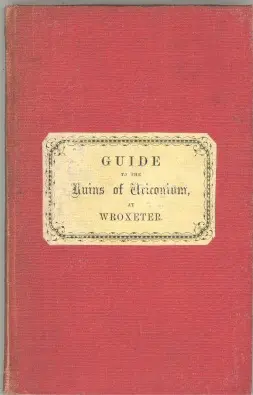
The Ruins of the Roman City of Uriconium, at Wroxeter, near Shrewsbury
Thomas Wright
THE CLASSIC COLLECTION · 1862
"A History of Domestic Manners and Sentiments in England During the Middle Ages" by Thomas Wright is a historical account written in the mid-19th century. The book seeks to provide a comprehensive look at the everyday life, customs, and thoughts of the English people during the Middle Ages, emphasizing their domestic arrangements and practices. The author aims to fill a gap in literature by creating a vivid picture of historical domestic life, juxtaposing it with modern society to illustrate how past customs have shaped contemporary manners and sentiments. At the start of the book, Wright introduces his purpose and methodology, stating that his work focuses on domestic manners and sentiments rather than the traditional histories of rulers and events. He briefly discusses the existing literature on related subjects, emphasizing the need for a cohesive view of domestic life during various historical periods. Wright outlines the structure of his work, which will explore the Anglo-Saxon period through to the Reformation, highlighting the significant transitions in social customs and practices, ultimately aiming to create an engaging narrative that draws from original research rather than previous compilations. The opening chapters promise to examine aspects such as housing, dining customs, and the furnishings of Anglo-Saxon households, setting the stage for a detailed investigation of medieval domestic life.
Introduction adapted from the source catalogue; source summaries may be automatically generated.
Free to read · English · 152,792 words · No account needed
MAKE TIME FOR A GOOD BOOK
On by default. Untick to stop anonymous reading totals. Each page counts after 10 seconds in view. How this works.
Anonymous counting is on unless you have switched it off.
The character of the minstrels, or jougleurs, their wandering life, and the ease with which they were admitted everywhere, caused them to be employed extensively as spies, and as bearers of secret news, and led people to adopt the disguise of a minstrel, as one which enabled them to pass through difficulties unobserved and unchallenged. In the story of Eustace the monk, when Eustace sought to escape from England, to avoid the pursuit of king John, he took a fiddle and a bow (a fiddlestick), and dressed himself as a minstrel, and in this garb he arrived at the coast, and, finding a merchant ready to sail, entered the ship with him. But the steersman, who did not recognise the minstrel as one of the passengers, ordered him out. Eustace expostulated, represented that he was a minstrel, and, after some dispute, the steersman, who seems to have had some suspicions either of his disguise or of his skill, concluded by putting the question, “At all events, if thou knowest any song, friend, let us have it.” The monk was not skilled in singing, but he replied boldly, “Know I one? Yea! of Agoulant, and Aymon, or of Blonchadin, or of Florence of Rome (these were all early metrical romances); there is not a song in the whole world but I know it. I should be delighted, no doubt, to afford you amusement; but, in truth, the sea frightens me so much at present, that I could not sing a song worth hearing.” He was allowed to pass. Some of those who adopted the disguise of the jougleur were better able to sustain it, and minstrelsy became considered as a polite accomplishment, perhaps partly on account of its utility. There is, in the history of the Fitz-Warines, a remarkable character of this description named John de Raunpaygne. Fulke Fitz-Warine had formed a design against his great enemy, Moris Fitz-Roger, and he established himself, with his fellow outlaws, in the forest near Whittington, in Shropshire, to watch him. Fulke then called to him John de Raunpaygne. “John,” said he, “you know enough of minstrelsy and joglery; dare you go to Whittington, and play before Moris Fitz-Roger, and spy how things are going on?” “Yea,” said John. He crushed a herb, and put it in his mouth, and his face began immediately to swell, and became so discoloured, that his own companions hardly knew him; and he dressed himself in poor clothes, and “took his box with his instruments of joglery and a great staff in his hand;” and thus he went to Whittington, and presented himself at the castle, and said that he was a jogeleur. The porter carried him to Sir Moris, who received him well, inquired in the first place for news, and receiving intelligence which pleased him (it was designedly false), he gave the minstrel a valuable silver cup as a reward. Now, “John de Raunpaygne was very ill-favoured in face and body, and on this account the ribalds of the household made game of him, and treated him roughly, and pulled him by his hair and by his feet. John raised his staff, and struck a ribald on the head, that his brain flew into the middle of the place. ‘Wretched ribald,’ said the lord, ‘what hast thou done?’ ‘Sir,’ said he, ‘for God’s mercy, I cannot help it; I have a disease which is very grievous, which you may see by my swollen face. And this disease takes entire possession of me at certain hours of the day, when I have no power to govern myself.’ Moris swore a great oath, that if it were not for the news he had brought, he would have his head cut off immediately. The jogeleur hastened his departure, for the time he remained there seemed very long.” The result of this adventure was the attack upon and slaughter of Moris Fitz-Roger by Fulk Fitz-Warine. Some time after this, Fulk Fitz-Warine, having recovered his castle of Whittington, was lamenting over the loss of his friend, Sir Audulf de Bracy, who had fallen into the hands of king John’s emissaries, and was a prisoner in Shrewsbury castle, where king John had come to make his temporary residence, and again asked the aid of John de Raunpaygne, who promised to make a visit to the king. “John de Raunpaygne knew enough of tabor, harp, fiddle, citole, and joglery; and he attired himself very richly, like an earl or baron, and he caused his hair and all his body to be entirely dyed as black as jet, so that nothing was white except his teeth. And he hung round his neck a very handsome tabor, and then, mounting a handsome palfrey, rode through the town of Shrewsbury to the gate of the castle; and by many a one was he looked at. John came before the king, and placed himself on his knees, and saluted the king very courteously. The king returned his salutation, and asked him whence he came. ‘Sire,’ said he, ‘I am an Ethiopian minstrel, born in Ethiopia.’ Said the king, ‘Are all the people in your land of your colour?’ ‘Yea, my lord, man and woman.’ ... John, during the day, made great minstrelsy of tabor and other instruments. When the king was gone to bed, Sir Henry de Audeley sent for the black minstrel, and led him into his chamber. And they made great melody; and when Sir Henry had drunk well, then he said to a valet, ‘Go and fetch Sir Audulf de Bracy, whom the king will put to death to-morrow; for he shall have a good night of it before his death.’ The valet soon brought Sir Audulf into the chamber. Then they talked and played. John commenced a song which Sir Audulf used to sing; Sir Audulf raised his head, looked at him full in the face, and with great difficulty recognised him. Sir Henry asked for some drink; John was very serviceable, jumped nimbly on his feet, and served the cup before them all. John was sly, he threw a powder into the cup, which nobody perceived, for he was a good jogeleur, and all who drunk became so sleepy that, soon after drinking, they lay down and fell asleep. John de Raunpaygne and Sir Audulf de Bracy took the opportunity for making their escape. We have here a mysterious intimation of the fact that the minstrel was employed also in dark deeds of poisoning. Still later on in the story of Fulk Fitz-Warine, the hero himself goes to a tournament in France in disguise, and John de Raunpaygne resumes his old character of a jougleur.” “John,” says the narrative, “was very richly attired, and well mounted, and he had a very rich tabor, and he struck the tabor at the entry to the lifts, that the hills and valleys rebounded, and the horses became joyful.”
Your reading position is saved on this browser. Take it to another device with a library code. Reading pages adapt to text, rather than matching a printed edition.
BEHIND THE BOOK
This eBook is for the use of anyone anywhere in the United States and most other parts of the world at no cost and with almost no restrictions whatsoever. You may copy it, give it away or re-use it under the terms of the Project Gutenberg License included with this eBook or online at www.gutenberg.org. If you are not located in the United States, you will have to check the laws of the country where you are located before using this eBook. Read the source licence.
The original source file, including credits and licence, is retained by this library. Request an original-format copy at no charge. Please include the book title and Project Gutenberg identifier #59351.
KEEP YOUR CURIOSITY GOING
Cécile Tormay

Moritz Busch
John L. Ransom
Frances Wright
Cécile Tormay

Mabel Potter Daggett