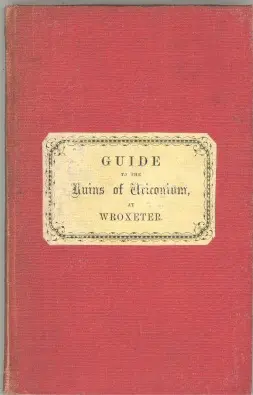
The Ruins of the Roman City of Uriconium, at Wroxeter, near Shrewsbury
Thomas Wright
THE CLASSIC COLLECTION · 1862
"A History of Domestic Manners and Sentiments in England During the Middle Ages" by Thomas Wright is a historical account written in the mid-19th century. The book seeks to provide a comprehensive look at the everyday life, customs, and thoughts of the English people during the Middle Ages, emphasizing their domestic arrangements and practices. The author aims to fill a gap in literature by creating a vivid picture of historical domestic life, juxtaposing it with modern society to illustrate how past customs have shaped contemporary manners and sentiments. At the start of the book, Wright introduces his purpose and methodology, stating that his work focuses on domestic manners and sentiments rather than the traditional histories of rulers and events. He briefly discusses the existing literature on related subjects, emphasizing the need for a cohesive view of domestic life during various historical periods. Wright outlines the structure of his work, which will explore the Anglo-Saxon period through to the Reformation, highlighting the significant transitions in social customs and practices, ultimately aiming to create an engaging narrative that draws from original research rather than previous compilations. The opening chapters promise to examine aspects such as housing, dining customs, and the furnishings of Anglo-Saxon households, setting the stage for a detailed investigation of medieval domestic life.
Introduction adapted from the source catalogue; source summaries may be automatically generated.
Free to read · English · 152,792 words · No account needed
MAKE TIME FOR A GOOD BOOK
On by default. Untick to stop anonymous reading totals. Each page counts after 10 seconds in view. How this works.
Anonymous counting is on unless you have switched it off.
But the most curious illustration of the universality of this practice is found in a Latin story, probably of the thirteenth century, in which we are told of a man who had a glutton for his wife. One day he roasted for their dinner a fowl, and when they had sat down at the table, the wife said, “Give me a wing?” The husband gave her the wing; and, at her demand, all the other members in succession, until she had devoured the whole fowl herself, at which, no longer able to contain his anger, he said, “Lo, you have eaten the whole fowl yourself, and nothing remains but the spit, which it is but right that you should taste also.” And thereupon he took the spit, and beat her severely with it.
Our cut (No. 106), taken from a large illumination, given from a manuscript of the fifteenth century by the late M. du Sommerard, in his great work on mediæval art, represents the servants of the hall, headed by the steward, or maître d’hôtel, with his rod of office, bringing the dishes to the table in formal procession. Their approach and arrival were usually announced by the sounding of trumpets and music. The servants were often preceded by music, as we see in our cut No. 107, taken from a very fine MS. of the early part of the fourteenth century, in the British Museum (MS. Reg. 2, B. vii.). A representation of a similar scene occurs at the foot of the large Flemish brass of Robert Braunche and his two wives at St. Margaret’s Church, Lynn, which is intended as a delineation of a feast given by the corporation of Lynn to king Edward III. Servants from both sides of the picture are bringing in that famous dish of chivalry, the peacock with his tail displayed; and two bands of minstrels are ushering in the banquet with their strains; the date of the brass is about 1364 A.D. Those who served at the table itself, whose business was chiefly to carve and present the wine, were of still higher rank--never less than esquires--and often, in the halls of princes and great chiefs, nobles and barons. The meal itself was conducted with the same degree of ceremony, of which a vivid picture may be drawn from the directions given in the work called the “Ménagier de Paris,” composed about the year 1393. When it was announced that the dinner was ready, the guests advanced to the hall, led ceremoniously by two maîtres d’hôtel, who showed them their places, and served them with water to wash their hands before they began. They found the tables spread with fine table-cloths, and covered with a profusion of richly-ornamented plate, consisting of salt-cellars, goblets, pots or cups for drinking, spoons, &c. At the high table, the meats were eaten from slices of bread, called trenchers (tranchoirs), which, after the meats were eaten, were thrown into vessels called couloueres. In a conspicuous part of the hall stood the dresser or cupboard, which was covered with vessels of plate, which two esquires carried thence to the table, to replace those which were emptied. Two other esquires were occupied in bringing wine to the dresser, from whence it was served to the guests at the tables. The dishes, forming a number of courses, varying according to the occasion, were brought in by valets, led by two esquires. An asséeur, or placer, took the dishes from the hands of the valets, and arranged them in their places on the table. After these courses, fresh table-cloths were laid, and the entremets were brought, consisting of sweets, jellies, &c., many of them moulded into elegant or fantastic forms; and, in the middle of the table, raised above the rest, were placed a swan, peacocks, or pheasants, dressed up in their feathers, with their beaks and feet gilt. In less sumptuous entertainments the expensive course of entremets was usually omitted. Last of all came the dessert, consisting of cheese, confectionaries, fruit, &c., concluded by what was called the issue (departure from table), consisting usually of a draught of hypocras, and the boute-hors (turn out), wine and spices served round, which terminated the repast. The guests then washed their hands, and repaired into another room, where they were served with wine and sweetmeats, and, after a short time, separated. The dinner, served slowly and ceremoniously, must have occupied a considerable length of time. After the guests had left the hall, the servers and attendants took their places at the tables.
Your reading position is saved on this browser. Take it to another device with a library code. Reading pages adapt to text, rather than matching a printed edition.
BEHIND THE BOOK
This eBook is for the use of anyone anywhere in the United States and most other parts of the world at no cost and with almost no restrictions whatsoever. You may copy it, give it away or re-use it under the terms of the Project Gutenberg License included with this eBook or online at www.gutenberg.org. If you are not located in the United States, you will have to check the laws of the country where you are located before using this eBook. Read the source licence.
The original source file, including credits and licence, is retained by this library. Request an original-format copy at no charge. Please include the book title and Project Gutenberg identifier #59351.
KEEP YOUR CURIOSITY GOING
Cécile Tormay

Moritz Busch
John L. Ransom
Frances Wright
Cécile Tormay

Mabel Potter Daggett