THE CLASSIC COLLECTION✦An outlaw’s diary: the CommuneCLASSIC FREE BOOKS
An outlaw’s diary: the Commune
Cécile Tormay
THE CLASSIC COLLECTION · 1920
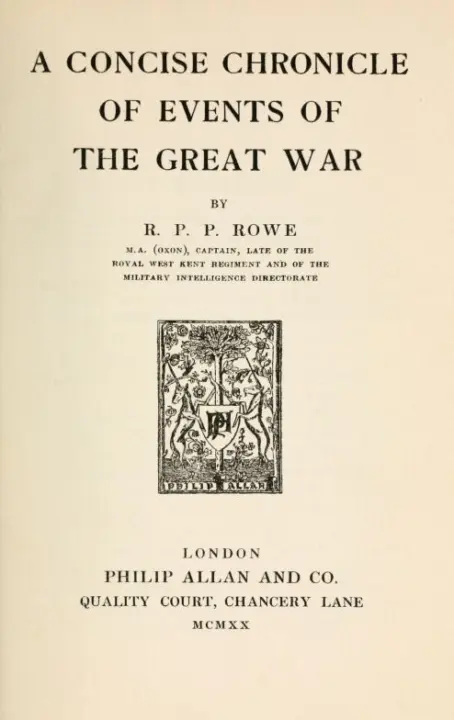
"A Concise Chronicle of Events of the Great War" by R. P. P. Rowe is a historical account written in the early 20th century. The book presents a detailed timeline of key events that transpired during World War I, beginning with the assassination of Archduke Franz Ferdinand and extending through various consequential military actions and diplomatic developments. It aims to serve as a concise and informative record of the war, utilizing authoritative sources to outline the battles and strategies involved. The opening of the chronicle establishes the groundwork for what follows, emphasizing the author's intent to provide a straightforward historical reference. Rowe clarifies the omission of maps due to practical limitations, but assures readers that the locations of key battles and events are accurately indicated. As the text transitions into the year-by-year chronology, it begins with pivotal incidents from 1914, starting with the assassination in Sarajevo, and then detailing the escalating tensions, declarations of war, and significant military engagements through a series of dates and events that create a comprehensive overview of the Great War's complex timeline.
Introduction adapted from the source catalogue; source summaries may be automatically generated.
Free to read · English · 67,463 words · No account needed
MAKE TIME FOR A GOOD BOOK
On by default. Untick to stop anonymous reading totals. Each page counts after 10 seconds in view. How this works.
Anonymous counting is on unless you have switched it off.
Dec. 13 (Thur.)
The Russian Constituent Assembly is forcibly dispersed by the
Bolshevists.
H.M.S. Stephen Furness (armed boarding-steamer) is sunk by a
submarine in the Irish Sea.
Dec. 14 (Fri.)
The French cruiser Châteaurenault is sunk by a submarine (10 lives
lost).
Dec. 15 (Sat.)
An armistice for one month from Dec. 17 is signed at Brest-Litovsk by representatives of the German Government and of the Russian Bolshevist Government.
General Guillaumet succeeds General Sarrail in command of the Allied
forces at Salonika.
Dec. 16 (Sun.)
H.M.S. Arbutus (sloop--employed as Special Service ship) is sunk by a submarine off the Bristol Channel.
Dec. 18 (Tues.)
Italy:--The Austro-Germans attack from Col Caprile to Monte Pertica; they capture Monte Asolone with 2000 prisoners.
An evening raid by German aeroplanes on Essex, Kent, and London (10 killed); one raider is brought down.
Dec. 19 (Wed.)
The Ukraine Government demands recognition by the Bolshevist
Government.
The Italians recapture part of Monte Asolone.
Dec. 21 (Fri.)
The Italians complete the recapture of Monte Asolone.
Palestine:--General Allenby advances northward.
Dec. 22 (Sat.)
Peace negotiations are opened at Brest-Litovsk between the German
Government and the Russian Bolshevist Government; Herr von Kühlmann
presides.
A German aeroplane raid on the Kentish coast; one machine is forced to land and its crew is captured.
Dec. 23 (Sun.)
Italy:--The Austro-Germans capture Val Bella and the Col del Rosso in the Frenzela Valley; they claim 9000 prisoners.
Three British destroyers, the Surprise, Tornado, and Torrent, are sunk by mines off the Dutch coast with considerable loss of life.
Dec. 24 (Mon.)
A British air-raid on Mannheim.
Dec. 26 (Wed.)
Vice-Admiral Sir Rosslyn Wemyss succeeds Admiral Sir John Jellicoe as First Sea Lord (see Nov. 29, 1916).
Dec. 27 (Thur.)
Palestine:--Turkish attacks north of Jerusalem are shattered and
a British offensive is launched subsequently against the defeated
enemy.
Dec. 28 (Fri.)
The Labour Memorandum on War Aims is adopted at a special British
Labour Conference.
Palestine:--The British advance on a nine-mile front: they capture
Ramah and Beitunia.
Dec. 29 (Sat.)
Palestine:--The British capture Bireh (on the Shechem road, nine
miles north of Jerusalem).
Dec. 30 (Sun.)
The Germans attack Welsh Ridge on the Cambrai Front, and gain ground.
Palestine:--The British continue to advance; they capture Bethel and
other villages.
The British destroyer Attack is sunk by a mine off Alexandria.
Jan. 1 (Tues.)
Italy:--The Austrians are driven from Zenson, west of the Piave.
Jan. 2 (Wed.)
The German peace conditions are denounced by the Bolshevists as a
policy of annexation.
Jan. 4 (Fri.)
The British hospital ship Rewa is sunk by a submarine in the Bristol Channel (three lives lost).
Jan. 5 (Sat.)
Mr. Lloyd George makes a declaration of 'War Aims' after
consultation with Mr. Asquith, Lord Grey, and the leaders of the
Labour Party.
Your reading position is saved on this browser. Take it to another device with a library code. Reading pages adapt to text, rather than matching a printed edition.
BEHIND THE BOOK
This eBook is for the use of anyone anywhere in the United States and most other parts of the world at no cost and with almost no restrictions whatsoever. You may copy it, give it away or re-use it under the terms of the Project Gutenberg License included with this eBook or online at www.gutenberg.org. If you are not located in the United States, you will have to check the laws of the country where you are located before using this eBook. Read the source licence.
The original source file, including credits and licence, is retained by this library. Request an original-format copy at no charge. Please include the book title and Project Gutenberg identifier #48525.
KEEP YOUR CURIOSITY GOING
Cécile Tormay

Moritz Busch
John L. Ransom
Frances Wright
Cécile Tormay

Mabel Potter Daggett