THE CLASSIC COLLECTION✦An outlaw’s diary: the CommuneCLASSIC FREE BOOKS
An outlaw’s diary: the Commune
Cécile Tormay
THE CLASSIC COLLECTION · 1920
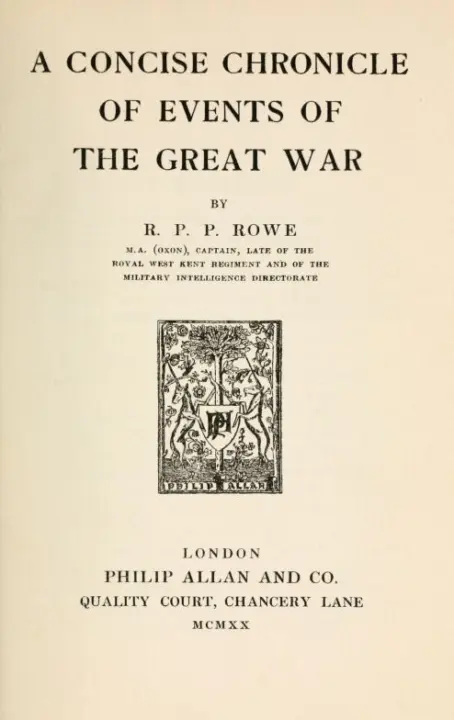
"A Concise Chronicle of Events of the Great War" by R. P. P. Rowe is a historical account written in the early 20th century. The book presents a detailed timeline of key events that transpired during World War I, beginning with the assassination of Archduke Franz Ferdinand and extending through various consequential military actions and diplomatic developments. It aims to serve as a concise and informative record of the war, utilizing authoritative sources to outline the battles and strategies involved. The opening of the chronicle establishes the groundwork for what follows, emphasizing the author's intent to provide a straightforward historical reference. Rowe clarifies the omission of maps due to practical limitations, but assures readers that the locations of key battles and events are accurately indicated. As the text transitions into the year-by-year chronology, it begins with pivotal incidents from 1914, starting with the assassination in Sarajevo, and then detailing the escalating tensions, declarations of war, and significant military engagements through a series of dates and events that create a comprehensive overview of the Great War's complex timeline.
Introduction adapted from the source catalogue; source summaries may be automatically generated.
Free to read · English · 67,463 words · No account needed
MAKE TIME FOR A GOOD BOOK
On by default. Untick to stop anonymous reading totals. Each page counts after 10 seconds in view. How this works.
Anonymous counting is on unless you have switched it off.
The Argentine Government hands Count Luxburg, the German agent in
Buenos Ayres, his passports.
A British naval air-raid on Zeebrugge.
Sept. 13 (Thur.)
Russia:--General Korniloff's revolt fails.
The Allies advance in Southern Albania.
Sept. 14 (Fri.)
Russia:--General Korniloff surrenders to General Alexeieff and the
Provisional Government.
Sept. 15 (Sat.)
Russia:--The Provisional Government proclaims a Republic; a new War Cabinet is appointed under M. Kerenski, who is virtually Dictator.
A British naval air-raid on enemy shipping between Ostend and
Blankenberghe.
Sept. 16 (Sun.)
Allied air-raids on Stuttgart and Colmar.
Sept. 18 (Tues.)
The British destroyer Contest is sunk by a submarine in the
English Channel.
Sept. 20 (Thur.)
The British attack on an eight-mile front east of Ypres: Inverness Copse, Glencorse Wood, and other important positions are captured, with 2000 prisoners.
Sept. 21 (Fri.)
East of Ypres the British repulse counter-attacks and make further
progress.
The Russians evacuate the important bridge-head of Jacobstadt (on the Dvina, 70 miles south-east of Riga).
East Africa:--The British advancing from the direction of the port of Kilwa break up an enemy force and drive it in flight towards the Mbemkuru River.
Sept. 22 (Sat.)
The Germans occupy Jacobstadt (south-east of Riga).
Ostend is shelled by British ships of the Belgian coast patrol.
French air-raids on Stuttgart, Trèves, Coblenz, and Frankfurt.
Sept. 24 (Mon.)
A night raid on London by German aeroplanes (15 killed).
Sept. 25 (Tues.)
A British naval force bombards Ostend.
A night raid on London by German aeroplanes (7 killed); one raider
is destroyed.
Sept. 26 (Wed.)
The British attack on a six-mile front east of Ypres; Polygon Wood
and Zonnebeke are captured.
Sept. 27 (Thur.)
A raid by British naval airmen on the German aerodrome at St. Denis
Westrem (near Ghent).
Sept. 28 (Fri.)
Mesopotamia:--The Turks are crushingly defeated by General Maude at Ramadieh on the Euphrates (the Battle of Ramadieh).
Sept. 29 (Sat.)
Mesopotamia:--The British victory at Ramadieh ends in the surrender of the Turkish force; over 3000 unwounded prisoners are captured.
A night raid on London by German aeroplanes (11 killed).
Sept. 30 (Sun.)
A night raid on London by German aeroplanes.
Oct. 1 (Mon.)
East of Ypres strong German counter-attacks are repulsed by the
British.
East Africa:--An enemy detachment of 200 surrenders to the British
north of the Central Railway.
A night raid on London by German aeroplanes (10 killed).
Oct. 2 (Tues.)
H.M.S. Drake (cruiser) is torpedoed off the north coast of
Ireland; she makes harbour and sinks in shallow water (19 lives
lost).
Oct. 4 (Thur.)
The British attack Passchendaele Ridge; positions of great importance and 4500 prisoners are captured.
Oct. 5 (Fri.)
An explosion occurs in a munitions factory at Chilwell, with heavy
loss of life.
Oct. 6 (Sat.)
Peru and Uruguay break off diplomatic relations with Germany.
Your reading position is saved on this browser. Take it to another device with a library code. Reading pages adapt to text, rather than matching a printed edition.
BEHIND THE BOOK
This eBook is for the use of anyone anywhere in the United States and most other parts of the world at no cost and with almost no restrictions whatsoever. You may copy it, give it away or re-use it under the terms of the Project Gutenberg License included with this eBook or online at www.gutenberg.org. If you are not located in the United States, you will have to check the laws of the country where you are located before using this eBook. Read the source licence.
The original source file, including credits and licence, is retained by this library. Request an original-format copy at no charge. Please include the book title and Project Gutenberg identifier #48525.
KEEP YOUR CURIOSITY GOING
Cécile Tormay

Moritz Busch
John L. Ransom
Frances Wright
Cécile Tormay

Mabel Potter Daggett