THE CLASSIC COLLECTION✦An outlaw’s diary: the CommuneCLASSIC FREE BOOKS
An outlaw’s diary: the Commune
Cécile Tormay
THE CLASSIC COLLECTION · 1920
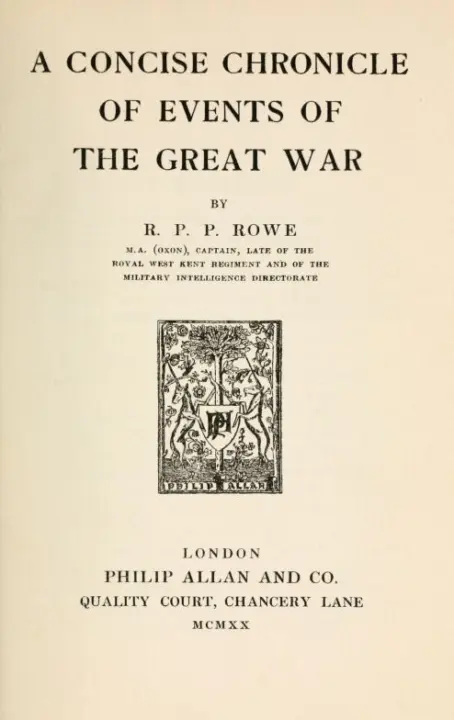
"A Concise Chronicle of Events of the Great War" by R. P. P. Rowe is a historical account written in the early 20th century. The book presents a detailed timeline of key events that transpired during World War I, beginning with the assassination of Archduke Franz Ferdinand and extending through various consequential military actions and diplomatic developments. It aims to serve as a concise and informative record of the war, utilizing authoritative sources to outline the battles and strategies involved. The opening of the chronicle establishes the groundwork for what follows, emphasizing the author's intent to provide a straightforward historical reference. Rowe clarifies the omission of maps due to practical limitations, but assures readers that the locations of key battles and events are accurately indicated. As the text transitions into the year-by-year chronology, it begins with pivotal incidents from 1914, starting with the assassination in Sarajevo, and then detailing the escalating tensions, declarations of war, and significant military engagements through a series of dates and events that create a comprehensive overview of the Great War's complex timeline.
Introduction adapted from the source catalogue; source summaries may be automatically generated.
Free to read · English · 67,463 words · No account needed
MAKE TIME FOR A GOOD BOOK
On by default. Untick to stop anonymous reading totals. Each page counts after 10 seconds in view. How this works.
Anonymous counting is on unless you have switched it off.
Lord Lansdowne's letter advising a revision of war aims is published
in the Daily Telegraph.
Nov. 30 (Fri.)
The Germans counter-attack in strength before Cambrai: they capture Lateau Wood and penetrate the British positions as far as La Vacquerie, Gonnelieu, and Gouzeaucourt; La Vacquerie is recovered by a British counter-attack; the Germans claim 4000 prisoners and 60 guns.
Dec. 1 (Sat.)
Cambrai Front:--The British recapture Gonnelieu.
East Africa:--The British drive the last enemy forces into
Portuguese territory.
Dec. 2 (Sun.)
German and Bolshevist plenipotentiaries meet at Brest-Litovsk to
negotiate an armistice.
Dec. 3 (Mon.)
The Russian General Staff surrenders to Bolshevist troops; General Dukhonin, the former Commander-in-Chief, is murdered.
Mesopotamia:--The Turks are driven out of the hills north of Deli Abbas; they retreat towards the Jebel Hamrin range.
Dec. 4 (Tues.)
Italy:--The Austro-Germans attack in the Asiago region and win
Italian hill positions.
Dec. 5 (Wed.)
Cambrai Front:--The British evacuate Bourlon Wood.
Italy:--The Austro-Germans make progress on the Asiago Front: Monte Zomo and Monte Castelgomberto are carried.
Dec. 6 (Thur.)
An insurrection breaks out in Lisbon against the Government in power
(see Dec. 11).
Roumania agrees to an armistice.
Cambrai Front:--Strong enemy attacks south of Bourlon Wood are
repulsed by the British.
Italy:--The Austro-Germans capture Monte Sisemol.
Palestine:--The British occupy Hebron.
A German aeroplane raid on London in the early morning (7 killed);
two raiders are destroyed.
Dec. 7 (Fri.)
The United States Government declares war on Austria.
The end of the Battle of Cambrai (see Nov. 20), the British gains
having been largely abandoned.
Dec. 8 (Sat.)
Ecuador breaks off diplomatic relations with Germany.
The Russian peoples on the Don and in the Urals revolt against the
Bolshevists.
Palestine:--The British advance isolates Jerusalem.
Dec. 9 (Sun.)
Palestine:--Fall of Jerusalem to General Allenby (see Dec. 11).
The Italians torpedo two Austrian battleships in the port of Trieste, sinking one of them (the Wien).
Dec. 10 (Mon.)
Panama declares war on Austria.
Dec. 11 (Tues.)
The Russian Constituent Assembly meets in Petrograd.
The Revolutionary party establishes itself in Lisbon, and forms a
Government which declares its solidarity with the Allies (see Dec.
6).
Palestine:--General Allenby formally enters Jerusalem accompanied by the military attachés of France, Italy, and the United States.
A German submarine bombards Funchal, Madeira.
A British air-raid on Germany between Metz and the Rhine.
Dec. 12 (Wed.)
The Germans attack, and gain some ground near Bullecourt.
Palestine:--General Allenby advances north and north-west of
Jerusalem.
A raid by German destroyers in the North Sea: they attack six merchantmen (five Neutral and one British) escorted by two British destroyers (the Partridge and the Pellew) and four armed trawlers; the merchantmen and the escort are all sunk with the exception of the destroyer Pellew, which is disabled.
Your reading position is saved on this browser. Take it to another device with a library code. Reading pages adapt to text, rather than matching a printed edition.
BEHIND THE BOOK
This eBook is for the use of anyone anywhere in the United States and most other parts of the world at no cost and with almost no restrictions whatsoever. You may copy it, give it away or re-use it under the terms of the Project Gutenberg License included with this eBook or online at www.gutenberg.org. If you are not located in the United States, you will have to check the laws of the country where you are located before using this eBook. Read the source licence.
The original source file, including credits and licence, is retained by this library. Request an original-format copy at no charge. Please include the book title and Project Gutenberg identifier #48525.
KEEP YOUR CURIOSITY GOING
Cécile Tormay

Moritz Busch
John L. Ransom
Frances Wright
Cécile Tormay

Mabel Potter Daggett