THE CLASSIC COLLECTION✦An outlaw’s diary: the CommuneCLASSIC FREE BOOKS
An outlaw’s diary: the Commune
Cécile Tormay
THE CLASSIC COLLECTION · 1920
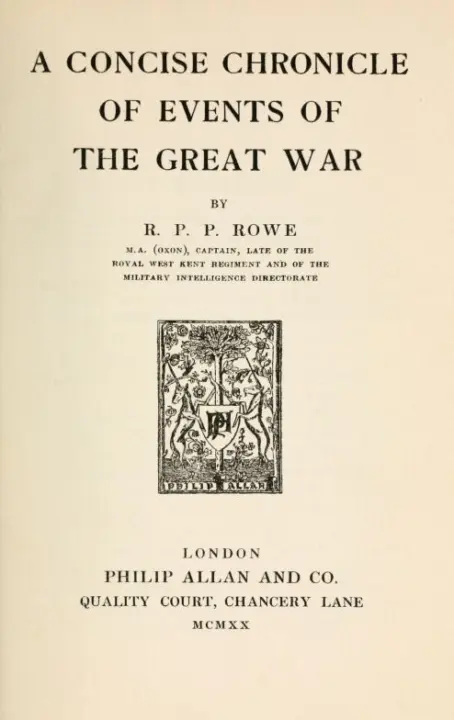
"A Concise Chronicle of Events of the Great War" by R. P. P. Rowe is a historical account written in the early 20th century. The book presents a detailed timeline of key events that transpired during World War I, beginning with the assassination of Archduke Franz Ferdinand and extending through various consequential military actions and diplomatic developments. It aims to serve as a concise and informative record of the war, utilizing authoritative sources to outline the battles and strategies involved. The opening of the chronicle establishes the groundwork for what follows, emphasizing the author's intent to provide a straightforward historical reference. Rowe clarifies the omission of maps due to practical limitations, but assures readers that the locations of key battles and events are accurately indicated. As the text transitions into the year-by-year chronology, it begins with pivotal incidents from 1914, starting with the assassination in Sarajevo, and then detailing the escalating tensions, declarations of war, and significant military engagements through a series of dates and events that create a comprehensive overview of the Great War's complex timeline.
Introduction adapted from the source catalogue; source summaries may be automatically generated.
Free to read · English · 67,463 words · No account needed
MAKE TIME FOR A GOOD BOOK
On by default. Untick to stop anonymous reading totals. Each page counts after 10 seconds in view. How this works.
Anonymous counting is on unless you have switched it off.
The British attack near Loos with partial success.
A Zeppelin raid on London (59 killed).
Oct. 14 (Thur.)
Bulgaria declares war on Serbia (see Oct. 11).
A Russian success near Dvinsk.
Oct. 15 (Fri.)
Great Britain declares war on Bulgaria.
The end of the Battle of Loos (see Sept. 25).
The Bulgarians take Vranja.
Oct. 16 (Sat.)
France declares war on Bulgaria.
Alsace:--The French recover the Hartmannsweilerkopf (lost after much
previous fighting).
Sir Ian Hamilton is recalled from Gallipoli, Sir Charles Monro being
appointed to succeed him.
Oct. 17 (Sun.)
The Italians capture Pregasina.
A French air-raid on Trèves.
Oct. 18 (Mon.)
Sir Edward Carson resigns his seat in the British Cabinet.
The Germans advance on Riga.
Oct. 19 (Tues.)
Italy declares war on Bulgaria.
A French force drives the Bulgarians from Strumnitza.
Oct. 21 (Thur.) Trafalgar, 1805.
The Bulgarians capture Veles (see Oct. 25 and 29).
An Allied squadron bombards the harbour of Dedeagatch and other points of military importance on the Bulgarian coast.
Oct. 22 (Fri.)
The 'Group' system of enlistment comes into operation in Great
Britain.
The Bulgarians capture Uskub and Rumanovo.
The Italians advance on the Isonzo front.
Oct. 23 (Sat.)
The Austro-Germans force the passage of the Danube at Orsova.
Mesopotamia:--The British reach Azizie in their advance on Baghdad.
A British submarine sinks the German cruiser Prinz Adalbert in the
Baltic.
Oct. 24 (Sun.)
The Germans are within ten miles of Riga.
The Danube route to Constantinople is opened to the Germans by their
victories in Serbia.
Oct. 25 (Mon.)
The Austro-German and Bulgarian forces effect a junction in the Kraina district. The Serbians recapture Veles (see Oct. 21 and 29).
The Cameroons:--Sende is occupied by the French.
The British destroyer Velox is mined off the Nab lightship.
Oct. 26 (Tues.)
The British transport Marquette is torpedoed in the Ægean.
Oct. 27 (Wed.)
French troops effect a junction with the Serbians at Veles. The French and British are in position across the Vardar.
The Russian Black Sea Fleet bombards Varna.
Oct. 28 (Thur.)
The French Ministry resigns: M. Briand becomes Premier (see March
17, 1917).
King George is thrown from his horse and injured in France.
Sir Charles Monro assumes command in Gallipoli.
H.M.S. Argyll (cruiser) is wrecked off the east coast of Scotland
(no lives lost).
Oct. 29 (Fri.)
Veles is retaken by the Bulgarians (see Oct. 21 and 25).
The British mine-sweeper Hythe is sunk off Gallipoli.
Oct. 30 (Sat.)
The Germans capture the Butte of Tahure.
The Serbian arsenal at Kragujevatz is captured by the Austrians.
The Cameroons:--Eseka is captured by the Allies.
Oct. 31 (Sun.)
A Russian counter-offensive near Dvinsk begins.
Nov. 2 (Tues.)
A Russian success on the Strypa: 5000 prisoners are taken.
An Italian success on the Isonzo front.
Nov. 3 (Wed.)
The Russians advance south-east of Dvinsk.
Your reading position is saved on this browser. Take it to another device with a library code. Reading pages adapt to text, rather than matching a printed edition.
BEHIND THE BOOK
This eBook is for the use of anyone anywhere in the United States and most other parts of the world at no cost and with almost no restrictions whatsoever. You may copy it, give it away or re-use it under the terms of the Project Gutenberg License included with this eBook or online at www.gutenberg.org. If you are not located in the United States, you will have to check the laws of the country where you are located before using this eBook. Read the source licence.
The original source file, including credits and licence, is retained by this library. Request an original-format copy at no charge. Please include the book title and Project Gutenberg identifier #48525.
KEEP YOUR CURIOSITY GOING
Cécile Tormay

Moritz Busch
John L. Ransom
Frances Wright
Cécile Tormay

Mabel Potter Daggett