THE CLASSIC COLLECTION✦An outlaw’s diary: the CommuneCLASSIC FREE BOOKS
An outlaw’s diary: the Commune
Cécile Tormay
THE CLASSIC COLLECTION · 1920
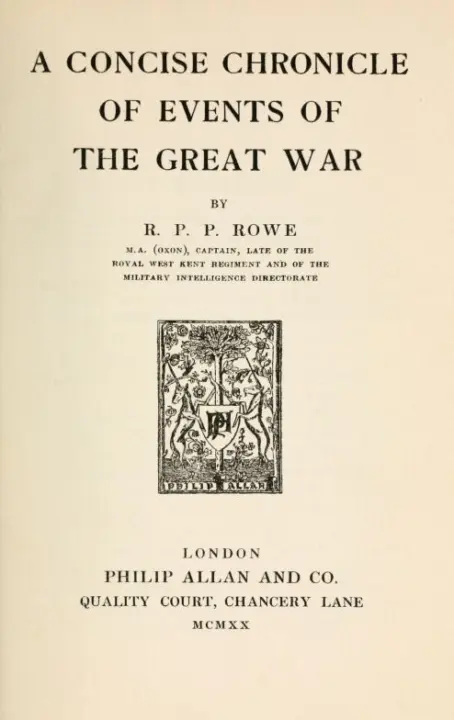
"A Concise Chronicle of Events of the Great War" by R. P. P. Rowe is a historical account written in the early 20th century. The book presents a detailed timeline of key events that transpired during World War I, beginning with the assassination of Archduke Franz Ferdinand and extending through various consequential military actions and diplomatic developments. It aims to serve as a concise and informative record of the war, utilizing authoritative sources to outline the battles and strategies involved. The opening of the chronicle establishes the groundwork for what follows, emphasizing the author's intent to provide a straightforward historical reference. Rowe clarifies the omission of maps due to practical limitations, but assures readers that the locations of key battles and events are accurately indicated. As the text transitions into the year-by-year chronology, it begins with pivotal incidents from 1914, starting with the assassination in Sarajevo, and then detailing the escalating tensions, declarations of war, and significant military engagements through a series of dates and events that create a comprehensive overview of the Great War's complex timeline.
Introduction adapted from the source catalogue; source summaries may be automatically generated.
Free to read · English · 67,463 words · No account needed
MAKE TIME FOR A GOOD BOOK
On by default. Untick to stop anonymous reading totals. Each page counts after 10 seconds in view. How this works.
Anonymous counting is on unless you have switched it off.
The British complete the capture of Bullecourt on the Siegfried line
(see May 12).
The Isonzo Front:--The Italians win the western slopes of Monte
Santo.
U.S.A. destroyers reach British waters.
May 18 (Fri.)
The Isonzo Front:--The Italians win the highest peak of Monte Vodice.
May 19 (Sat.)
Nicaragua breaks off diplomatic relations with Germany.
The Russian Coalition Government issues a declaration repudiating a
separate peace.
May 20 (Sun.)
The French advance near Moronvilliers and take 1000 prisoners: the end of the Second Battle of the Aisne (see April 16).
May 22 (Tues.)
The Hungarian Premier, Count Tisza, resigns.
May 23 (Wed.)
The Isonzo Front:--The Italians advance on a wide front on the Southern Carso, and capture important positions and 9000 prisoners.
A Zeppelin raid on East Anglia.
May 24 (Thur.)
The Isonzo Front:--The Italians make further progress on the
Southern Carso.
May 25 (Fri.)
The Isonzo Front:--The Italians continue to advance on the Southern
Carso.
A raid by 17 German aeroplanes on Folkestone; three German aeroplanes are brought down on the return journey by British naval airmen from Dunkirk.
H.M.S. Hilary (armed merchant cruiser) is sunk by a submarine in
the Atlantic.
May 26 (Sat.)
The British hospital ship Dover Castle is sunk by a submarine in the Mediterranean (6 lives lost).
May 27 (Whit Sunday)
The Isonzo Front:--The Italians reach the third Austrian line of defence; San Giovanni is captured.
May 28 (Mon.)
French Socialists resolve to attend the Stockholm Conference (see
June 1).
May 29 (Tues.)
The French liner Yarra is sunk by a submarine in the Mediterranean.
May 31 (Thur.)
The Austrian Reichsrath is summoned for the first time during the war; the new Emperor Charles promises a more liberal constitution after the war.
June 1 (Fri.)
Great Britain:--Lord Devonport resigns the office of Food Controller
(see June 15).
The French Premier, M. Ribot, announces the refusal of his Government to allow French Socialists to attend the Stockholm Conference (see May 9 and Aug. 13).
British naval aeroplanes bomb the German bases at Bruges, Ostend,
and Zeebrugge.
June 2 (Sat.)
The British transport Cameronian is sunk by a submarine in the
Mediterranean (63 lives lost).
June 3 (Sun.)
Great Allied air-raids on the German aerodromes at Zeebrugge, St.
Denis Westrom, and Bruges.
A French air-raid on Trèves, as a reprisal for the bombardment of
Bar-le-Duc.
June 4 (Mon.)
Resignation of General Alexeieff as Russian Commander-in-Chief; he is succeeded by General Brussiloff (see Aug. 1).
June 5 (Tues.)
An action at long range between British light cruisers and destroyers, under Commodore Tyrwhitt, and six German destroyers; one German destroyer, the S20, is sunk by gunfire.
Ostend is bombarded by British naval forces.
A daylight raid by 18 German aeroplanes on the south-eastern counties of England; two German aeroplanes are destroyed.
June 7 (Thur.)
Your reading position is saved on this browser. Take it to another device with a library code. Reading pages adapt to text, rather than matching a printed edition.
BEHIND THE BOOK
This eBook is for the use of anyone anywhere in the United States and most other parts of the world at no cost and with almost no restrictions whatsoever. You may copy it, give it away or re-use it under the terms of the Project Gutenberg License included with this eBook or online at www.gutenberg.org. If you are not located in the United States, you will have to check the laws of the country where you are located before using this eBook. Read the source licence.
The original source file, including credits and licence, is retained by this library. Request an original-format copy at no charge. Please include the book title and Project Gutenberg identifier #48525.
KEEP YOUR CURIOSITY GOING
Cécile Tormay

Moritz Busch
John L. Ransom
Frances Wright
Cécile Tormay

Mabel Potter Daggett