THE CLASSIC COLLECTION✦An outlaw’s diary: the CommuneCLASSIC FREE BOOKS
An outlaw’s diary: the Commune
Cécile Tormay
THE CLASSIC COLLECTION · 1920
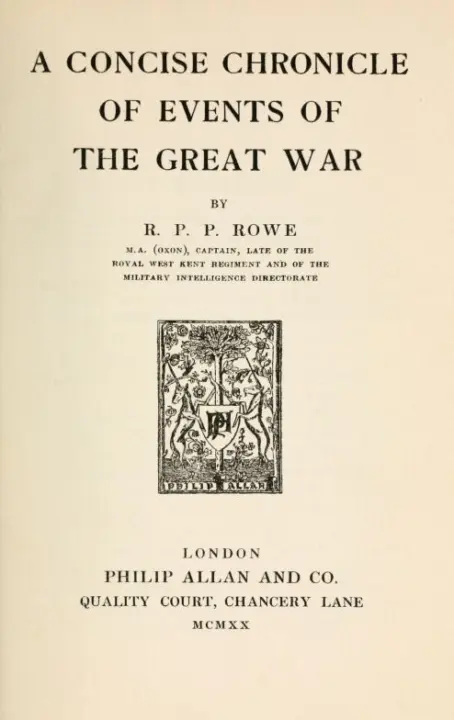
"A Concise Chronicle of Events of the Great War" by R. P. P. Rowe is a historical account written in the early 20th century. The book presents a detailed timeline of key events that transpired during World War I, beginning with the assassination of Archduke Franz Ferdinand and extending through various consequential military actions and diplomatic developments. It aims to serve as a concise and informative record of the war, utilizing authoritative sources to outline the battles and strategies involved. The opening of the chronicle establishes the groundwork for what follows, emphasizing the author's intent to provide a straightforward historical reference. Rowe clarifies the omission of maps due to practical limitations, but assures readers that the locations of key battles and events are accurately indicated. As the text transitions into the year-by-year chronology, it begins with pivotal incidents from 1914, starting with the assassination in Sarajevo, and then detailing the escalating tensions, declarations of war, and significant military engagements through a series of dates and events that create a comprehensive overview of the Great War's complex timeline.
Introduction adapted from the source catalogue; source summaries may be automatically generated.
Free to read · English · 67,463 words · No account needed
MAKE TIME FOR A GOOD BOOK
On by default. Untick to stop anonymous reading totals. Each page counts after 10 seconds in view. How this works.
Anonymous counting is on unless you have switched it off.
The Caucasus:--Mush is abandoned by the Russians (see Aug. 24, 1916).
May 4 (Fri.)
The British gain ground near St. Quentin and Hargicourt; the French take Craonne, carry German trenches on a front of 2½ miles, and capture 1000 prisoners.
The British transport Transylvania is sunk by a submarine in the Mediterranean (over 400 lives lost).
May 5 (Sat.)
Russia:--The Council of Workmen's and Soldiers' Delegates passes
a vote of confidence in the Provisional Government by a narrow
majority.
The French advance on a front of 20 miles north of the Aisne and capture important ground towards Laon; they carry the Chemin-des-Dames and the crest of the Craonne Ridge; over 6000 prisoners are taken.
H.M.S. Lavender (sloop) is sunk by a submarine in the English
Channel.
May 6 (Sun.)
German counter-attacks on the Aisne Front are repulsed, and the French capture 2000 more prisoners.
May 7 (Mon.)
A German attack on the British near Lens is repulsed.
A German aeroplane raid on north-east London in the early morning (1
killed).
May 8 (Tues.)
Liberia breaks off diplomatic relations with Germany.
The Germans attack in strength and recapture Fresnoy from the
British (see May 3).
The French carry an enemy position beyond Chevreux (north-east of
Craonne).
May 9 (Wed.)
A resolution is passed by the Russian Committee of Workmen's and Soldiers' Delegates in favour of an International Socialist Peace Conference to be held at Stockholm (see May 28).
Macedonia:--The British advance near Lake Doiran.
May 10 (Thur.)
A scouting force of light cruisers and destroyers under Commodore Tyrwhitt engage 11 enemy destroyers off Harwich, and chase them back to Zeebrugge.
May 12 (Sat.)
Arras Front:--The British capture important enemy positions and the greater part of Bullecourt (see May 17).
Zeebrugge is bombarded by British naval forces.
May 14 (Mon.)
Great Britain:--Sir Eric Geddes is appointed Controller at the
Admiralty.
The British gain ground north of Gavrelle, and capture Rœux.
The Isonzo Front:--The Italians assume the offensive from Gorizia to
Plava.
May 15 (Tues.)
General Pétain succeeds General Nivelle as Commander-in-Chief of the French army; he is succeeded by General Foch as Chief of Staff.
The Isonzo Front:--The Italians advance on the slopes of Monte Santo.
British naval forces destroy the Zeppelin L 22 in the North Sea.
An Austrian naval force sinks 14 British drifters in the Adriatic
and escapes to harbour.
May 16 (Wed.)
It is announced that Major-General J. L. van Deventer is appointed to supreme command in East Africa, in succession to Major-General Hoskins (see Jan. 28).
Russia:--M. Miliukoff resigns: a Coalition Government is formed, with Prince Lvoff as Premier and M. Kerenski as War Minister.
The end of the First Battle of Arras (see April 9).
May 17 (Thur.)
Honduras breaks off diplomatic relations with Germany.
Your reading position is saved on this browser. Take it to another device with a library code. Reading pages adapt to text, rather than matching a printed edition.
BEHIND THE BOOK
This eBook is for the use of anyone anywhere in the United States and most other parts of the world at no cost and with almost no restrictions whatsoever. You may copy it, give it away or re-use it under the terms of the Project Gutenberg License included with this eBook or online at www.gutenberg.org. If you are not located in the United States, you will have to check the laws of the country where you are located before using this eBook. Read the source licence.
The original source file, including credits and licence, is retained by this library. Request an original-format copy at no charge. Please include the book title and Project Gutenberg identifier #48525.
KEEP YOUR CURIOSITY GOING
Cécile Tormay

Moritz Busch
John L. Ransom
Frances Wright
Cécile Tormay

Mabel Potter Daggett