THE CLASSIC COLLECTION✦An outlaw’s diary: the CommuneCLASSIC FREE BOOKS
An outlaw’s diary: the Commune
Cécile Tormay
THE CLASSIC COLLECTION · 1920
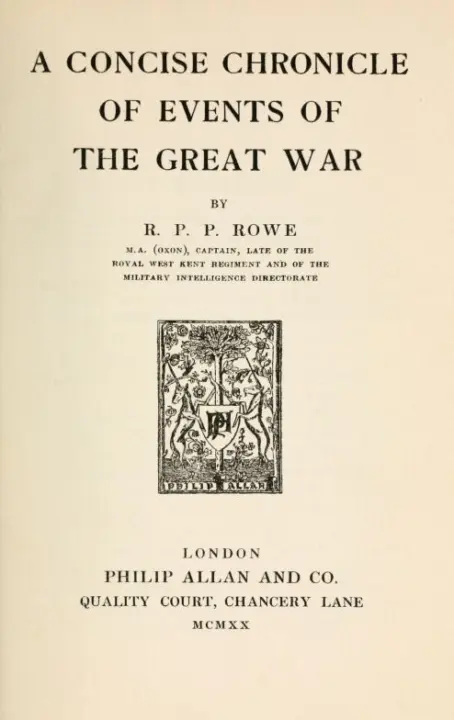
"A Concise Chronicle of Events of the Great War" by R. P. P. Rowe is a historical account written in the early 20th century. The book presents a detailed timeline of key events that transpired during World War I, beginning with the assassination of Archduke Franz Ferdinand and extending through various consequential military actions and diplomatic developments. It aims to serve as a concise and informative record of the war, utilizing authoritative sources to outline the battles and strategies involved. The opening of the chronicle establishes the groundwork for what follows, emphasizing the author's intent to provide a straightforward historical reference. Rowe clarifies the omission of maps due to practical limitations, but assures readers that the locations of key battles and events are accurately indicated. As the text transitions into the year-by-year chronology, it begins with pivotal incidents from 1914, starting with the assassination in Sarajevo, and then detailing the escalating tensions, declarations of war, and significant military engagements through a series of dates and events that create a comprehensive overview of the Great War's complex timeline.
Introduction adapted from the source catalogue; source summaries may be automatically generated.
Free to read · English · 67,463 words · No account needed
MAKE TIME FOR A GOOD BOOK
On by default. Untick to stop anonymous reading totals. Each page counts after 10 seconds in view. How this works.
Anonymous counting is on unless you have switched it off.
The Canadians win back the trenches they had lost at Ypres (from south of Sanctuary Wood to north of Hill 60: see June 2).
The Russian 4th Army advances on Baranovitchi.
In the Baltic, Russian destroyers attack a convoy of German steamers escorted by warships: they sink the German auxiliary cruiser Herrmann and two German torpedo boats.
June 14 (Wed.)
The Allied Economic Conference meets in Paris.
The British occupy Wilhelmsthal, the capital of German East Africa.
June 15 (Thur.)
Fresh German attacks at Verdun.
Russian victories on the Strypa and on the frontiers of Galicia.
Mesopotamia:--A British success on the Tigris.
June 16 (Fri.)
Arabia:--The Grand Sherif of Mecca captures Jeddah from the Turks.
H.M.S. Eden (destroyer) is sunk by a collision in the Channel.
June 17 (Sat.)
Czernowitz is again captured by the Russians.
June 18 (Sun.)
Death of von Moltke.
Immelman, the famous German airman, is shot down by a British airman.
Russian progress continues in the Bukovina.
June 19 (Mon.)
Fierce fighting between the Russians and Austrians before Kovel.
June 21 (Wed.)
A Note is presented to the Greek Government by Great Britain,
France, and Russia, demanding complete demobilisation of the Greek
army.
June 22 (Thur.)
M. Skouloudis, the Greek Premier, resigns and is succeeded by M. Zaimis (see Nov. 4, 1915, and Sept. 11, 1916). Greece accepts the Allies' demands.
The Germans are within three miles of Verdun.
Further Russian progress in the Bukovina.
June 23 (Fri.)
Fierce German attacks at Verdun: Fort Thiaumont is stormed.
Kimpolung (Southern Bukovina) is captured by the Russians.
The Great Eastern Railway Company's steamer Brussels (master, Captain Charles Fryatt) is captured by a German torpedo flotilla and taken to Zeebrugge (see July 27).
June 24 (Sat.)
Verdun:--Fleury is stormed by the Germans; this is the extreme point
of their advance.
The Russians are in possession of almost all the Bukovina.
June 25 (Sun.)
Verdun:--A French success at Fleury.
Asiago is recaptured by the Italians (see May 31); the Austrians are pressed back along the entire Trentino Front.
June 26 (Mon.)
The trial of Sir Roger Casement for high treason begins (see June
29).
June 27 (Tues.)
Western Front:--Heavy bombardments and many trench raids by the
British.
A Russian reverse near Kovel.
The Italians recapture Arsiero (see May 31) and Posina.
June 28 (Wed.)
It is announced in the House of Commons that the British and French Governments have abandoned the Declaration of London.
June 29 (Thur.)
Sir Roger Casement is sentenced to death (see April 21, Aug. 3).
June 30 (Fri.)
Verdun:--The French recapture Fort Thiaumont.
Heavy bombardments of the German lines along the Western Front.
The Russians capture Kolomea (Galicia).
July 1 (Sat.) (The Battle of the Boyne, 1690).
Your reading position is saved on this browser. Take it to another device with a library code. Reading pages adapt to text, rather than matching a printed edition.
BEHIND THE BOOK
This eBook is for the use of anyone anywhere in the United States and most other parts of the world at no cost and with almost no restrictions whatsoever. You may copy it, give it away or re-use it under the terms of the Project Gutenberg License included with this eBook or online at www.gutenberg.org. If you are not located in the United States, you will have to check the laws of the country where you are located before using this eBook. Read the source licence.
The original source file, including credits and licence, is retained by this library. Request an original-format copy at no charge. Please include the book title and Project Gutenberg identifier #48525.
KEEP YOUR CURIOSITY GOING
Cécile Tormay

Moritz Busch
John L. Ransom
Frances Wright
Cécile Tormay

Mabel Potter Daggett