THE CLASSIC COLLECTION✦An outlaw’s diary: the CommuneCLASSIC FREE BOOKS
An outlaw’s diary: the Commune
Cécile Tormay
THE CLASSIC COLLECTION · 1920
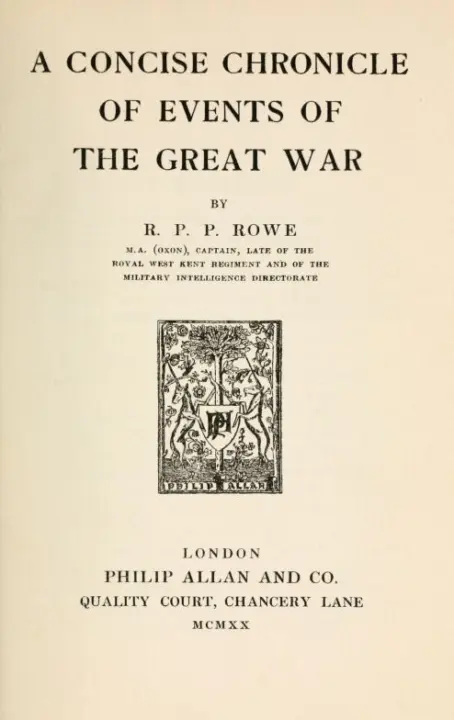
"A Concise Chronicle of Events of the Great War" by R. P. P. Rowe is a historical account written in the early 20th century. The book presents a detailed timeline of key events that transpired during World War I, beginning with the assassination of Archduke Franz Ferdinand and extending through various consequential military actions and diplomatic developments. It aims to serve as a concise and informative record of the war, utilizing authoritative sources to outline the battles and strategies involved. The opening of the chronicle establishes the groundwork for what follows, emphasizing the author's intent to provide a straightforward historical reference. Rowe clarifies the omission of maps due to practical limitations, but assures readers that the locations of key battles and events are accurately indicated. As the text transitions into the year-by-year chronology, it begins with pivotal incidents from 1914, starting with the assassination in Sarajevo, and then detailing the escalating tensions, declarations of war, and significant military engagements through a series of dates and events that create a comprehensive overview of the Great War's complex timeline.
Introduction adapted from the source catalogue; source summaries may be automatically generated.
Free to read · English · 67,463 words · No account needed
MAKE TIME FOR A GOOD BOOK
On by default. Untick to stop anonymous reading totals. Each page counts after 10 seconds in view. How this works.
Anonymous counting is on unless you have switched it off.
The Germans win successes at Verdun and Vimy.
Italy:--Bettale is taken by the Austrians.
May 26 (Fri.)
The Bulgarians and Germans advance into Greek Macedonia and capture
Fort Rupel.
May 29 (Mon.)
A great German attack at Verdun: the French line holds.
A renewed British advance in German East Africa: Neu Langenburg is
occupied.
May 30 (Tues.)
Verdun:--The French abandon the Bethincourt-Cumières road.
Italy:--The battle for the Pass of Buola.
East Africa:--A Belgian force invades Ruanda.
May 31 (Wed.) Union Day, South Africa, 1910.
The Battle of Jutland is fought between the main British and German
fleets: the German fleet, with considerable loss, escapes aided by
mist.[3]
[3] The following were the British vessels lost in this action:--
Battle Cruisers--
Indefatigable
Invincible
Queen Mary
Cruisers--
Black Prince
Defence
Warrior
Flotilla leader--
Tipperary
Destroyers--
Ardent
Fortune
Nestor
Nomad
Shark
Sparrowhawk
Turbulent
The larger German vessels known to have been sunk were the
following:--
Lutzow, Pommern, Frauenlob, Wiesbaden, Elbing, Rostock.
Italy:--Asiago and Arsiero are captured by the Austrians (see June
25 and 27).
The Caucasus:--Mamakhatun is retaken by the Turks (see March 14 and
July 12).
June 1 (Thur.)
Verdun:--The Germans begin a fresh attack on Fort Vaux.
June 2 (Fri.)
The Germans capture trenches from the Canadians at Ypres (see June 13), and from the French at Verdun.
June 4 (Sun.)
Verdun:--Fort Vaux is isolated.
A great Russian offensive is launched in the Bukovina and the Ukraine (with the 8th and 9th Armies): rapid progress is made, and many thousands of prisoners are captured.
The end of the Battle of the Trentino: the Austrian advance is
checked (see May 14).
June 5 (Mon.)
H.M.S. Hampshire is sunk off the Orkneys and Lord Kitchener
drowned.
June 6 (Tues.)
The Germans gain ground from the British at Hooge.
Verdun:--Fierce German attacks on Fort Vaux.
The Russians capture Lutsk from the Austrians.
June 7 (Wed.)
Verdun:--Fort Vaux is captured by the Germans.
June 8 (Thur.)
The Russian 7th Army launches an offensive in Eastern Galicia:
Buczacz is captured.
June 9 (Fri.)
The War Council of the Allies meets in London.
Arabia:--The Emir Hussein, Grand Sherif of Mecca, revolts against the Turks and gains possession of Mecca.
The Italian transport Principe Umberto is sunk by a submarine in the Adriatic (many lives lost).
June 10 (Sat.)
A great Russian victory near Czernowitz: 35,000 prisoners are
captured.
East Africa:--Momba is occupied by the British.
June 11 (Whit Sunday)
Verdun:--A German advance near Thiaumont.
Venice is bombed by Austrian seaplanes.
June 12 (Mon.)
The Germans are within four miles of Verdun.
A further Russian advance in the Bukovina.
Southern Persia:--Kerman is occupied by a British force.
June 13 (Tues.)
Your reading position is saved on this browser. Take it to another device with a library code. Reading pages adapt to text, rather than matching a printed edition.
BEHIND THE BOOK
This eBook is for the use of anyone anywhere in the United States and most other parts of the world at no cost and with almost no restrictions whatsoever. You may copy it, give it away or re-use it under the terms of the Project Gutenberg License included with this eBook or online at www.gutenberg.org. If you are not located in the United States, you will have to check the laws of the country where you are located before using this eBook. Read the source licence.
The original source file, including credits and licence, is retained by this library. Request an original-format copy at no charge. Please include the book title and Project Gutenberg identifier #48525.
KEEP YOUR CURIOSITY GOING
Cécile Tormay

Moritz Busch
John L. Ransom
Frances Wright
Cécile Tormay

Mabel Potter Daggett