
Life of Edwin Forrest, the American Tragedian. Volume 2 (of 2)
William Rounseville Alger & Horatio, Jr. Alger
THE CLASSIC COLLECTION · 1898
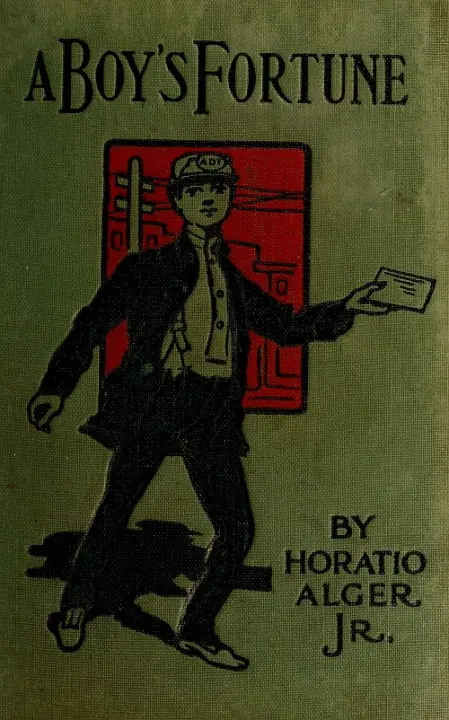
"A Boy's Fortune; Or, The Strange Adventures of Ben Baker" by Horatio Alger, Jr. is a novel written in the late 19th century. The story follows the journey of Ben Baker, a sixteen-year-old boy from the countryside who arrives in New York City with hopes of making a fortune and learning about business. As he navigates the challenges of urban life, he encounters various characters that influence his path, including his estranged uncle, Nicholas Walton, and new friends like a kind reporter named Hugh Manton. The opening of the novel introduces Ben as he spends his first night in the city, having fallen asleep on a park bench. A policeman offers him guidance, leading him to a restaurant where he meets Manton. The young boy's situation is precarious, having just arrived in New York with little money and no place to stay. After enjoying a meal and discussing dreams of success, Ben is offered a place to sleep by Manton, setting him on a path of new adventures. The chapter hints at the complexities of family relations, as Ben's uncle, unbeknownst to him, harbors a deep secret regarding Ben's father, suggesting that his quest for fortune may involve more than just hard work.
Introduction adapted from the source catalogue; source summaries may be automatically generated.
Free to read · English · 51,613 words · No account needed
MAKE TIME FOR A GOOD BOOK
On by default. Untick to stop anonymous reading totals. Each page counts after 10 seconds in view. How this works.
Anonymous counting is on unless you have switched it off.
Again they found themselves in Geneva, which Ben thought, on the whole, a pleasant place of residence. Here, too, he could make abundant use of his new acquisition, and did not fail to avail himself of his opportunity. So he enjoyed his stay in the charming Swiss city until one day he made an astounding discovery.
The most interesting walk in Geneva is along the borders of the lake. Near it are placed seats on which the visitor may sit and survey the unequalled view.
Ben had seated himself one day, with a French book in his hand, which he was studying, when he observed a couple of ladies seat themselves near him. He would have given them no further thought if by chance the name of Major Grafton, spoken by one of them, had not reached his ears.
"I see that Major Grafton is here," said one. "You know we met him
at Florence."
"Yes, the one who had the sick boy with him."
"The same."
"It was his son, was it not?"
"I thought so at the time, but I have since learned that I was mistaken. He was the boy's guardian."
"The boy died, did he not?"
"Yes, and it must have been a serious calamity to him."
"You mean that he was very much attached to the boy?"
"No, I don't mean that. On the contrary, he appeared to care very little for him. It was the pecuniary loss I was thinking of."
"Explain yourself."
"You must know, then, that the boy was heir to a large fortune, the income of which, during his minority, was payable to Major Grafton for his benefit. No doubt the guardian made a good thing out of it. He probably made it pay both the boy's expenses and his own."
"Then, on the boy's death, he would lose this income?"
"Precisely."
"It is strange," said the younger lady; "but he still has a boy with
him."
"He has?" inquired the other, in surprise.
"The name he calls him is Philip."
"That was the name of the boy who died."
"Are you sure that he died? Are you sure that this is not the same
boy?"
"Positive."
"It is very singular. A strange idea has occurred to me."
"What is it?"
"What if he is passing off this boy for the first, in order to retain the liberal income which he received as guardian?"
"But that would be fraudulent."
"That is true; but I think Major Grafton would be capable of it. I hear from my brother that he gambles, and a gambler is not apt to be overburdened with principle."
Your reading position is saved on this browser. Take it to another device with a library code. Reading pages adapt to text, rather than matching a printed edition.
William Rounseville Alger & Horatio, Jr. Alger

William Rounseville Alger & Horatio, Jr. Alger

Horatio, Jr. Alger

Horatio, Jr. Alger
BEHIND THE BOOK
This eBook is for the use of anyone anywhere in the United States and most other parts of the world at no cost and with almost no restrictions whatsoever. You may copy it, give it away or re-use it under the terms of the Project Gutenberg License included with this eBook or online at www.gutenberg.org. If you are not located in the United States, you will have to check the laws of the country where you are located before using this eBook. Read the source licence.
The original source file, including credits and licence, is retained by this library. Request an original-format copy at no charge. Please include the book title and Project Gutenberg identifier #52017.
KEEP YOUR CURIOSITY GOING
Coulson Kernahan

Maurice Baring
Frances Wright
Cécile Tormay

Frederic Jesup Stimson

W. H. P. (William Henry Pope) Jarvis