
Life of Edwin Forrest, the American Tragedian. Volume 2 (of 2)
William Rounseville Alger & Horatio, Jr. Alger
THE CLASSIC COLLECTION · 1898
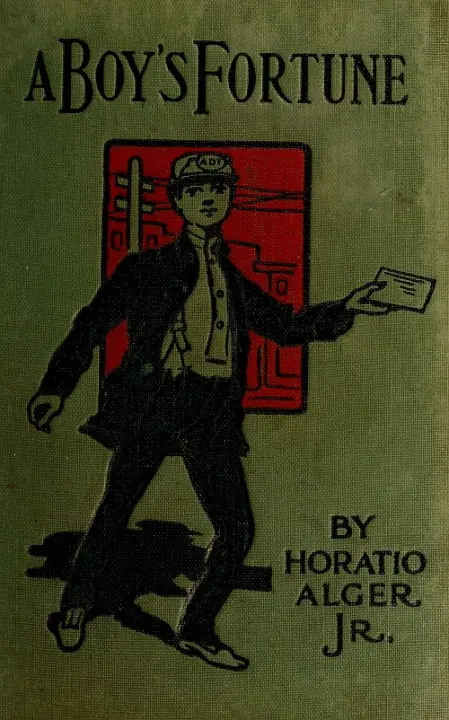
"A Boy's Fortune; Or, The Strange Adventures of Ben Baker" by Horatio Alger, Jr. is a novel written in the late 19th century. The story follows the journey of Ben Baker, a sixteen-year-old boy from the countryside who arrives in New York City with hopes of making a fortune and learning about business. As he navigates the challenges of urban life, he encounters various characters that influence his path, including his estranged uncle, Nicholas Walton, and new friends like a kind reporter named Hugh Manton. The opening of the novel introduces Ben as he spends his first night in the city, having fallen asleep on a park bench. A policeman offers him guidance, leading him to a restaurant where he meets Manton. The young boy's situation is precarious, having just arrived in New York with little money and no place to stay. After enjoying a meal and discussing dreams of success, Ben is offered a place to sleep by Manton, setting him on a path of new adventures. The chapter hints at the complexities of family relations, as Ben's uncle, unbeknownst to him, harbors a deep secret regarding Ben's father, suggesting that his quest for fortune may involve more than just hard work.
Introduction adapted from the source catalogue; source summaries may be automatically generated.
Free to read · English · 51,613 words · No account needed
MAKE TIME FOR A GOOD BOOK
On by default. Untick to stop anonymous reading totals. Each page counts after 10 seconds in view. How this works.
Anonymous counting is on unless you have switched it off.
When Clarence Plantagenet saw his poor country cousin marching up Broadway escorted by a policeman he was very much surprised, but on the whole he was not displeased.
"Do you know that boy?" asked his companion.
"No, certainly not," answered Clarence, coloring.
"I thought you looked as if you did."
"He looks like a boy I met in the country last summer," was the
evasive answer.
"Poor devil! I wonder what he has been doing."
"Stealing, very likely," said Clarence, shrugging his shoulders.
"He doesn't look like a thief."
"Appearances are deceitful," said Clarence, oracularly.
At the supper-table, where Clarence met his father for the first time since he had called at his office, he said:
"Oh, papa, what do you think? That country boy I saw in your office
has got into trouble."
"Do you mean your cousin Benjamin?"
"I suppose he is my cousin," said Clarence, reluctantly, "but I don't care about knowing him for a relation. I saw him on Broadway in charge of a policeman."
"Are you sure of this?" said Mr. Walton, much surprised.
"Yes; I knew him well enough by his clothes."
Clarence then gave an account of his meeting Ben.
"Did you speak to him?" asked his father.
"Mercy, no! Percy Van Dyke was with me. I wouldn't for a hundred dollars have him know that I had a cousin arrested, and such a countryfied-looking cousin, too."
"I think Benjamin would be a good-looking boy if he were well
dressed," said Mr. Walton.
"I don't," said Clarence, decidedly.
"I am sorry to hear he has got into trouble," said Mr. Walton, who
was not so mean as his son. "I think I ought to do something to help
him."
"Better leave him to his fate, pa. No doubt he is a bad boy."
"I can't understand why he should be. My sister is poor but an excellent woman, and his father was an exemplary man."
"I don't think we have any call to trouble ourselves about this boy," said Clarence. "He has disgraced us, and we couldn't do anything without having it all come out."
"By the way, Clarence, I have two tickets to the Grand Opera House this evening; would you like to go?"
"Just the thing, pa; I was wondering what we should do to pass the
time."
"Edwin Booth is to appear as Cardinal Richelieu. It is one of his best characters. It will be a rare treat."
"Percy Van Dyke is to be there with his sister," said Clarence. "That is the reason why he wouldn't take supper with me at Delmonico's this evening."
Your reading position is saved on this browser. Take it to another device with a library code. Reading pages adapt to text, rather than matching a printed edition.
William Rounseville Alger & Horatio, Jr. Alger

William Rounseville Alger & Horatio, Jr. Alger

Horatio, Jr. Alger

Horatio, Jr. Alger
BEHIND THE BOOK
This eBook is for the use of anyone anywhere in the United States and most other parts of the world at no cost and with almost no restrictions whatsoever. You may copy it, give it away or re-use it under the terms of the Project Gutenberg License included with this eBook or online at www.gutenberg.org. If you are not located in the United States, you will have to check the laws of the country where you are located before using this eBook. Read the source licence.
The original source file, including credits and licence, is retained by this library. Request an original-format copy at no charge. Please include the book title and Project Gutenberg identifier #52017.
KEEP YOUR CURIOSITY GOING
Coulson Kernahan

Maurice Baring
Frances Wright
Cécile Tormay

Frederic Jesup Stimson

W. H. P. (William Henry Pope) Jarvis