
Life of Edwin Forrest, the American Tragedian. Volume 2 (of 2)
William Rounseville Alger & Horatio, Jr. Alger
THE CLASSIC COLLECTION · 1898
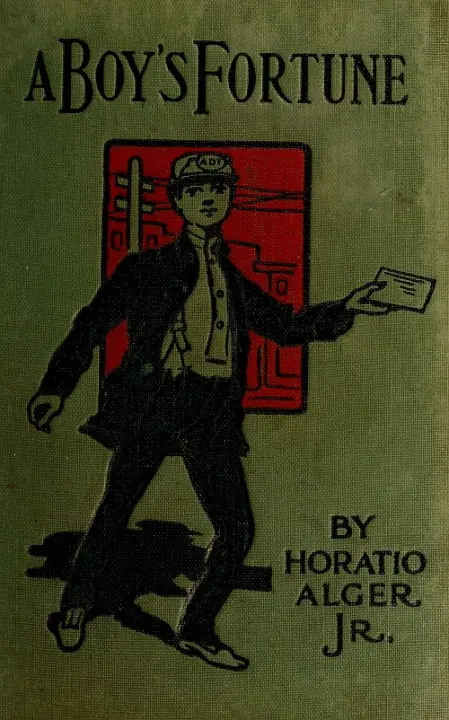
"A Boy's Fortune; Or, The Strange Adventures of Ben Baker" by Horatio Alger, Jr. is a novel written in the late 19th century. The story follows the journey of Ben Baker, a sixteen-year-old boy from the countryside who arrives in New York City with hopes of making a fortune and learning about business. As he navigates the challenges of urban life, he encounters various characters that influence his path, including his estranged uncle, Nicholas Walton, and new friends like a kind reporter named Hugh Manton. The opening of the novel introduces Ben as he spends his first night in the city, having fallen asleep on a park bench. A policeman offers him guidance, leading him to a restaurant where he meets Manton. The young boy's situation is precarious, having just arrived in New York with little money and no place to stay. After enjoying a meal and discussing dreams of success, Ben is offered a place to sleep by Manton, setting him on a path of new adventures. The chapter hints at the complexities of family relations, as Ben's uncle, unbeknownst to him, harbors a deep secret regarding Ben's father, suggesting that his quest for fortune may involve more than just hard work.
Introduction adapted from the source catalogue; source summaries may be automatically generated.
Free to read · English · 51,613 words · No account needed
MAKE TIME FOR A GOOD BOOK
On by default. Untick to stop anonymous reading totals. Each page counts after 10 seconds in view. How this works.
Anonymous counting is on unless you have switched it off.
Mrs. Tilton's house was ablaze with light, for it was the evening of the great party. Ambitious of social distinction, she took care to do things on a handsome scale, though she was not averse to saving money where it would not attract attention.
Among the young ladies present were two with whom we are especially concerned. One of them was Arethusa Jayne, who was dressed with more splendor than taste. She made a profuse display of jewelry, some of which, we may confidentially inform the reader, was borrowed from a well-known jeweler, who was handsomely paid for the favor. Of course no one suspected this, and the society young men were misled into thinking that the owner of so many diamonds must be very rich. This was precisely what Arethusa desired, for she was in the market, and had been for more years than she liked to remember.
Another young lady, still better known to us, was Rose Beaufort. She was the most plainly dressed young lady in the handsome parlors, yet she attracted an unusual share of attention.
"Who is that pretty young lady?" asked a middle-aged lady of
Arethusa.
"That?" answered Miss Jayne, with a sneer. "Oh, that is Miss
Beaufort, the music-teacher."
"She is very sweet-looking."
"Do you think so? I don't at all agree with you. To me she looks very artful, and I have reason to think that beneath her innocent exterior there is something quite different."
"That is a pity."
"It is not surprising. Still water runs deep, you know."
Rose kept in the background. She had no wish to make herself conspicuous at Mrs. Tilton's gay party. She would rather not have been there, but did not wish to disappoint her employer.
"Ah, here you are, Miss Beaufort," said a glad voice.
Rose looked up, and her face flushed with pleasure as she recognized
Clinton Randall.
"I did not think you would find me," she said.
"I was sure to do it. I have been looking for you everywhere. Can't
you spare a seat for me?"
Rose moved, and Clinton sat down beside her on the sofa. He had scarcely been there two minutes, however, when Arethusa discovered them. She went straightway to her aunt.
"Aunt Lucy," she said, in a low voice, "look at the sofa opposite."
"Well?" said Mrs. Tilton, who was rather short-sighted.
"There is your precious music-teacher monopolizing Clinton Randall.
Didn't I tell you?"
"I am really shocked at her brazen ways. You were right, Arethusa."
"For goodness' sake, separate them before the whole room notices
them."
"How can I do it?"
"Send her to the piano."
Your reading position is saved on this browser. Take it to another device with a library code. Reading pages adapt to text, rather than matching a printed edition.
William Rounseville Alger & Horatio, Jr. Alger

William Rounseville Alger & Horatio, Jr. Alger

Horatio, Jr. Alger

Horatio, Jr. Alger
BEHIND THE BOOK
This eBook is for the use of anyone anywhere in the United States and most other parts of the world at no cost and with almost no restrictions whatsoever. You may copy it, give it away or re-use it under the terms of the Project Gutenberg License included with this eBook or online at www.gutenberg.org. If you are not located in the United States, you will have to check the laws of the country where you are located before using this eBook. Read the source licence.
The original source file, including credits and licence, is retained by this library. Request an original-format copy at no charge. Please include the book title and Project Gutenberg identifier #52017.
KEEP YOUR CURIOSITY GOING
Coulson Kernahan

Maurice Baring
Frances Wright
Cécile Tormay

Frederic Jesup Stimson

W. H. P. (William Henry Pope) Jarvis