
Life of Edwin Forrest, the American Tragedian. Volume 2 (of 2)
William Rounseville Alger & Horatio, Jr. Alger
THE CLASSIC COLLECTION · 1898
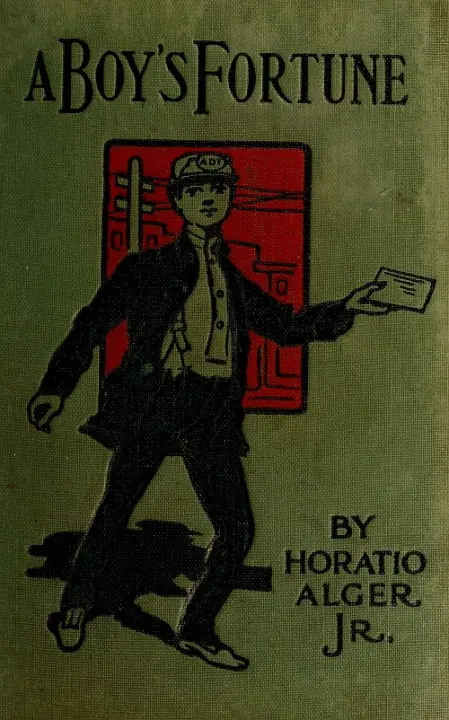
"A Boy's Fortune; Or, The Strange Adventures of Ben Baker" by Horatio Alger, Jr. is a novel written in the late 19th century. The story follows the journey of Ben Baker, a sixteen-year-old boy from the countryside who arrives in New York City with hopes of making a fortune and learning about business. As he navigates the challenges of urban life, he encounters various characters that influence his path, including his estranged uncle, Nicholas Walton, and new friends like a kind reporter named Hugh Manton. The opening of the novel introduces Ben as he spends his first night in the city, having fallen asleep on a park bench. A policeman offers him guidance, leading him to a restaurant where he meets Manton. The young boy's situation is precarious, having just arrived in New York with little money and no place to stay. After enjoying a meal and discussing dreams of success, Ben is offered a place to sleep by Manton, setting him on a path of new adventures. The chapter hints at the complexities of family relations, as Ben's uncle, unbeknownst to him, harbors a deep secret regarding Ben's father, suggesting that his quest for fortune may involve more than just hard work.
Introduction adapted from the source catalogue; source summaries may be automatically generated.
Free to read · English · 51,613 words · No account needed
MAKE TIME FOR A GOOD BOOK
On by default. Untick to stop anonymous reading totals. Each page counts after 10 seconds in view. How this works.
Anonymous counting is on unless you have switched it off.
In one of the large business buildings appropriated chiefly to offices, within a stone's throw of Printing-House Square, were the commodious offices of Nathan Codicil, a prominent lawyer, whose business related chiefly to the estates of wealthy clients.
Mr. Codicil himself was a dignified-looking gentleman, of grave aspect, whose whitening locks seemed to indicate that he had reached the age of threescore. He was a cautious, careful, trustworthy man, whose reputation was deservedly high.
Mr. Grafton and Ben, stepping out of the elevator, paused before the door of Mr. Codicil's office for a moment, when the former opened the door and entered.
"You may sit down here, Philip, while I go in and speak to Mr. Codicil," said Mr. Grafton, indicating a chair near the door.
"I wish he wouldn't call me Philip," thought Ben. "I like my own
name much better."
He did not complain aloud, however, for he felt that his salary
was liberal enough to compensate him for some slight sacrifice of
feeling.
"Good morning, Mr. Grafton," said the lawyer, advancing to meet his
visitor.
"Good morning, Mr. Codicil; I am glad to find you in, for I've made quite an effort to reach your office at an early hour. You observe I have brought the boy with me."
The sharp eyes of the lawyer had not failed to note the presence of
Ben.
"You observe that he is in excellent health, despite all reports to
the contrary."
"So it appears," said the lawyer. "He seems to have lost all
resemblance to the family."
"Do you think so?" said Grafton, carelessly. "Opinions differ about that. For my own part, I can see the resemblance plainly."
"How old is he now?"
"Sixteen."
"I have not seen him since he was four years of age."
"Twelve years effect many changes."
"Very true."
"And now, Mr. Codicil, as I have another engagement very soon, if you can conveniently attend to our little business at once--"
"Certainly, sir."
Mr. Codicil prepared a receipt which he requested Mr. Grafton to sign. He then opened a check-book and filled a check for a large amount, which he handed to his visitor. The latter pocketed it with evident satisfaction.
"I hope, Mr. Codicil, you are not disappointed to know that the boy
is still alive?" he said.
"Heaven knows that I wish no harm to the lad!" said the lawyer, warmly. "Yet, when I consider how his poor cousins are compelled to struggle for a living, I cannot help regretting the injustice of old John Portland's will, which maintains one grandchild in luxury, while three others, having equal natural claims, should be thrown on the cold mercies of the world."
Your reading position is saved on this browser. Take it to another device with a library code. Reading pages adapt to text, rather than matching a printed edition.
William Rounseville Alger & Horatio, Jr. Alger

William Rounseville Alger & Horatio, Jr. Alger

Horatio, Jr. Alger

Horatio, Jr. Alger
BEHIND THE BOOK
This eBook is for the use of anyone anywhere in the United States and most other parts of the world at no cost and with almost no restrictions whatsoever. You may copy it, give it away or re-use it under the terms of the Project Gutenberg License included with this eBook or online at www.gutenberg.org. If you are not located in the United States, you will have to check the laws of the country where you are located before using this eBook. Read the source licence.
The original source file, including credits and licence, is retained by this library. Request an original-format copy at no charge. Please include the book title and Project Gutenberg identifier #52017.
KEEP YOUR CURIOSITY GOING
Coulson Kernahan

Maurice Baring
Frances Wright
Cécile Tormay

Frederic Jesup Stimson

W. H. P. (William Henry Pope) Jarvis