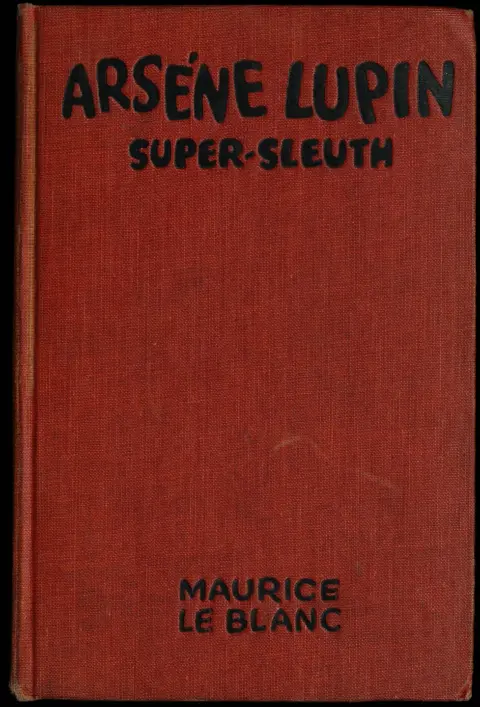
Arsène Lupin, super-sleuth
Maurice Leblanc
THE CLASSIC COLLECTION · 1910
"813" by Maurice Leblanc is a suspenseful detective novel written in the early 20th century. The story revolves around the enigmatic character Arsène Lupin, a gentleman burglar, as he engages in a thrilling game of cat and mouse with the authorities after committing a series of crimes, including a shocking murder. The novel introduces readers to a high-stakes world of intrigue, where Kesselbach, a wealthy man, becomes embroiled in a plot that threatens not only his life but also his ambitions. The opening of "813" sets a tense atmosphere with Mr. Kesselbach discovering that someone has invaded his hotel suite while he was away. Anxious and paranoid, he discusses strange occurrences with his secretary, Chapman, pointing out the peculiarities in their situation. When the mysterious Arsène Lupin makes his dramatic entrance, the tension escalates to a confrontation filled with twists and a daring heist, leaving readers breathless and eager to uncover the secrets surrounding Kesselbach's wealth and ambitions, as well as Lupin's true motives.
Introduction adapted from the source catalogue; source summaries may be automatically generated.
Free to read · English · 109,524 words · No account needed
MAKE TIME FOR A GOOD BOOK
On by default. Untick to stop anonymous reading totals. Each page counts after 10 seconds in view. How this works.
Anonymous counting is on unless you have switched it off.
A cyclone passed through Lupin's brain, a hurricane in which roars of thunder, gusts of wind, squalls of all the distraught elements were tumultuously unchained in the chaotic night.
And great flashes of lightning shot through the darkness. And, by the dazzling gleam of those lightning-flashes, Lupin, scared, shaken with thrills, convulsed with horror, saw and tried to understand.
He did not move, clinging to the enemy's throat, as if his stiffened fingers were no longer able to release their grip. Besides, although he now knew, he had not, so to speak, the exact feeling that it was Dolores. It was still the man in black, Louis de Malreich, the foul brute of the darkness; and that brute he held and did not mean to let go.
But the truth rushed upon the attack of his mind and of his consciousness; and, conquered, tortured with anguish, he muttered:
"Oh, Dolores! . . . Dolores! . . ."
He at once saw the excuse: it was madness. She was mad. The sister of Altenheim and Isilda, the daughter of the last of the Malreichs, of the demented mother, of the drunken father, was herself mad. A strange madwoman, mad with every appearance of sanity, but mad nevertheless, unbalanced, brain-sick, unnatural, truly monstrous.
That he most certainly understood! It was homicidal madness. Under the obsession of an object toward which she was drawn automatically, she killed, thirsting for blood, unconsciously, infernally.
She killed because she wanted something, she killed in self-defence, she killed because she had killed before. But she killed also and especially for the sake of killing. Murder satisfied sudden and irresistible appetites that arose in her. At certain seconds in her life, in certain circumstances, face to face with this or that being who had suddenly become the foe, her arm had to strike.
And she struck, drunk with rage, ferociously, frenziedly.
A strange madwoman, not answerable for her murders, and yet so lucid in her blindness, so logical in her mental derangement, so intelligent in her absurdity! What skill, what perseverance, what cunning contrivances, at once abominable and admirable!
And Lupin, in a rapid view, with prodigious keenness of outlook, saw the long array of bloodthirsty adventures and guessed the mysterious paths which Dolores had pursued.
He saw her obsessed and possessed by her husband's scheme, a scheme which she evidently understood only in part. He saw her, on her side, looking for that same Pierre Leduc whom her husband was seeking, looking for him in order to marry him and to return, as queen, to that little realm of Veldenz from which her parents had been ignominiously driven.
Your reading position is saved on this browser. Take it to another device with a library code. Reading pages adapt to text, rather than matching a printed edition.
Maurice Leblanc

Maurice Leblanc
Maurice Leblanc

Maurice Leblanc
BEHIND THE BOOK
This eBook is for the use of anyone anywhere in the United States and most other parts of the world at no cost and with almost no restrictions whatsoever. You may copy it, give it away or re-use it under the terms of the Project Gutenberg License included with this eBook or online at www.gutenberg.org. If you are not located in the United States, you will have to check the laws of the country where you are located before using this eBook. Read the source licence.
The original source file, including credits and licence, is retained by this library. Request an original-format copy at no charge. Please include the book title and Project Gutenberg identifier #34758.
KEEP YOUR CURIOSITY GOING
Coulson Kernahan

Maurice Baring
Frances Wright
Cécile Tormay

Frederic Jesup Stimson

W. H. P. (William Henry Pope) Jarvis