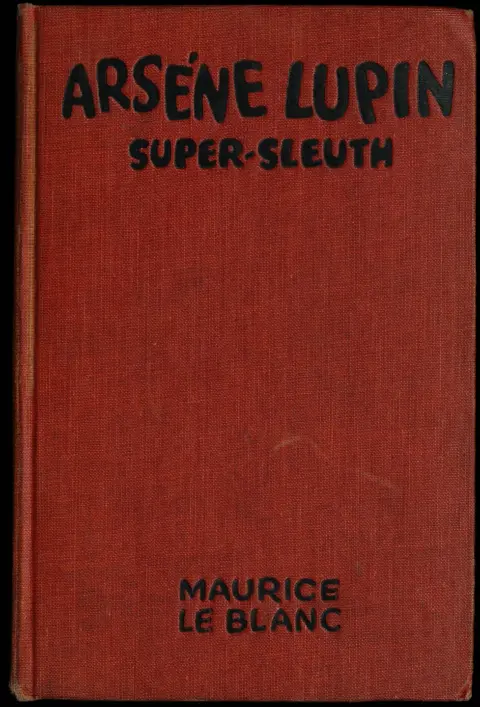
Arsène Lupin, super-sleuth
Maurice Leblanc
THE CLASSIC COLLECTION · 1910
"813" by Maurice Leblanc is a suspenseful detective novel written in the early 20th century. The story revolves around the enigmatic character Arsène Lupin, a gentleman burglar, as he engages in a thrilling game of cat and mouse with the authorities after committing a series of crimes, including a shocking murder. The novel introduces readers to a high-stakes world of intrigue, where Kesselbach, a wealthy man, becomes embroiled in a plot that threatens not only his life but also his ambitions. The opening of "813" sets a tense atmosphere with Mr. Kesselbach discovering that someone has invaded his hotel suite while he was away. Anxious and paranoid, he discusses strange occurrences with his secretary, Chapman, pointing out the peculiarities in their situation. When the mysterious Arsène Lupin makes his dramatic entrance, the tension escalates to a confrontation filled with twists and a daring heist, leaving readers breathless and eager to uncover the secrets surrounding Kesselbach's wealth and ambitions, as well as Lupin's true motives.
Introduction adapted from the source catalogue; source summaries may be automatically generated.
Free to read · English · 109,524 words · No account needed
MAKE TIME FOR A GOOD BOOK
On by default. Untick to stop anonymous reading totals. Each page counts after 10 seconds in view. How this works.
Anonymous counting is on unless you have switched it off.
A ground-floor flat, at the corner of the Boulevard Haussmann and the Rue de Courcelles. Here lived Prince Sernine: Prince Sernine, one of the most brilliant members of the Russian colony in Paris, whose name was constantly recurring in the "Arrivals and Departures" column in the newspapers.
Eleven o'clock in the morning. The prince entered his study. He was a man of thirty-eight or forty years of age, whose chestnut hair was mingled with a few silver threads on the temples. He had a fresh, healthy complexion and wore a large mustache and a pair of whiskers cut extremely short, so as to be hardly noticeable against the fresh skin of his cheeks.
He was smartly dressed in a tight-fitting frock-coat and a white drill waistcoat, which showed above the opening.
"Come on!" he said, in an undertone. "I have a hard day's work before
me, I expect."
He opened a door leading into a large room where a few people sat
waiting, and said:
"Is Varnier there? Come in, Varnier."
A man looking like a small tradesman, squat, solidly built, firmly set upon his legs, entered at the summons. The prince closed the door behind him:
"Well, Varnier, how far are you?"
"Everything's ready for this evening, governor."
"Good. Tell me in a few words."
"It's like this. After her husband's murder, Mrs. Kesselbach, on the strength of the prospectuses which you ordered to be sent to her, selected as her residence the establishment known as the Retreat for Gentlewomen, at Garches. She occupies the last of the four small houses, at the bottom of the garden, which the management lets to ladies who prefer to live quite apart from the other boarders, the house known as the Pavillon de l'Impératrice."
"What servants has she?"
"Her companion, Gertrude, with whom she arrived a few hours after the crime, and Gertrude's sister Suzanne, whom she sent for to Monte Carlo and who acts as her maid. The two sisters are devoted to her."
"What about Edwards, the valet?"
"She did not keep him. He has gone back to his own country."
"Does she see people?"
"No. She spends her time lying on a sofa. She seems very weak and ill. She cries a great deal. Yesterday the examining-magistrate was with her for two hours."
"Very good. And now about the young girl."
"Mlle. Geneviève Ernemont lives across the way . . . in a lane running toward the open country, the third house on the right in the lane. She keeps a free school for backward children. Her grandmother, Mme. Ernemont, lives with her."
"And, according to what you wrote to me, Geneviève Ernemont and Mrs. Kesselbach have become acquainted?"
Your reading position is saved on this browser. Take it to another device with a library code. Reading pages adapt to text, rather than matching a printed edition.
Maurice Leblanc
Maurice Leblanc
Maurice Leblanc

Maurice Leblanc
BEHIND THE BOOK
This eBook is for the use of anyone anywhere in the United States and most other parts of the world at no cost and with almost no restrictions whatsoever. You may copy it, give it away or re-use it under the terms of the Project Gutenberg License included with this eBook or online at www.gutenberg.org. If you are not located in the United States, you will have to check the laws of the country where you are located before using this eBook. Read the source licence.
The original source file, including credits and licence, is retained by this library. Request an original-format copy at no charge. Please include the book title and Project Gutenberg identifier #34758.
KEEP YOUR CURIOSITY GOING
Coulson Kernahan

Maurice Baring
Frances Wright
Cécile Tormay

Frederic Jesup Stimson

W. H. P. (William Henry Pope) Jarvis