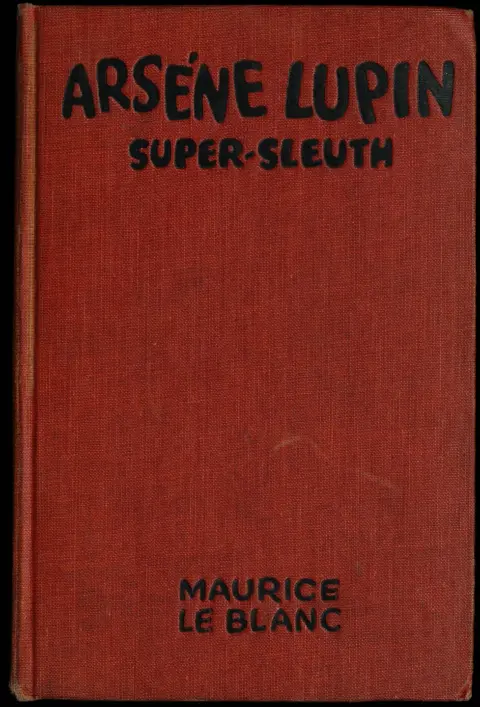
Arsène Lupin, super-sleuth
Maurice Leblanc
THE CLASSIC COLLECTION · 1910
"813" by Maurice Leblanc is a suspenseful detective novel written in the early 20th century. The story revolves around the enigmatic character Arsène Lupin, a gentleman burglar, as he engages in a thrilling game of cat and mouse with the authorities after committing a series of crimes, including a shocking murder. The novel introduces readers to a high-stakes world of intrigue, where Kesselbach, a wealthy man, becomes embroiled in a plot that threatens not only his life but also his ambitions. The opening of "813" sets a tense atmosphere with Mr. Kesselbach discovering that someone has invaded his hotel suite while he was away. Anxious and paranoid, he discusses strange occurrences with his secretary, Chapman, pointing out the peculiarities in their situation. When the mysterious Arsène Lupin makes his dramatic entrance, the tension escalates to a confrontation filled with twists and a daring heist, leaving readers breathless and eager to uncover the secrets surrounding Kesselbach's wealth and ambitions, as well as Lupin's true motives.
Introduction adapted from the source catalogue; source summaries may be automatically generated.
Free to read · English · 109,524 words · No account needed
MAKE TIME FOR A GOOD BOOK
On by default. Untick to stop anonymous reading totals. Each page counts after 10 seconds in view. How this works.
Anonymous counting is on unless you have switched it off.
And he saw her at the Palace Hotel, in the room of her brother, Altenheim, at the time when she was supposed to be at Monte Carlo. He saw her, for days together, spying upon her husband, creeping along the walls, one with the darkness, undistinguishable and unseen in her shadowy disguise.
And, one night, she found Mr. Kesselbach fastened up . . . and she
stabbed him.
And, in the morning, when on the point of being denounced by the floor-waiter . . . she stabbed him.
And, an hour later, when on the point of being denounced by Chapman, she dragged him to her brother's room . . . and stabbed him.
All this pitilessly, savagely, with diabolical skill.
And, with the same skill, she communicated by telephone with her two maids, Gertrude and Suzanne, both of whom had arrived from Monte Carlo, where one of them had enacted the part of her mistress. And Dolores, resuming her feminine attire, discarding the fair wig that altered her appearance beyond recognition, went down to the ground-floor, joined Gertrude at the moment when the maid entered the hotel and pretended herself to have just arrived, all ignorant of the tragedy that awaited her.
An incomparable actress, she played the part of the wife whose life is shattered. Every one pitied her. Every one wept for her. Who could have suspected her?
And then came the war with him, Lupin, that barbarous contest, that unparalleled contest which she waged, by turns, against M. Lenormand and Prince Sernine, spending her days stretched on her sofa, ill and fainting, but her nights on foot, scouring the roads indefatigable and terrible.
And the diabolical contrivances: Gertrude and Suzanne, frightened and subdued accomplices, both of them serving her as emissaries, disguising themselves to represent her, perhaps, as on the day when old Steinweg was carried off by Baron Altenheim, in the middle of the Palais de Justice.
And the series of murders: Gourel drowned; Altenheim, her brother, stabbed. Oh, the implacable struggle in the underground passages of the Villa des Glycines, the invisible work performed by the monster in the dark: how clear it all appeared to-day!
And it was she who tore off his mask as Prince Sernine, she who betrayed him to the police, she who sent him to prison, she who thwarted all his plans, spending her millions to win the battle.
And then events followed faster: Suzanne and Gertrude disappeared, dead, no doubt! Steinweg, assassinated! Isilda, the sister, assassinated!
"Oh, the ignominy, the horror of it!" stammered Lupin, with a start of
revulsion and hatred.
Your reading position is saved on this browser. Take it to another device with a library code. Reading pages adapt to text, rather than matching a printed edition.
Maurice Leblanc
Maurice Leblanc
Maurice Leblanc

Maurice Leblanc
BEHIND THE BOOK
This eBook is for the use of anyone anywhere in the United States and most other parts of the world at no cost and with almost no restrictions whatsoever. You may copy it, give it away or re-use it under the terms of the Project Gutenberg License included with this eBook or online at www.gutenberg.org. If you are not located in the United States, you will have to check the laws of the country where you are located before using this eBook. Read the source licence.
The original source file, including credits and licence, is retained by this library. Request an original-format copy at no charge. Please include the book title and Project Gutenberg identifier #34758.
KEEP YOUR CURIOSITY GOING
Coulson Kernahan

Maurice Baring
Frances Wright
Cécile Tormay

Frederic Jesup Stimson

W. H. P. (William Henry Pope) Jarvis