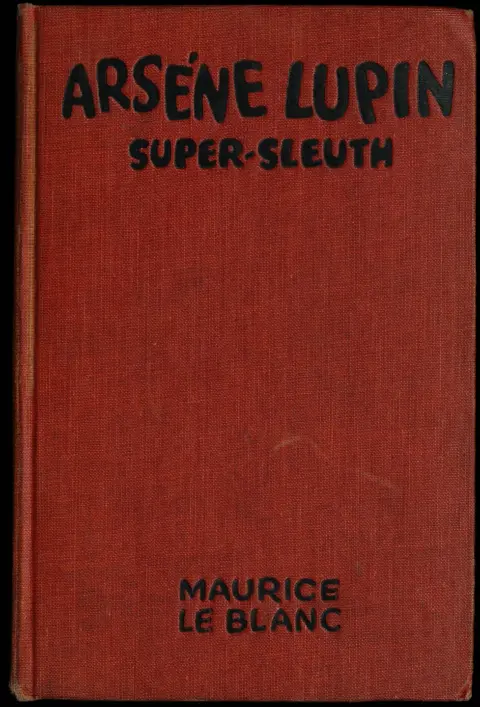
Arsène Lupin, super-sleuth
Maurice Leblanc
THE CLASSIC COLLECTION · 1910
"813" by Maurice Leblanc is a suspenseful detective novel written in the early 20th century. The story revolves around the enigmatic character Arsène Lupin, a gentleman burglar, as he engages in a thrilling game of cat and mouse with the authorities after committing a series of crimes, including a shocking murder. The novel introduces readers to a high-stakes world of intrigue, where Kesselbach, a wealthy man, becomes embroiled in a plot that threatens not only his life but also his ambitions. The opening of "813" sets a tense atmosphere with Mr. Kesselbach discovering that someone has invaded his hotel suite while he was away. Anxious and paranoid, he discusses strange occurrences with his secretary, Chapman, pointing out the peculiarities in their situation. When the mysterious Arsène Lupin makes his dramatic entrance, the tension escalates to a confrontation filled with twists and a daring heist, leaving readers breathless and eager to uncover the secrets surrounding Kesselbach's wealth and ambitions, as well as Lupin's true motives.
Introduction adapted from the source catalogue; source summaries may be automatically generated.
Free to read · English · 109,524 words · No account needed
MAKE TIME FOR A GOOD BOOK
On by default. Untick to stop anonymous reading totals. Each page counts after 10 seconds in view. How this works.
Anonymous counting is on unless you have switched it off.
Another sound grated under the window, more plainly this time, but still so faint that it needed Lupin's trained ear to distinguish it.
Minutes, terrifying minutes. . . . The darkness was impenetrable. No light of star or moon relieved it.
And, suddenly, without hearing anything, he knew that the man was in
the room.
And the man walked toward the bed. He walked as a ghost walks, without displacing the air of the room, without shaking the objects which he touched.
But, with all his instinct, with all his nervous force, Lupin saw the movements of the enemy and guessed the very sequence of his ideas.
He himself did not budge, but remained propped against the wall, almost on his knees, ready to spring.
He felt that the figure was touching, feeling the bed-clothes, to find the spot at which it must strike. Lupin heard its breath. He even thought that he heard the beating of its heart. And he noticed with pride that his own heart beat no louder than before . . . whereas the heart of the other . . . oh, yes, he could hear it now, that disordered, mad heart, knocking, like a clapper of a bell, against the cavity of the chest!
The hand of the other rose. . . .
A second, two seconds. . . .
Was he hesitating? Was he once more going to spare his adversary?
And Lupin, in the great silence, said:
"But strike! Why don't you strike?"
A yell of rage. . . . The arm fell as though moved by a spring.
Then came a moan.
Lupin had caught the arm in mid-air at the level of the wrist. . . . And, leaping out of bed, tremendous, irresistible, he clutched the man by the throat and threw him.
That was all. There was no struggle. There was no possibility even of a struggle. The man lay on the floor, nailed, pinned by two steel rivets, which were Lupin's hands. And there was not a man in the world strong enough to release himself from that grip.
And not a word. Lupin uttered none of those phrases in which his mocking humor usually delighted. He had no inclination to speak. The moment was too solemn.
He felt no vain glee, no victorious exaltation. In reality, he had but one longing, to know who was there: Louis de Malreich, the man sentenced to death, or another? Which was it?
At the risk of strangling the man, he squeezed the throat a little more . . . and a little more . . . and a little more still. . . .
And he felt that all the enemy's strength, all the strength that remained to him, was leaving him. The muscles of the arm relaxed and became lifeless. The hand opened and dropped the dagger.
Your reading position is saved on this browser. Take it to another device with a library code. Reading pages adapt to text, rather than matching a printed edition.
Maurice Leblanc
Maurice Leblanc
Maurice Leblanc

Maurice Leblanc
BEHIND THE BOOK
This eBook is for the use of anyone anywhere in the United States and most other parts of the world at no cost and with almost no restrictions whatsoever. You may copy it, give it away or re-use it under the terms of the Project Gutenberg License included with this eBook or online at www.gutenberg.org. If you are not located in the United States, you will have to check the laws of the country where you are located before using this eBook. Read the source licence.
The original source file, including credits and licence, is retained by this library. Request an original-format copy at no charge. Please include the book title and Project Gutenberg identifier #34758.
KEEP YOUR CURIOSITY GOING
Coulson Kernahan

Maurice Baring
Frances Wright
Cécile Tormay

Frederic Jesup Stimson

W. H. P. (William Henry Pope) Jarvis