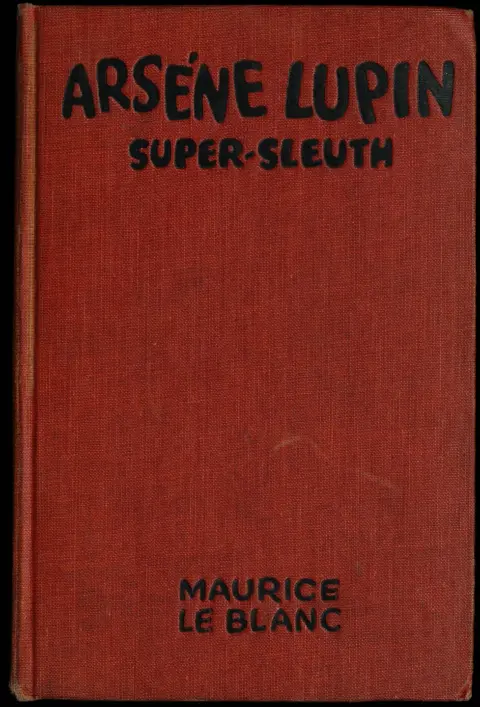
Arsène Lupin, super-sleuth
Maurice Leblanc
THE CLASSIC COLLECTION · 1910
"813" by Maurice Leblanc is a suspenseful detective novel written in the early 20th century. The story revolves around the enigmatic character Arsène Lupin, a gentleman burglar, as he engages in a thrilling game of cat and mouse with the authorities after committing a series of crimes, including a shocking murder. The novel introduces readers to a high-stakes world of intrigue, where Kesselbach, a wealthy man, becomes embroiled in a plot that threatens not only his life but also his ambitions. The opening of "813" sets a tense atmosphere with Mr. Kesselbach discovering that someone has invaded his hotel suite while he was away. Anxious and paranoid, he discusses strange occurrences with his secretary, Chapman, pointing out the peculiarities in their situation. When the mysterious Arsène Lupin makes his dramatic entrance, the tension escalates to a confrontation filled with twists and a daring heist, leaving readers breathless and eager to uncover the secrets surrounding Kesselbach's wealth and ambitions, as well as Lupin's true motives.
Introduction adapted from the source catalogue; source summaries may be automatically generated.
Free to read · English · 109,524 words · No account needed
MAKE TIME FOR A GOOD BOOK
On by default. Untick to stop anonymous reading totals. Each page counts after 10 seconds in view. How this works.
Anonymous counting is on unless you have switched it off.
"No, alone. And, as soon as dinner is over, make a start, ostensibly."
"But I am not to go to Paris. . . ."
"No, remain outside the park, half a mile down the road, until I come. You will have a long wait."
He smoked another cigarette, went for a stroll, passed in front of the castle, saw a light in Dolores' rooms and then returned to the chalet.
There he took up a book. It was The Lives of Illustrious Men.
"There is one missing: the most illustrious of all. But the future will put that right; and I shall have my Plutarch some day or other."
He read the life of Cæsar and jotted down a few reflections in the
margin.
At half-past eleven, he went to his bedroom.
Through the open window, he gazed into the immense, cool night, all astir with indistinct sounds. Memories rose to his lips, memories of fond phrases which he had read or uttered; and he repeatedly whispered Dolores's name, with the fervor of a stripling who hardly dares confide to the silence the name of his beloved.
He left the window half open, pushed aside a table that blocked the way, and put his revolvers under his pillow. Then, peacefully, without evincing the least excitement, he got into bed, fully dressed as he was, and blew out the candle.
And his fear began.
It was immediate. No sooner did he feel the darkness around him than his
fear began!
"Damn it all!" he cried.
He jumped out of bed, took his weapons and threw them into the passage:
"My hands, my hands alone! Nothing comes up to the grip of my hands!"
He went to bed again. Darkness and silence, once more. And, once more,
his fear. . . .
The village clock struck twelve. . . .
Lupin thought of the foul monster who, outside, at a hundred yards, at fifty yards from where he lay, was trying the sharp point of his dagger:
"Let him come, let him come?" whispered Lupin, shuddering. "Then the ghosts will vanish. . . ."
One o'clock, in the village. . . .
And minutes passed, endless minutes, minutes of fever and anguish. . . . Beads of perspiration stood at the roots of his hair and trickled down his forehead; and he felt as though his whole frame were bathed in a sweat of blood. . . .
Two o'clock. . . .
And now, somewhere, quite close, a hardly perceptible sound stirred, a sound of leaves moving . . . but different from the sound of leaves moving in the night breeze. . . .
As Lupin had foreseen, he was at once pervaded by an immense calm. All his adventurous being quivered with delight. The struggle was at hand, at last!
Your reading position is saved on this browser. Take it to another device with a library code. Reading pages adapt to text, rather than matching a printed edition.
Maurice Leblanc

Maurice Leblanc

Maurice Leblanc

Maurice Leblanc
BEHIND THE BOOK
This eBook is for the use of anyone anywhere in the United States and most other parts of the world at no cost and with almost no restrictions whatsoever. You may copy it, give it away or re-use it under the terms of the Project Gutenberg License included with this eBook or online at www.gutenberg.org. If you are not located in the United States, you will have to check the laws of the country where you are located before using this eBook. Read the source licence.
The original source file, including credits and licence, is retained by this library. Request an original-format copy at no charge. Please include the book title and Project Gutenberg identifier #34758.
KEEP YOUR CURIOSITY GOING
Coulson Kernahan

Maurice Baring
Frances Wright
Cécile Tormay

Frederic Jesup Stimson

W. H. P. (William Henry Pope) Jarvis