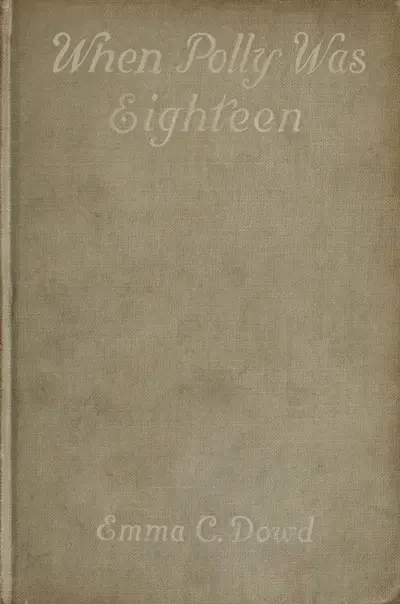
When Polly Was Eighteen
Emma C. Dowd
THE CLASSIC COLLECTION · 1915
"Doodles, the Sunshine Boy" by Emma C. Dowd is a children's novel written in the early 20th century. The story centers around a young boy named Doodles, who faces physical challenges but is filled with joy and creativity, largely brought to life through his relationship with his family and his pet mockingbird, Caruso. The narrative hints at themes of resilience, family dynamics, and the importance of friendship and community. At the start of the book, we meet Blue Stickney, Doodles's older brother, as he attends an auction at a bird shop where he unwittingly decides to buy a defeated-looking bird for Doodles—who captures hearts with his joy for life despite his struggles. Blue's initial intention is to lift Doodles's spirits, setting off a series of events that define their close bond. As the family navigates hardship, including financial concerns and Doodles's health issues, the introduction of secondary characters, like Granny O'Donnell and their neighbor, Dorothy Rose, hints at a larger community dynamic that supports Doodles and his aspirations. Blue's determination to care for Doodles and the new bird creates both tender and humorous moments, suggesting a comforting exploration of childhood joys and the complexities of familial love.
Introduction adapted from the source catalogue; source summaries may be automatically generated.
Free to read · English · 63,418 words · No account needed
MAKE TIME FOR A GOOD BOOK
On by default. Untick to stop anonymous reading totals. Each page counts after 10 seconds in view. How this works.
Anonymous counting is on unless you have switched it off.
“Ladies and gentlemens ... beautiful lark ... emperor of singers ... not swell to look at, but.... Only twenty cents!—Twenty─two am I offered? ... shame, ladies and gentlemens!” And so on, in tones of pleading and mild complaint.
Blue, meanwhile, studied the placarded window, where all manner of feathered stock, “slightly damaged, but every bird a bargain,” was announced to be sold to the highest bidder.
“Lovely starling ... ladies and gentlemens,... how much?” the persuasive voice skipped on, but was rudely interrupted by another.
“Huntin’ fer bargains?” A boy of Blue’s own size nudged him in the back. “Why don’t yer go in ’n’ git one fer Doodles? ’T ’u’d keep him f’m bein’ down ’n’ dumpy. My aunt—”
“‘Down ’n’ dumpy’—Doodles!” Blue’s rallying laugh drowned the “ladies and gentlemens” drifting through the doorway. “Huh,” he chuckled, “guess yer don’t know Doodles!”
“Ain’t he, now? S’posed all sick folks was. My aunt she—”
“Doodles dumpy!” The boy’s shoulders shook again. “Why, if there was nothin’ left in the whole world but just barbers’ poles, Doodles ’u’d sure make friends with the stripes. And he’d have the best time ever—bet you he would!” Blue’s hard little face grew suddenly tender, as he thought of the brother whose life was all pain and all joy.
The auction was over. The crowd poured out into the noisy street. Here and there a bird─cage told that a lame canary, a blind bobolink, or some other “damaged” fluff of feathers had changed owners.
One of the purchasers, a small, hatless girl, clad in scowls and a lace─collared coat, halted when she saw Blue, and began recklessly to swing her cage.
“Here, you Mame Sweeney!” the boy cried, seizing the child’s arm; “don’t yer see you’re scarin’ that bird ’most to death?”
“Le’ go!” she snapped. “’T ain’t yours!” She wrenched herself free, and defiantly thrashed the cage about her knees.
“Stop it!” The girl found her hand gripped in a vise of muscles.
“Le’ me be!” she screamed. “Don’t care if I do scare him! Horrid old
thing!”
A little group of newsboys circled about them, eager for a closer view of the cause of the wrangle.
The ragged gray bird, panting on the floor of his prison, did not invite favor. There was a subdued chorus of grunts and ejaculations. Then disapproval burst into bantering speech.
“Ain’t he a dood!”—“Mame, wha’ ’d yer pay fer th’ beaut?”—“Whin ’ll he give a concert?”—“Sure, if he sings like he looks, he’ll bate th’ show!”
The girl frowned on the teasing lads.
Your reading position is saved on this browser. Take it to another device with a library code. Reading pages adapt to text, rather than matching a printed edition.
Emma C. Dowd
BEHIND THE BOOK
This eBook is for the use of anyone anywhere in the United States and most other parts of the world at no cost and with almost no restrictions whatsoever. You may copy it, give it away or re-use it under the terms of the Project Gutenberg License included with this eBook or online at www.gutenberg.org. If you are not located in the United States, you will have to check the laws of the country where you are located before using this eBook. Read the source licence.
The original source file, including credits and licence, is retained by this library. Request an original-format copy at no charge. Please include the book title and Project Gutenberg identifier #58164.
KEEP YOUR CURIOSITY GOING
Coulson Kernahan

Maurice Baring
Frances Wright
Cécile Tormay

Frederic Jesup Stimson

W. H. P. (William Henry Pope) Jarvis